
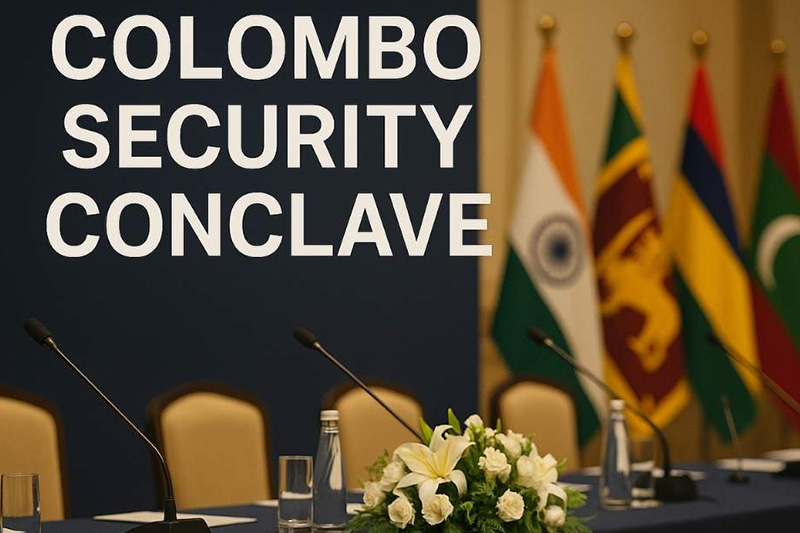
On 19 April, Indian Foreign Secretary Vikram Misri announced that the Colombo Security Conclave (CSC) would be granted the status of an international organisation.
Since its revival in 2020, the grouping has steadily progressed, leading efforts of institutionalisation by finalising the charter and signing a Memorandum of Understanding (MOU) to establish a secretariat in Colombo.
At a time when the world order is undergoing significant flux and the Indian Ocean Region (IOR) is witnessing geopolitical turbulence and heated contestation, the CSC has space to play a critical role. Sri Lanka, an island nation now focusing on its economic recovery, is likely to benefit from the grouping’s institutional consolidation. The institution, in addition to enhancing the island’s security, will supplement Colombo’s development, strategic, and normative aspirations.
Resurgence of the CSC
What began in 2011 as trilateral National Security Adviser (NSA)-level talks between Sri Lanka, India, and the Maldives evolved into the CSC in 2020 after a hiatus between 2014 and 2019.
Since 2020, the cohort of the group’s membership has also seen a steady increase with the induction of Bangladesh and Mauritius in 2024. The 2025 edition of the NSA-level talks of the conclave also saw the participation of Seychelles as an observer nation and Malaysia as a guest nation.
The resuscitation and the slow expansion of the group suggest critical strategic momentum and synergy that continues to drive the operational arc of the conclave. As such, the CSC promises to offer a platform for institutionalisation of security cooperation, ranging from the Bay of Bengal to the Western Indian Ocean Region.
The CSC has rapidly emerged as a critical forum to enhance cooperation in the domain of maritime security among its members in the Indian Ocean, given how the world order is rapidly changing. Countries in the Eastern Hemisphere are playing a critical role in shaping the global economy. Furthermore, China’s increasing military power and strategic presence are resulting in a contest in the Indo-Pacific.
The IOR, a vital strategic theatre within the broader Indo-Pacific geography, is thus witnessing several debates regarding supply chain resilience, infrastructure ownership, and sea lines of communication. These concerns have been further amplified by Covid-19, Russia’s invasion of Ukraine, and recent developments caused by the prolonged conflicts in West Asia.
Enhancing national security and development
For Sri Lanka, the CSC would go a long way in securing its interests and economic ambitions. As an island nation dependent on imports and located at the heart of key maritime trade routes, its security has largely depended on securing supply chains and safeguarding its Exclusive Economic Zone (EEZ).
This realisation has only grown following the economic crisis. As such, Colombo has expressed its interest in promoting defence reforms and military modernisation, especially under former President Ranil Wickremesinghe.
This has prompted a push to move away from the shadows of civil war and be more outward-looking on security, especially by focusing on maritime domain awareness and maritime security. There seems to be a continued consensus on this despite the change in government.
In this regard, the CSC remains pegged on issues of non-traditional maritime security challenges. Challenges posed by rising sea levels; Illegal, Unreported, and Unregulated (IUU) fishing; climate change-induced natural disasters; and steady erosion of ecological balance in the Indian Ocean maritime space remain key priorities for the grouping. Given the heavy reliance of Sri Lanka and other member countries on the maritime domain for economic growth and prosperity, these challenges characterise much of their developmental priorities.
Furthermore, given its geographical location and economic limitations, the country remains vulnerable to challenges related to cybersecurity, piracy, and trafficking, among others.
For instance, South Asia and the IOR have been witnessing a significant increase in drug trafficking in recent years. Increasing turmoil in Myanmar has also contributed to the former and has resulted in the trafficking of Sri Lankan nationals to run cyber scam centres in Southeast Asia. To exacerbate the issue, several cyber scam centres are now shifting their base to Sri Lanka.
Furthermore, Colombo remains vulnerable to cyber attacks, as was seen with hackers stealing $ 2.5 million from the Treasury recently. The crisis in West Asia has also fuelled the recent revival of Somalian piracy.
Given the transnational nature of these challenges and Sri Lanka’s vulnerabilities, cooperation with neighbours and like-minded countries will remain essential for Colombo. The CSC appears to be well placed to mitigate such challenges.
The cooperation between member countries on these non-traditional issues will thus further Sri Lanka’s ambitions to enhance its national security and supplement its outward-looking strategy. Cooperation with countries would not only address the lack of military capacity and resources but also help in effective burden sharing.
Strengthening operational and normative prowess
Despite its internal turmoil, Sri Lanka has often positioned itself as a key maritime hub in the IOR. However, existing regional institutions and organisations have failed to supplement Colombo’s ambitions.
For instance, the South Asian Association for Regional Cooperation (SAARC) remains largely dysfunctional and its prospects of revival remain low following India-Pakistan escalations in May 2025. The Bay of Bengal Initiative for Multi-Sectoral Technical and Economic Cooperation (BIMSTEC), focused on economic and technology cooperation, has charted minimal progress.
On the other hand, organisations like the Indian Ocean Rim Association (IORA) and Indian Ocean Naval Symposium (IONS), though vital for maritime governance in the Indian Ocean, remain ill-equipped to foster cooperation and partnerships, largely due to their diverse composition and vast geographical scope.
The revival of the CSC can also be seen as a result of the seeming limitations of these frameworks. Importantly, the CSC remains narrow in scope and functions, underscoring the shift towards minilateralism and like-minded partnership. It continues to benefit from its limited roster of member countries and geographical scope.
While the central mandate of the IORA is anchored on the delivery and sustenance of maritime governance, the CSC’s focus remains exclusively on issues of security. Given that the conclave was initiated and continues to be driven with NSA-level talks as its apex forum of dialogue, the security impetus of the group remains key. This will further advance Colombo’s security imperatives and strategic ambitions.
For Sri Lanka, which has long championed the IOR as a zone of peace, the grouping will seek to enhance regional governance, especially on non-traditional security challenges, making up for the lack of functional regional institutions and organisations. This will help address regional challenges and disorder.
Furthermore, with the CSC’s Headquarters in Colombo, it will be at the centre of norm-making and dissemination in the IOR. It will be able to float ideas, conduct shuttle diplomacy, and even implement decisions that could benefit all of the member countries. Given its geography, Sri Lanka remains an important catalyst for regional cohesion, especially with its understanding of the national security thinking of other littoral members.
The IOR continues to become strategically important and crowded, with the growing presence of new players. This has also continued to drive India’s robust foreign policy in the region.
The CSC, in this regard, would further cooperate with India and help foster a stable security architecture to counter existing and emerging threats at a time of global flux and unpredictability. Such cooperation on security would also result in enhanced trust between India and Sri Lanka, which would in turn increase Colombo’s ability to diversify its relations while accounting for Indian concerns and sensitivities.
This would reduce the number of friction points between both countries, addressing their trust deficit and leading to more cooperation and development opportunities. The CSC also helps Sri Lanka shed its anxieties about overdependence on India, especially by enhancing cooperation with other member states.
As such, it is vital for the CSC to navigate the areas of strategic divergence and direct focus on pathways to enhance cooperation on issues that remain at the centre of the security and developmental priorities of these countries. Increasingly, focus must also be directed towards efforts to herald a forward-looking agenda for the conclave.
Going forward, the onset of new technologies is likely to shape the nature of maritime security preparedness. The group must therefore calibrate efforts to build synergies in domains such as undersea critical infrastructure, maritime domain awareness, environmental sustainability, and climate mitigation.
As an immediate next step, the CSC must continue to direct efforts to conclude the institutionalisation of the group. Towards this end, it would be essential for the proposed secretariat in Colombo to be set up and operationalised. The assumption of the role of a secretary general of the group would be critical in providing institutional direction to achieve synergy among the member states.
As the group consolidates its institutional arrangements, a forward-looking agenda would also require a rethink on elevating the apex dialogue platform within the group. While an NSA-level format has served the group well, as the CSC takes strides by way of formal institutionalisation, ministerial-level dialogues and summits would pave the way for reaching operational synergy.
With the CSC, Sri Lanka is poised to enhance its security, economic, and strategic aspirations. Colombo is also set to play a critical role in fostering cooperation and synergy within the group and in the wider Indian Ocean.
*Shivamurthy is an Associate Fellow in Neighbourhood Studies at the Observer Research Foundation [ORF]. Haldar is an Associate Fellow in Maritime Studies at the ORF. The article was published on The Sunday Morning.
(Source-The Leader)


