
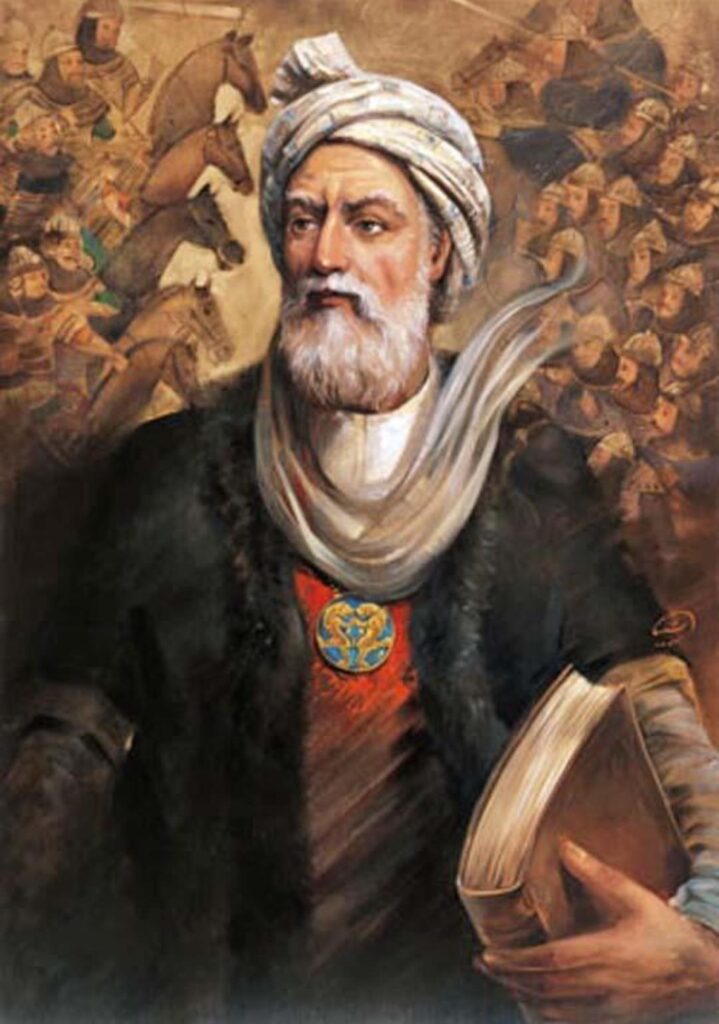
“ Mausoleums will decay
under the heat of the sun and the pouring rain.
But the palace I have built with my poetry
shall not dissolve ,
neither in the blazing heat of the sun
nor in the torrential rain.
Through the fire of my thirty years of suffering
I awakened the Persians with my verse .
Therefore, I declare my immortality ,
for I have sown the seeds of the Persian nation ”
- Shahname
The national poet of Persia proclaims his own immortality. By composing a single epic poem known as the Shahnameh, also called “The Book of Kings,” he attained this enduring status.
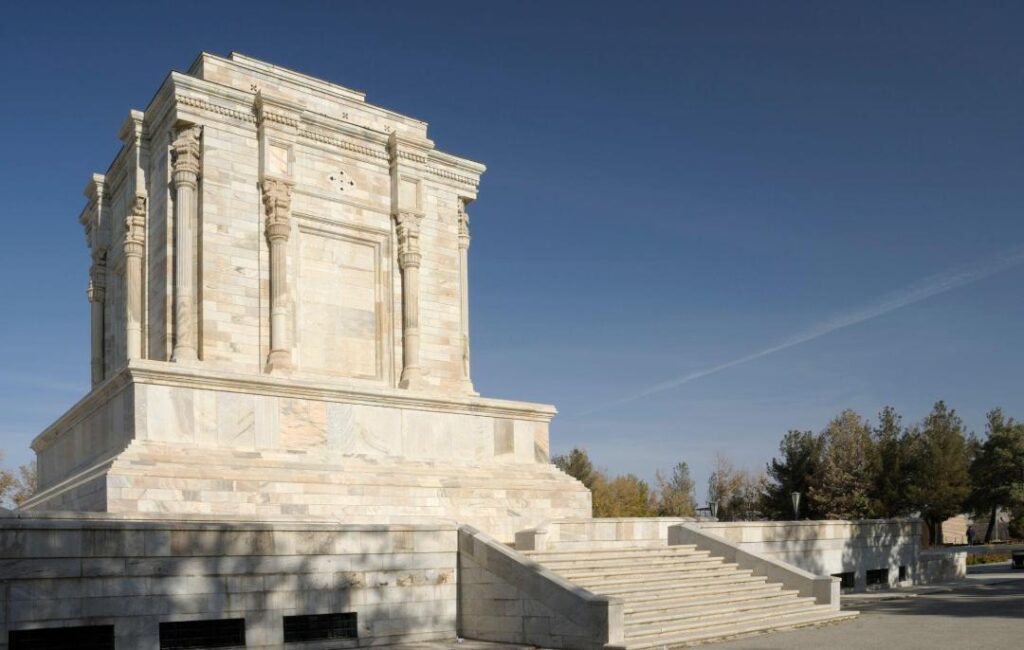
The remains of Ferdowsi rest in Tus, in the Khorasan province. After his passing, his literary legacy spread across the world, reflecting the highest human virtues truth, goodwill, and devotion towards fellow humanity, the homeland, and the traditions and culture of his people.
Throughout world history, epic literature has existed in a wide variety of forms and traditions. Yet among all types of epic poetry, the Shahnameh stands above them, distinguished by its unmatched stature.
While many epic works are rooted in myth and legend, in the case of Ferdowsi’s Shahnameh, mythology is employed primarily as a literary ornament and as a means of enhancing poetic elegance. It is also used to create a more engaging, vivid, and emotionally compelling reading experience for the audience.
The Shahnameh is not a work that can be read once and then set aside forever. This incomparable masterpiece deserves repeated reading. With each encounter, it reveals new insights of historical and moral significance, offering the reader ever-deepening layers of wisdom and reflection.
Iran, in essence, is a land of poetry. As with the life stories of many great figures, a vast body of literature exists about the life of Ferdowsi; however, much of it blends myth with historical reality. Overall, the Shahnameh has been preserved in its integrity, with no substantial alterations or revisions over time. Within this epic,
Ferdowsi also reveals much about himself, embedding elements of his own life and worldview into the narrative.
Tus, near the village of Bazh, in the Khorasan region, is traditionally regarded as the birthplace of Ferdowsi, who was born around 940 CE. His father was a farmer, and during that era the agricultural class was considered relatively prosperous and lived with dignity, wealth, and a degree of independence.
As Ferdowsi himself expresses in his verses:
“ They (the farmers) ploughed the land with the plough, sowed and harvested grain,
and when they sat down to eat the food they had earned,
no one held authority over them.”
His original name was Abu al-Qasim Mansur, but he became universally known as Ferdowsi. From his youth, he devoted himself to learning and immersed himself in books, demonstrating deep knowledge of philosophy, logic, and history.
However, what distinguished him from other Persian poets was his unparalleled achievement in composing the epic Shahnameh, through which he surpassed many of his contemporaries and secured a unique position in literary history.
Ferdowsi’s most significant achievement was a cultural and linguistic revolution: the revival and strengthening of the Persian language. He was fully aware of the transformative nature of his work, as reflected in his own words.
“ Through thirty years of suffering, I awakened the Persians with my poetry .”
This does not imply that there were no significant poets before him. In fact, during the reign of Sultan Mahmud and other rulers, many poets existed in royal courts, often focusing on praising their patrons, lamenting the hardships of old age, or reflecting on the impermanence of life.
Ferdowsi, however, went beyond this tradition. In addition to composing a monumental epic, he elevated the Persian language by resisting the overwhelming influence of Arabic and Turkish. He restored Persian literary identity by giving new life to the language itself.
Although he did use a small number of Arabic words, many of these had already become fully integrated into Persian usage at the time. There was also a widespread belief that it was nearly impossible to construct even a single sentence in Persian without Arabic expressions.
Ferdowsi decisively disproved this assumption. Through his mastery of language, he composed numerous verses using pure Persian, without relying on Arabic or Turkish vocabulary, thereby demonstrating the richness and independence of the Persian language.
With the rise of the Islamic state and the subsequent establishment of Muslim rule over Iran, as in many other regions, it was natural for the Persian language to come under the strong influence of Arabic. In countries such as Syria, Egypt, Iraq, and Lebanon, Arabic was fully adopted, along with its linguistic identity. However, although the Iranian people embraced Islam, they successfully preserved both their cultural identity and their language with remarkable resilience.
The enduring truth reflected in this historical development is closely tied to the revolutionary literary achievement of Ferdowsi, who elevated and revitalized the Persian language.
Moreover, this great poet also restored and preserved the historical legacy and heroic traditions of the Iranian people. As a result, his work not only inspired a strong sense of national pride and heroism but also strengthened the people’s self confidence and cultural identity.
Another important aspect to consider is the thematic diversity and narrative structure of the Shahnameh. It can be read continuously from beginning to end, or alternatively, one may begin at any point and still engage with an independent and complete story.
Each episode within the work stands largely on its own, with distinct structures and themes that rarely repeat across different narratives.
Conflicts between characters, moral dilemmas, climactic turning points, moments of sorrow or triumph, and the eventual resolutions all vary significantly from one story to another. Such diversity arises naturally from Ferdowsi’s exceptional narrative skill.
At the heart of his method is a commitment to grounding his stories in historical or traditional sources, upon which he builds richly developed characters. His primary focus is the art of storytelling itself, which he sustains with remarkable freshness, creativity, and literary elegance throughout the entire epic.
” Do not harm even an ant
carrying a grain of rice
its life is sweet ,
just as ours is “
Among the greatest stories ever written, one can experience the highest level of emotional depth, moral complexity, and literary beauty in the Shahnameh. A striking example is the tragic tale of “Rostam and Sohrab,” which stands out as one of its most powerful and emotionally moving narratives.
The climax of this story is as follows: the king, having fatally wounded a young warrior in battle, realizes only at the very last moment that the man he has killed is, in fact, his own son. In desperation, he immediately sends a messenger to King Kay Kavus of a neighboring land, requesting the life saving medicine Nushdaroo. However, fearing that the reunion of father and son would threaten his own throne, Kay Kavus delays sending the medicine until it is too late. By the time it arrives, Sohrab has already died.
From this story, the Persian people derived the proverb: “The physician arrives when the patient has already died.” Another remarkable feature of the Shahnameh is its strong ethical foundation. Across the entire epic, every story is shaped around moral values and philosophical reflection.
One such moral voice in the narrative warns,
“ Do you not fear God?
Are you not ashamed before your father?
Fate will take revenge upon you .
Do not kill your brother
would you become a murderer?
Release me.
You will never see me again.
If you kill me, what gain will you have
when you both stand together in regret?
Reflect upon this “.
Another distinctive feature of the Shahnameh is its exceptional literary value. Ferdowsi’s primary purpose was to revive and elevate the Persian language along with its historical consciousness.
In the process of portraying the ancient condition of the Iranian nation and imagining its restoration, he employed his immense creative talent to produce an elegant and linguistically refined epic of approximately 60,000 verses, marked by precise grammar and outstanding poetic craftsmanship. Through this work, he constructed a powerful tradition of storytelling and conveyed profound moral messages to society.
“ At first a friend, in the end an enemy
such is the fate of the world .
If you scorn the world,
it will show kindness to you ;
if you love the world,
it will bring you endless suffering .
Learn this advice from me :
do not become attached to the world,
for you will never then regret.”
A true appreciation of the Shahnameh requires reading it in its original language. When translated into other languages, much of its beauty, rhythm, and expressive power is inevitably diminished. The highly refined poetic expressions of Persian often lose their depth in translation, sometimes appearing as repetitive or emotionally flat phrases.
There is a Persian proverb that says, “The end of the Shahnameh is happy.” It is used to imply that the most important aspect of any narrative is its conclusion. However, the ending of the Shahnameh itself, unfortunately, was not a happy one.
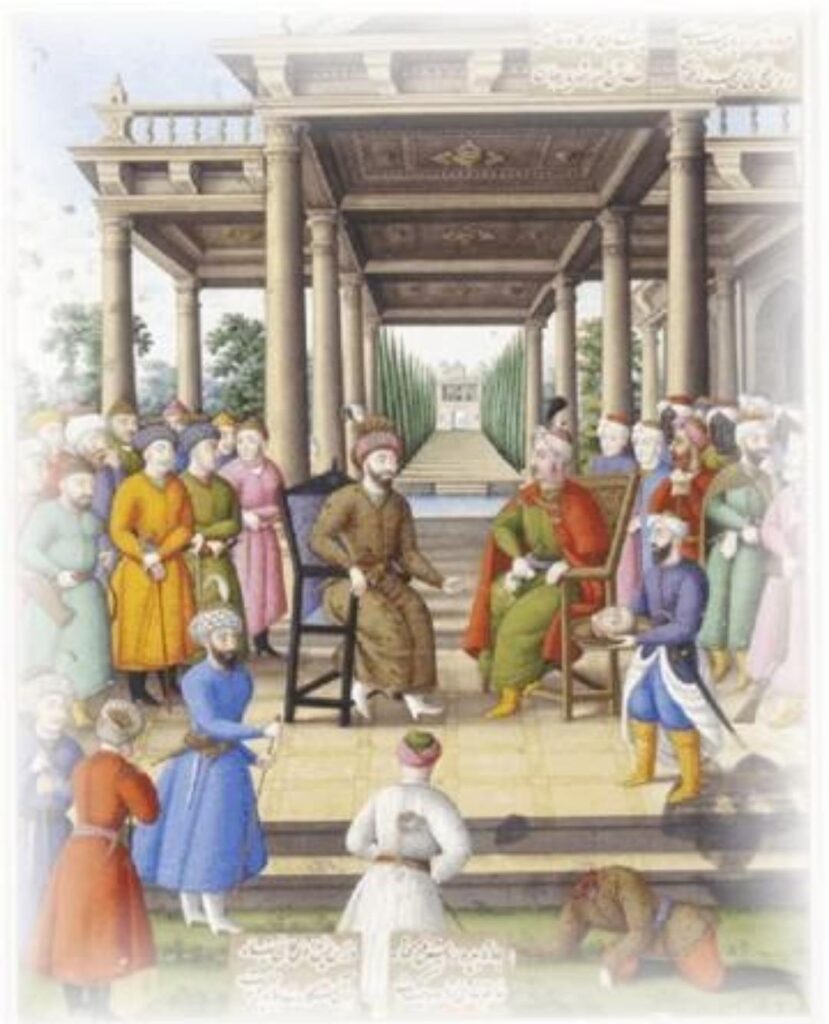
Ferdowsi devoted thirty years nearly half of his life to composing this monumental work. Yet his final years were marked by tragedy. According to tradition, Sultan Mahmud of Ghazni had agreed to reward him with one gold coin for each verse of the Shahnameh. However, when the epic was completed with its 60,000 verses, court officials driven by jealousy and concerns over the enormous payment persuaded the Sultan to withhold the promised reward.
As a result, instead of gold coins, Sultan Mahmud is said to have sent 60,000 silver coins to Ferdowsi. Disappointed deeply by the Sultan’s breach of promise, Ferdowsi is said to have distributed the silver coins among the poor, the workers, and the needy.
Later, after living in solitude for a long period, he composed a satirical poem about the Sultan. This reportedly angered Sultan Mahmud at first, but over time he is said to have realized the injustice he had committed. As a result, he decided to send the originally promised reward of 60,000 gold coins to Ferdowsi.
However, according to legend, when the royal caravan carrying the gold coins reached the gates of Tus, Ferdowsi’s funeral procession was leaving through another gate. Thus, the reward arrived at the very moment the poet had already been laid to rest.
Yet it is clear that such a monumental work was never created merely for material reward. The immense effort that went into researching, shaping, and poetically refining the epic made the Shahnameh a masterpiece far beyond material measures.
Comprising
approximately 60,000 verses, the work took around thirty years to complete meaning that, on average, Ferdowsi composed only about five verses per day.
The legacy of Ferdowsi and the Shahnameh will, without doubt, endure as one of the highest forms of epic poetry for as long as the Persian language exists and indeed for as long as world literature itself continues to be read and valued.
Such reflections capture the moral and philosophical depth that runs throughout the Shahnameh, where ethical ideals, human struggle, and destiny are interwoven into a timeless literary vision.
“ To be honest is a virtue one should wish for,
as the world and fate may test you like a seeking force
like an unbent bow .”

By — Fathima Zamaa Shifani
The Cultural Expert
Iran Cultural Center
Embassy of the Islamic Republic of Iran
Sri Lanka


