
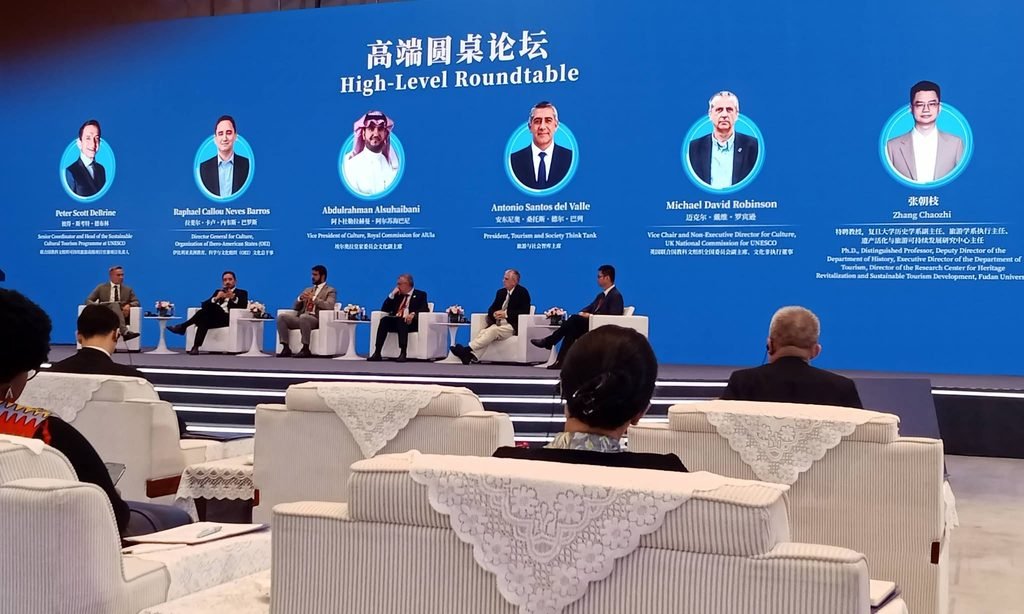
The Liangzhu Forum, centered on China’s Liangzhu civilization which boasts a history spanning over 5,000 years served as a significant platform for international cultural cooperation in 2026. This fourth edition of the forum took place from October 18 to 20 in Hangzhou, Zhejiang Province, China.
I had the opportunity to participate in this international cultural dialogue held in Hangzhou, China, with the support of the China Cultural Center in Sri Lanka. Notably, a group of journalists from Sri Lanka also took part in this dialogue.
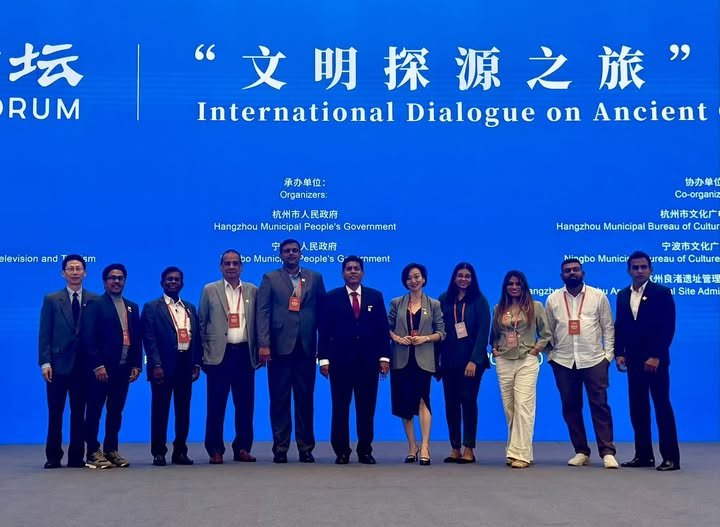
The forum was organized under the theme: “Bridging the Past and the Future: Safeguarding Cultural Heritage for Our Times.” Key objectives included the preservation of cultural heritage across various nations, the exchange of archaeological findings, the repatriation of lost cultural artifacts to their countries of origin, and the promotion of a sustainable tourism industry.
90th Anniversary of the Discovery of the Liangzhu Ruins
The 2026 forum held special significance as it coincided with the 90th anniversary of the discovery of the archaeological ruins of Liangzhu.
The discovery of archaeological evidence in the Liangzhu region began in 1936. Subsequent excavations and research revealed the existence of an organized urban civilization that thrived there approximately 5,000 years ago.
Urban planning, palace complexes, burial sites, water management systems, and artistic objects crafted from jade serve as evidence of the advanced nature of this civilization.
In 2019, the archaeological ruins of Liangzhu were inscribed on the UNESCO World Heritage List. This not only brought international recognition to significant archaeological evidence regarding China’s 5,000-year history of civilization, but also led to an expansion in the study of these findings.
Scholars and representatives from nearly 60 countries
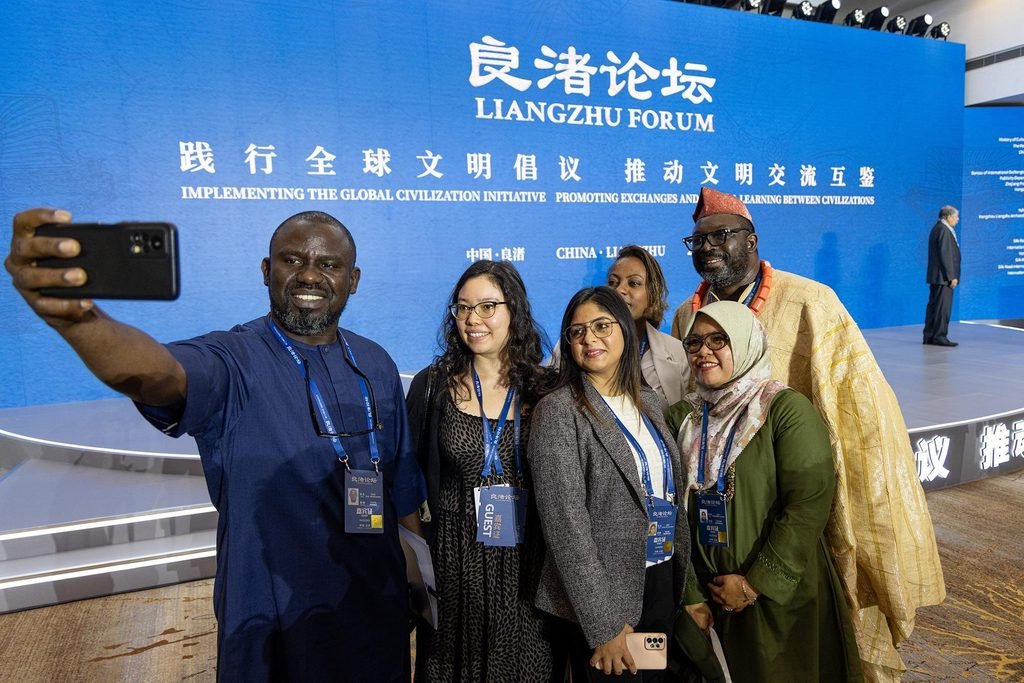
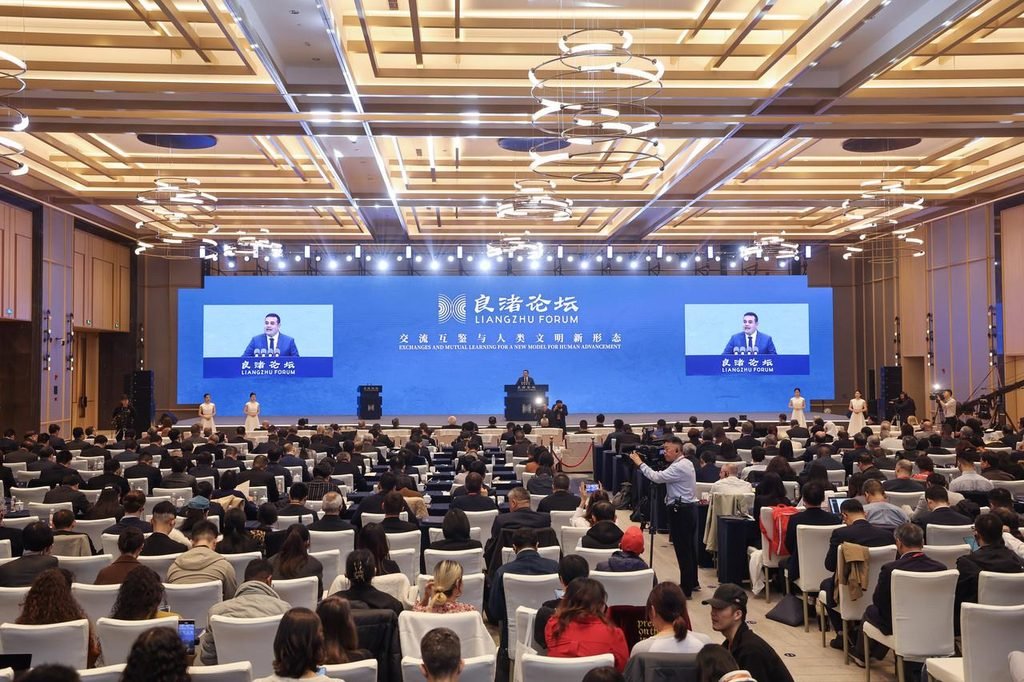
Nearly 800 participants including scholars, archaeologists, experts in the cultural sector, and government representatives from nearly 60 countries and regions attended this year’s forum.
The forum was jointly organized by China’s Ministry of Culture and Tourism, the National Cultural Heritage Administration, and the Zhejiang Provincial Government.
Representatives from international organizations such as the United Nations Educational, Scientific and Cultural Organization (UNESCO), the International Centre for the Study of the Preservation and Restoration of Cultural Property (ICCROM), the Asian Alliance for Cultural Heritage Conservation, and the International Alliance for Heritage Protection also participated.
Lina Mendoni, Greece’s Minister of Culture, who attended the opening session of the forum, highlighted the importance of moving beyond traditional methods to incorporate new technologies and integrated management approaches for the protection of cultural heritage. It was emphasized that cultural heritage cannot be protected by any single nation alone in the face of challenges such as climate change and urbanization, and that international cooperation is essential.
Five Sub-forums for Key Discussions
The 4th Liangzhu Forum in 2026 comprised a main session, five sub-forums, and five associated programs.
The key topics discussed within these five sub-forums were as follows:
1. The Origins of Early Civilizations and Archaeological Evidence
Discussions were held regarding the emergence of early civilizations worldwide, insights revealed through archaeological excavations, and international scholarly dialogue on the preservation of such heritage. This also coincided with the 90th anniversary of the discovery of the Liangzhu ruins.
2. World Heritage Listing and the Preservation of Heritage Value
Discussions focused on the process of inscribing sites onto the UNESCO World Heritage List, safeguarding the historical value of heritage sites, and ensuring their transmission to future generations. 3. Utilizing new technology for the preservation of cultural heritage
Attention was focused on the preservation of archaeological sites and cultural artifacts through the use of digital technology, artificial intelligence, and new scientific methodologies.
4. Recovering lost cultural artifacts and returning them to their countries of origin
Discussions were held regarding international cooperation, legal frameworks, and policies aimed at the repatriation of archaeological and cultural artifacts which had been removed from their countries of origin at various points in history back to their home nations.
5. Cultural Heritage and Sustainable Tourism
Attention was focused on developing the tourism industry while safeguarding historical sites, ensuring economic benefits for local communities, and preserving environmental and cultural values.
International Agreements for Preservation
A notable outcome of this forum was the signing of cooperation agreements among international organizations dedicated to the protection of cultural heritage.
A Memorandum of Understanding (MoU) on cooperation was signed between China’s National Cultural Heritage Administration and ICCROM (headquartered in Rome). Additionally, a strategic cooperation agreement was signed between the Asian Cultural Heritage Conservation Alliance and the International Alliance for the Protection of Heritage. Such collaborations provide an opportunity for countries to exchange knowledge, technology, and research experience regarding the preservation of cultural heritage.
Artists from 14 Countries – A New Opportunity for Cultural Exchange
The participation of international artists was a notable feature among the special programs organized in parallel with the forum.
Twenty-five renowned artists from 14 countries visited Hangzhou, where they explored historical and cultural sites including Liangzhu before presenting their own creative works.
This initiative included an art exchange program centered on the Silk Road, a Liangzhu cultural and creative marketplace, and an exhibition of contemporary works inspired by Chinese cultural heritage.
Notably, the influence of ancient Liangzhu jade carvings was evident in the modern designs and artistic products showcased. An Understanding of World Civilizations for the Younger Generation
Another significant objective of the Lianxu Forum was to foster cultural understanding among the younger generation.
On October 19, the ‘Liangzhu Civilization in Dialogue with the World’ program was held at Zhejiang International Studies University, bringing together foreign diplomatic representatives, international scholars, and university students.
Discussions focused on understanding the civilizations of various nations, the preservation of historical heritage, and cross-cultural exchange.
Opening China’s Cultural Heritage to the World
Another significant concept highlighted at the Liangzhu Forum is that the protection of cultural heritage and the pursuit of economic and social development are not mutually exclusive processes.
A cultural tourism zone has been developed, centered around the Liangzhu archaeological site, which connects historical landmarks, ancient villages, museums, and cultural creative centers. This initiative provides an opportunity to safeguard cultural heritage while simultaneously fostering the livelihoods of local residents. A notable feature is the use of modern digital technology and artificial intelligence to provide tourists with an immersive experience of the ancient city.
From the past to the present, and from the present to the future
The 2026 4th Liangzhu Forum cannot be described merely as an international conference. It represents a significant endeavor to foster understanding, cooperation, and mutual respect among the world’s diverse civilizations.
The urban civilization established by the people of Liangzhu 5,000 years ago offers the modern world valuable lessons in technical knowledge, social organization, and cultural creativity.
Furthermore, the forum underscores the necessity for international cooperation to address contemporary global challenges, such as climate change, urbanization, the destruction of cultural assets, and the loss of historical heritage. In particular, it highlights the importance of promoting dialogue over conflict, and cooperation over competition, among people of different nations and cultures. Accordingly, the 4th Lianzhou Forum in 2026 can be regarded not merely as an opportunity to introduce China’s ancient civilizational heritage to the world, but as a significant platform that has paved the way for international dialogue aimed at shaping the future world while safeguarding the common cultural heritage of humanity.
Part Ten
Note by
Chandana Wijekoon


