
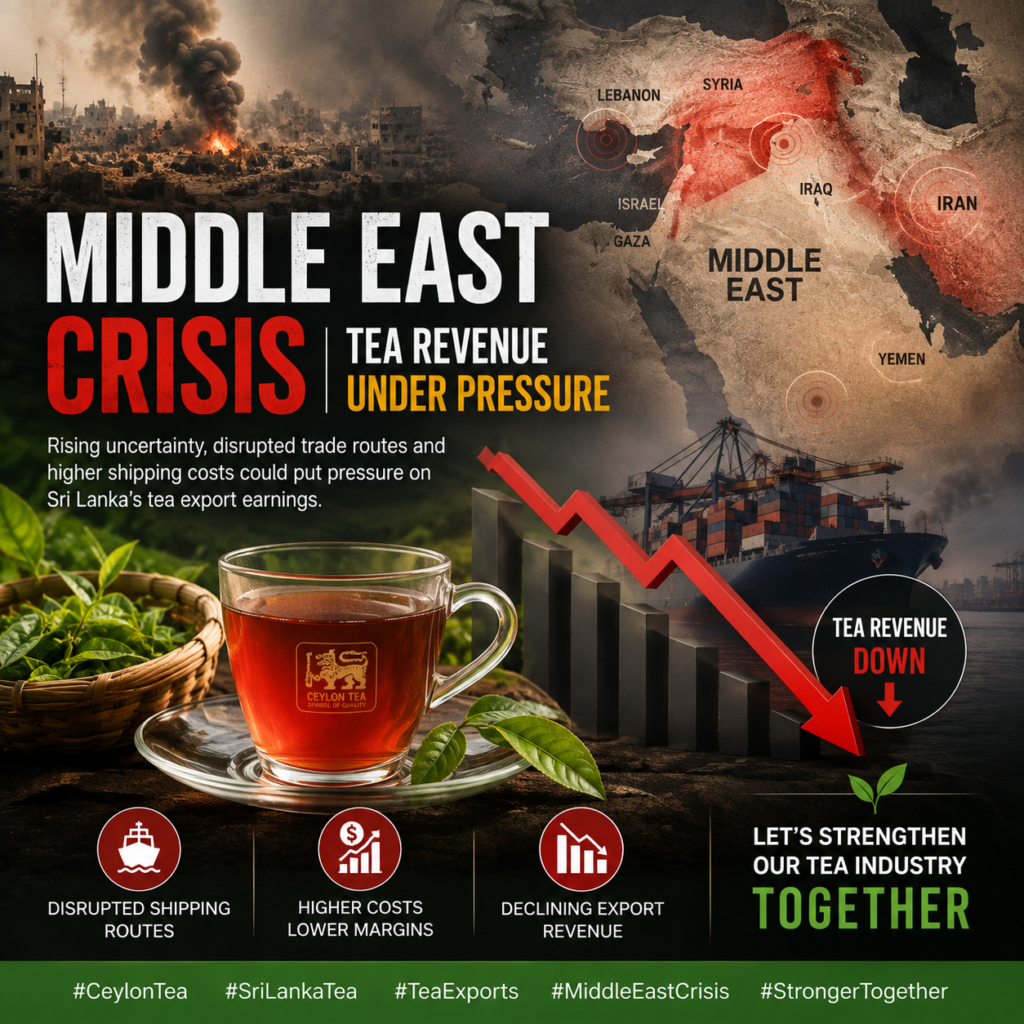
Sri Lanka’s tea export earnings fell by USD 67 million in the first seven months of 2026, as disruptions to Middle East shipping routes compounded weaker demand across several key markets.
Export volumes for the January to July period dropped 4.9 per cent to 143.51 million kilogrammes, down from 150.85 million kilogrammes in the corresponding period last year, according to data from Forbes and Walker Research and Customs figures analysed by Siyaka Research.
Volumes fall as Middle East disruptions bite
The contraction accelerated sharply in July, when exports fell to 20.41 million kilogrammes, a decline of 3.63 million kilogrammes, or roughly 15 per cent, compared with 24.04 million kilogrammes a year earlier.
Analysts attributed the renewed pressure in July largely to continued disruptions along Middle Eastern shipping routes, which affected both export flows and market access during the month.
The impact proved particularly severe across the Middle East and neighbouring markets.
Exports to Libya collapsed by around 58 per cent to 5.4 million kilogrammes from 13 million kilogrammes, while shipments to the United Arab Emirates fell by a similar margin, dropping to 4.4 million kilogrammes from 10.6 million kilogrammes.
Saudi Arabia bucked the trend, with imports holding broadly steady at around 4.8 million kilogrammes compared with 4.7 million kilogrammes previously, while Syria recorded a modest rise to 4.7 million kilogrammes from 4.5 million kilogrammes.
Markets further afield also felt the strain, with exports to Chile falling by approximately 24 per cent to 4.9 million kilogrammes and China recording an 8 per cent decline to 5.5 million kilogrammes.
Iraq saw a steep 36 per cent drop to 14.42 million kilogrammes, though Russia posted a 2.6 per cent increase to 13.35 million kilogrammes.
Türkiye emerged as the largest single importer of Ceylon Tea for the period, with imports surging 138 per cent to 24.76 million kilogrammes from 10.40 million kilogrammes, while Azerbaijan also recorded strong growth of 49 per cent, reaching 7.14 million kilogrammes.
Rupee gains fail to offset dollar decline
Alongside the fall in volumes, dollar realisations weakened considerably.
Export earnings for the first seven months stood at approximately USD 817 million, down from USD 884 million a year earlier, while the average FOB value declined to USD 5.70 per kilogramme from USD 5.86, despite a marked rise in the rupee-denominated FOB value.
In July alone, the average FOB value rose to Rs. 1,921.95 per kilogramme, an increase of Rs. 155.44 from Rs. 1,766.51 a year earlier, though the stronger local currency price was not enough to compensate for lower volumes and weaker dollar returns.
For the seven-month period as a whole, the average FOB value rose by Rs. 77.65 to Rs. 1,826.16 per kilogramme, yet fell by USD 0.16 per kilogramme in dollar terms.
This divergence illustrates the underlying pressure facing the sector, as rising local-currency prices continue to mask a deterioration in the dollar value of shipments, which remains the more critical measure for foreign exchange generation.
The category breakdown offered little reassurance, with Instant Tea the only segment to post a positive volume variance during the period, while all other categories recorded declines.
In rupee terms, most categories showed gains, though the position in dollars was markedly weaker, with Green Tea the sole category to record a positive dollar variance.(Source- The Leader)


