
Freedom of conscience and religion has deep historical roots in Iran and remains closely interwoven with the country’s cultural identity. Long before Islam became the dominant faith and continued thereafter religious minorities have lived within Iranian society.
Over the centuries, these communities have maintained their traditions, contributing to Iran’s diverse religious landscape. Following the Iranian Revolution, the status and experience of religious minorities have been widely discussed, with differing interpretations regarding the extent of religious freedom. Nevertheless, historical evidence suggests that Iran has long been home to a variety of belief systems, with Christianity holding a particularly notable place among them. From the pre-Islamic era onward, Christian communities have existed in Iran, preserving their identity, traditions, and places of worship. This enduring presence is reflected in the country’s ancient churches, many of which continue to stand as significant cultural and historical landmarks.
Among the most prominent are the Nane Maryam Church in Urmia, the Vank Cathedral in Isfahan, and the Saint Thaddeus Monastery in West Azerbaijan Province. *Nane Maryam Church* One of the Oldest Christian Sites Located in Urmia often regarded as a cradle of ancient Iranian civilization the Nane Maryam Church is widely considered one of the oldest churches in the world. Tradition holds that it was established not long after the time of Jesus Christ. Known in the Assyrian language as Mart Maryam (“Saint Mary”), some historians regard it as second only to the Church of the Nativity in Bethlehem in terms of antiquity.
Architecturally, the church is modest and square in form, constructed with stone and mortar. Its interior includes a prayer hall, altar, and several adjoining rooms. In contrast to many Western churches, it contains no statues or painted icons, reflecting the traditions of Eastern Christian communities.
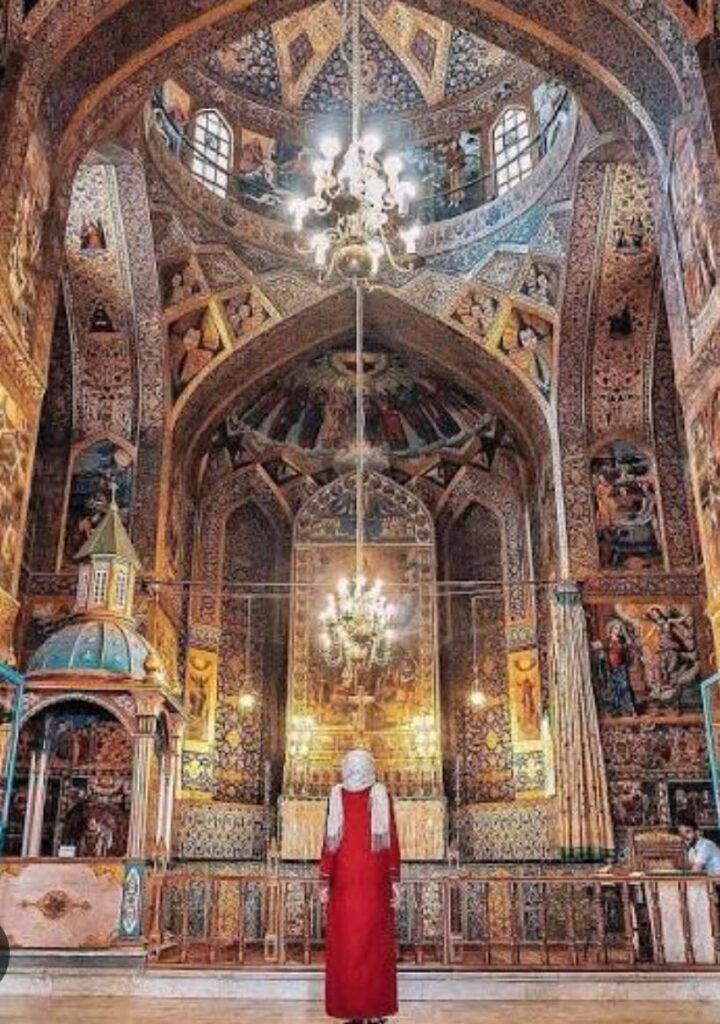
Historical accounts record several notable associations, including the reported restoration support of a Chinese princess in 642 CE, a visit by the Venetian traveler Marco Polo, and documentation by American scholar A. V. Williams Jackson in the early twentieth century. *Vank Cathedral* A Fusion of Persian and Armenian Art Situated in the Jolfa district of Isfahan, Vank Cathedral stands as one of the most renowned Christian landmarks in Iran. It dates back to the Safavid era, when Isfahan served as the imperial capital. The cathedral is distinguished by its unique architectural synthesis, blending Persian design elements with Armenian ecclesiastical style. Its richly decorated interior features intricate frescoes depicting biblical narratives, executed by skilled Iranian artists.
The complex also includes a museum that houses valuable manuscripts, royal decrees, and historical artifacts. A printing press and library further highlight the cathedral’s role as a center of cultural and intellectual activity during the Safavid period. *Saint Thaddeus Monastery* A Sacred Pilgrimage Site Located in Iran’s West Azerbaijan Province near its northwestern borders, the Saint Thaddeus Monastery is among the country’s most important Christian pilgrimage sites.
Believed to date between the 6th and 9th centuries, it is associated with Saint Thaddeus, one of the apostles of Jesus Christ. According to tradition, Saint Thaddeus traveled to the region around 40 CE to spread Christianity. It is said that he converted a local princess, Sandokht, to the faith; both were later martyred. The monastery is believed to house their tombs, making it a place of deep spiritual significance. Despite suffering damage during an earthquake in 1319, the monastery has endured as a site of devotion. Each year, it attracts large numbers of pilgrims who gather to commemorate their faith and heritage. The presence of Christian churches in Iran reflects a long-standing tradition of religious diversity and cultural interaction. These historic sites not only serve as places of worship but also stand as enduring symbols of Iran’s rich architectural, artistic, and spiritual heritage.

By Zamaa Shifani


