
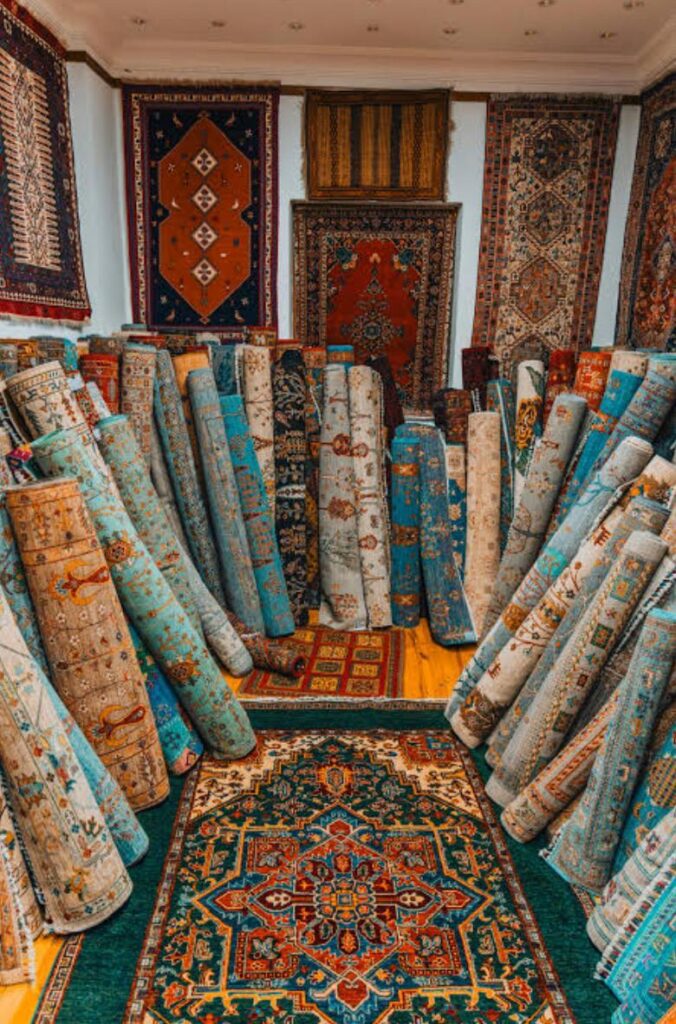
For centuries, the world has recognized Persian art through its carpets. Even today, Iran remains one of the leading countries in weaving silk and wool carpets. Among non-oil exports, the carpet industry is one of the main sources of foreign exchange for the country.
It is believed that Asian nomadic tribes were the first to create carpets for floor covering. Due to the harsh, dusty, and cold ground conditions they faced, they needed such coverings. By weaving together wool and fabric pieces, they created mats that solved this problem.
This is considered the origin of modern carpets. From early times, carpets held an important place as trade goods. Persian carpets, in particular, were renowned for their beauty and quality, surpassing all others. Historical evidence suggests that carpet weaving in Iran dates back over 2,500 years to the Achaemenid period. Greek and Roman records also mention Persian carpets.
The historian Xenophon, who visited Iran several times, mentions in his famous work Anabasis that there was a carpet workshop in Sardis (in present-day Turkey), which was then part of the Persian Empire.
Archaeological discoveries further confirm this. Decorated carpets from the Achaemenid era have been found in Central Asia. Due to the cold climate, they were well preserved.
The designs, including horse riders and their distinctive hats, indicate their Persian origin. Winged animals seen in the designs resemble those found in the ruins of Persepolis.During the Sassanian period (6th–7th century CE), Iran had an internationally renowned carpet industry.
Carpets in royal palaces and noble homes were woven with gold and silver threads and decorated with pearls and emeralds. Unlike earlier woven curtains, carpets were widely used for flooring during this time.
Arab historical writings describe a famous carpet from the palace of Ctesiphon. It covered a grand hall and was known as the “Winter Carpet.” It depicted a beautiful garden, allowing the king to experience the feeling of spring even during winter. It was made using precious materials like gold, silver, and gems, and measured about 84 feet (25.65 meters).
With the arrival of Islam, carpets, once considered luxury items, became essential in daily life. Since then, carpets have been widely used in mosques.During this period, prayer mats and zilu carpets were produced in large quantities. Zilu carpets, often used in mosques, featured Kufic-style Arabic inscriptions.
The Safavid dynasty, a purely Persian royal lineage, brought a renaissance in Persian art. During the reign of Shah Tahmasp, decorative arts reached their peak, and many carpet designs emerged. Famous carpets from this era include. The Milan Hunting Carpet,
The Ardabil Carpet
The Vienna Hunting Carpet (once owned by Peter the Great)
Classifying Persian carpets is difficult due to their diverse designs. Many patterns were inspired by book covers, medals, weapons, architecture, and arabesque designs from the 15th century.
Northwestern Persia became famous for medallion carpets, featuring a large central design surrounded by plant motifs. This style contributed to the development of garden-themed carpets.
Another type is the “vase carpet,” associated with Shah Abbas, featuring repeated vase motifs.
This design originated in Kerman and was later used in royal palaces.
A unique style known as “Polonaise carpets” also emerged during Shah Abbas’s time. These used rich colors and had designs resembling metal engravings, creating a distinct artistic beauty.
Another well-known type is the Isfahan carpet, notable for its intricate weaving, lotus designs, and rich colors such as pomegranate shades.Carpet weaving techniques also vary. The structure includes vertical warp threads and horizontal weft threads. Two main techniques are used:
Flat weaving (like early mats)Knotting technique (used in carpets)In knotting, small threads are tied around warp threads. There are different types of knots, including single and double knots. The Persian knot (Senneh knot) gives a finer and smoother surface, while Turkish knots create a different texture.
The quality of a carpet depends not only on design but also on materials. Wool, cotton, and silk are used, with silk being the finest. There are around 200 types of silk.Dyes are another important aspect. Persian carpets traditionally use natural dyes derived from plants and insects. Even today, synthetic dyes are not widely preferred.
For example, Blue comes from indigo
Red from madder roots and insects. Yellow from pomegranate peel, saffron, and other plants.These natural dyes are long-lasting, unlike chemical dyes, which fade quickly.
Even today, carpets in Iran are woven by hand using traditional methods.
Carpet weaving remains a major household industry. Major centers include Kashan, Nain, Isfahan, Qom,Mashhad, Khorasan, Kurdistan, Hamadan, Yazd, Kerman, Sistan, Baluchistan, and East Azerbaijan.Overall, more than 3 million people are directly or indirectly involved in this industry.

By- Zamaa Shifani


