
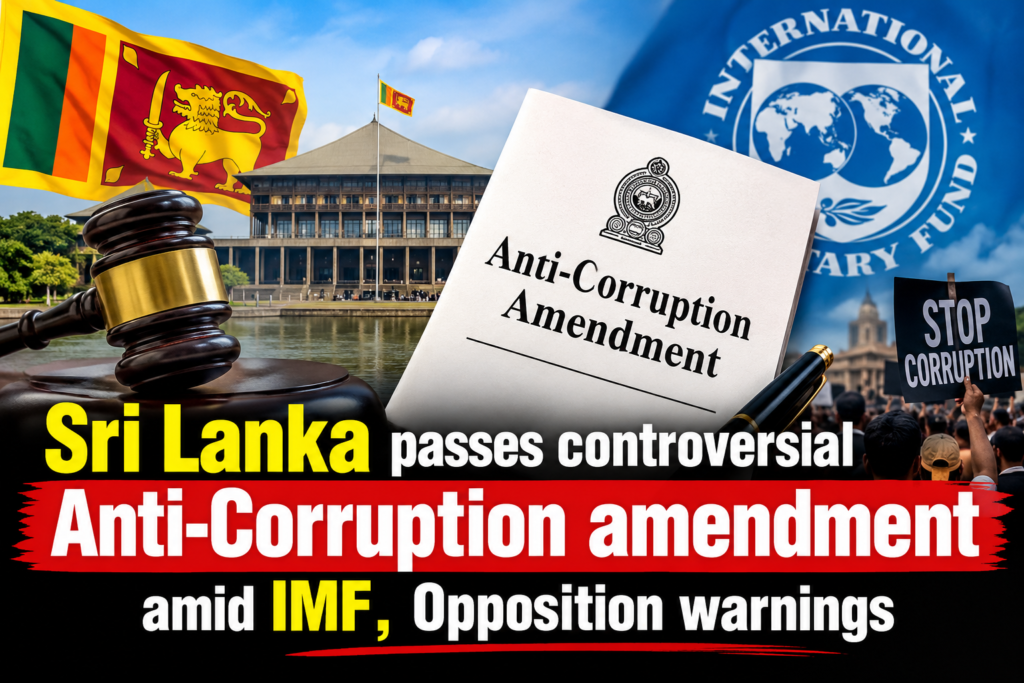
Sri Lanka’s Parliament on Thursday passed the Anti-Corruption (Amendment) Bill with amendments and without a vote, despite concerns raised by the opposition, civil society, and the International Monetary Fund (IMF).
The legislation amends the Anti-Corruption Act, No. 9 of 2023, a landmark piece of legislation which was adopted to align Sri Lanka’s domestic laws with international standards, particularly the United Nations Convention Against Corruption (UNCAC).
The legislative changes had also drawn caution from the International Monetary Fund.
IMF Mission Chief for Sri Lanka Evan Papageorgiou previously warned that proposed amendments risked weakening key transparency safeguards, particularly around the asset declaration framework and public ownership registers, which form part of governance benchmarks under the country’s economic reform program.
Opposition warns of weakened oversight

The main opposition Samagi Jana Balawegaya (SJB) argued that the amendments create loopholes that shield public officials from scrutiny.
SJB Parliamentarian Mujibur Rahman pointed out that under the new provisions, public access to asset declarations of public officials is limited solely to filing formal complaints, rather than allowing scrutiny by researchers or journalists, backed by penalties of up to a one-year prison sentence and a 100,000-rupee fine.
“Because of this harsh penalty, no one will come forward to look into these matters. Knowing that this amendment could subject them to a 100,000-rupee fine and prison time, everyone will be discouraged from probing further,” Rahman said.
Rahman criticized raising the threshold for state-owned enterprises requiring asset declarations from a 25-percent government shareholding to over 50 percent, which excludes partially state-owned entities.
He raised concerns over the removal of declaration requirements for household cohabitants and the exclusion of bodies such as the National Olympic Committee.
There were several issues with the new legislation, he pointed out, including restricting the manner in which publicised asset declarations can be used by the public, failing to provide a clear definition regarding the redaction or removal of information disclosed in asset declarations, and removing the requirement to declare the assets and liabilities of persons cohabiting in the same household.
“Why are you now bringing these amendments to that Act? The primary objective you initially proposed in bringing amendments to this Act was specifically to shield ministers, MPs, and public servants by concealing their assets and liabilities.”
“You have compromised the very public mandate you received. These amendments turn their back on that mandate. You have discarded the transparency and accountability demanded by that mandate. That is why the assets and liabilities of your ministers and MPs became a subject of debate in recent times.”
Allegations were raised against National People’s Power ministers and MPs when they the law first required them to make asset declarations.
“How was so much wealth acquired? It was precisely because of those allegations that you sought a shield to ensure that the assets and liabilities of ministers, MPs, and public officials would not be openly discussed.”
Following public outcry and opposition from civil society organisations, the government was forced to remove ministers and MPs from that shield and restrict that protection solely to public officials, the legislator said.
A redacted copy of a public official’s assets and liabilities can be obtained under the amended Act; but according to Section 11(2) under the new amendment, it can only be obtained strictly for the purpose of lodging a complaint.
“You cannot obtain copies to conduct investigative journalism or carry out research. And if someone is deemed to have “misused” it, it becomes an offence punishable not merely by a fine of 100,000 rupees, but by imprisonment of up to one year!”
“Defamation lawsuits can already be filed to claim damages. While such laws already exist, why introduce this new provision?”
“Because of this harsh penalty, no one will come forward to look into these matters. People will be intimidated. If someone tries to investigate whether a public official has illicitly acquired wealth, knowing that this amendment could subject them to a 100,000-rupee fine and prison time, everyone will be discouraged from probing further.
The new law does not conform to international benchmarks, Rahman said.
“We can define this amendment as nothing less than an incentive for corruption. That is why this clause has been identified as failing international standards. Why reverse this progress?”
“By reversing this, you are indirectly providing a protective cover for public officials to engage in corruption.
“Amid the perks and privileges granted to public officials, those cannot be traced; investigating them comes to a halt. Is there a hidden scheme beneath this to utilize those perks and privileges granted to public officials to target and hunt down opposition political leaders in this country? Because they can be weaponized. Because no one can investigate them! What they receive remains concealed.”
Dismantling the requirement that a public official must declare not only their own assets, but also the assets of individuals cohabiting in the same household facilitates corruption Rahman said.
“Typically, corrupt individuals register stolen wealth in the names of those closest to them. That is a classic tactic of corruption. It is being done even now, as you well know! When tracing the assets of certain individuals today, they are not registered under their own names, but under the names of third parties. You are removing that clause!”
“This is not what the people who voted for you expected. The people granted you a mandate for transparency, accountability, and the eradication of corruption. Yet, having secured that mandate, instead of strengthening the Act, diluting it and providing cover to the corrupt is deeply regrettable.”
Under the amended Act, officials appointed to state institutions where the government holds a 50 percent shareholding must submit their asset declarations. The threshold was previously 25 percent.
“What is the logic behind excluding entities holding between 25% and 50%? How can you guarantee that corruption will not occur through appointed officials in those entities? A multitude of serious doubts and suspicions have been created by your actions.”
Court rulings
The approval of the amendments to the Act follow a determination by the Supreme Court last month on petitions filed by Transparency International Sri Lanka (TISL).
Speaker Jagath Wickramaratne had announced that the court found Clause 17 unconstitutional without a two-thirds parliamentary majority and a national referendum.
The court also determined that repealing Section 80(1)(e) — which requires declarations from household cohabitants — was inconsistent with equal protection rights under Article 12(1) unless passed by a special majority.
Government defends practical fixes
Defending the bill during the parliamentary debate, Prime Minister Harini Amarasuriya rejected allegations that the government was weakening the anti-graft framework.
She claimed the amendments were introduced to resolve operational and human resource constraints, while introducing provisions to recover stolen public funds, which were missing in the original 2023 law.
“This is, in fact, an attempt to resolve the practical challenges, institutional challenges, and human resource issues encountered in implementing the anti-corruption process for the first time in Sri Lanka’s history, rather than diluting it,” Amarasuriya said.
Excerpt — Economy next


