
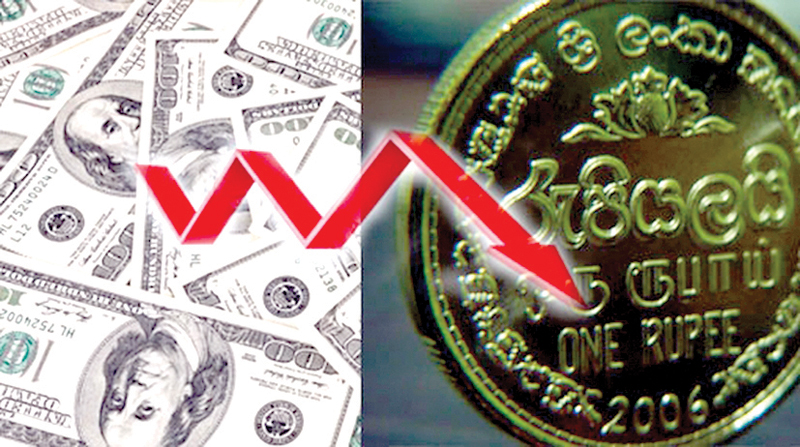
Last week, headlines from Bloomberg screamed that the Sri Lankan rupee was the worst performing currency in Asia, and then, just a few days later, that the rupee was suddenly the best performing currency in Asia. On May 26, the Central Bank of Sri Lanka made the biggest interest rate hike in three years.
The rupee-dollar conversion rate is one of those indicators that economists and the average citizen obsess over. For citizens, a strong rupee is a good thing because consumption is dependent on the prices of imports – from upstream intermediate goods such as fuel and fertiliser, to downstream household consumption goods such as lentils, dried or tinned fish, and cooking oil.
In the handful of media engagements I have participated in, I have always found the line of questioning about the economy to be deeply limiting and shortsighted. “What is the state of our reserves? Will the rupee go up or down against the dollar?” It is in the nature of a financial speculator to obsess over day-to-day market fluctuations, and we have all been taught to think like that. It is not the journalist but the institutionalisation of neoclassical economics that is to blame.
Our national economy moves from disequilibrium to disequilibrium and we lack a frame to view the longer arc of the business cycle and our place in it.
Neoclassical economics has long abandoned the bigger questions that classical political economy and development economics sought to answer: Why do nations get rich (or stay poor)? How is society organised in the production of value? Who are the winners and losers in the distribution of that value?
The causes of depreciation
Back in 2022, economists blamed ‘money printing’ for the depreciation of the rupee and the resulting inflation. By money printing they specifically seemed to mean Central Bank financing of the Government’s Budget deficit. The Central Bank Act of 2023, a condition of the 17th IMF program, effectively decoupled fiscal and monetary policy by making the Central Bank independent and preventing it from financing the budget deficit.
The Public Financial Management Act and the Economic Transformation Act of 2024 place a hard legal cap on the Government’s Budget deficit. We now have a situation where there is a primary Budget surplus (that is, a surplus in the Government Budget before accounting for debt repayments) and an independent Central Bank that cannot finance a Government deficit.
Therefore, the current bout of depreciation occurs within the framework of the 17th IMF program and its fiscal guardrails. At least three major reasons have been put forward to explain this depreciation. These are real, but they are triggers acting on a deeper structural weakness – not mechanisms in themselves.
Firstly, the release of pent-up demand through the massive import of automobiles is argued to have increased the import bill and placed downward pressure on the rupee. This rationale seems to be accepted by the Government which has applied a temporary 50 percent surcharge to discourage automobile imports.
Secondly, the massive rise in oil prices following the US war on Iran and ensuing Hormuz Crisis is said to have a similar effect. This rationale has again been recognised by the Government, which has re-adopted the QR code fuel rationing system and increased prices to control demand.
A third reason, linked to the second, is the decline in remittances and tourism inflows following the Hormuz Crisis. Many Sri Lankan migrants work in the Persian Gulf States which are in economic turmoil. Tourists from Europe often transit through those same States where the airspace is no longer safe.
One could argue that many of these factors also existed in the lead up to the 2022 crisis. The Covid-19 pandemic disrupted supply chains and halted inflows of tourism and remittances; the Russia-Ukraine-NATO war caused global fuel and commodity prices to surge to unprecedented levels.
In the lead up to the 2022 default, Sri Lanka faced a classic ‘terms of trade’ crisis – a deterioration of the relative price of exports to imports. All countries that specialise in exports of raw materials, low-value-added manufactures, and volatile services are prone to such crises. These crises inevitably place immense pressure on the currency, leading to depreciation and pass-through inflation.
However, the response by economists, policymakers, and the IMF was to focus entirely on the Budget deficit while ignoring the weakness of the country’s production structure. The result is that 17th IMF program has left us with a primary budget surplus but thin external reserves.
The combination of weakened State capacity and IMF fiscal guardrails mean that the State has few alternatives but to allow inflation to pass through with cost-reflective energy pricing, while raising interest rates to ensure rupee yields match the expected inflation. Both policy decisions will have a destructive effect on the real economy.
Neoclassical economics teaches that, in general, the depreciation of a currency is good for exports and bad for imports. Indeed, the economic history of the newly industrialised countries of Asia demonstrates that an undervalued currency certainly played a key role in the export-oriented industrialisation. Therefore, depreciation is often prescribed as a policy instrument to improve export competitiveness.
Yet, this assessment is based on conditions that do not hold in all contexts. If raw materials and intermediate goods – including food and energy – are produced within the national economy, then depreciation makes the final exported product more competitive in global markets without adversely affecting the cost of production of local firms.
However, where no domestic supply chain exists, depreciation has the effect of increasing domestic costs of production without increasing export competitiveness. This is the case for Sri Lanka’s main export – apparel.
The actual impact of depreciation is to lower the real wage of the worker. Between 2021 and 2024, the World Bank reports that real wages contracted by 16.9 percent for the private sector and 22 percent for the public sector. Much of this contraction is the function of a depreciating currency. As the cost of imported inputs is relatively inelastic, the wage of the worker is the first cost to be cut to preserve the firm’s profit margin.
Anyone who has sat in a collective bargaining meeting will tell you that rising costs of production due to a depreciating currency are among the chief excuses given by bosses to withhold a pay rise.
Economic actors respond to volatilities based on their class interests. Former Central Bank Governor Indrajith Coomaraswamy said that traders have been frontloading imports while exporters have been withholding foreign currency. Both are exacerbating the shock by betting on a depreciating currency. This too is an echo of what happened in the lead up to 2022.
Inflation and depreciation are not solely fiscal or monetary problems. They are linked to the productivity of, and distribution of resources within, the real economy.
The behaviour of Sri Lanka’s banking sector is highly commercialised, as the system lacks a major State-owned development bank to guide the flow of credit to strategic sectors and assist in the creation of productive assets. Credit functions as a kind of claim on resources; therefore, who gets credit and for what purpose has an impact on the real economy.
The majority of bank lending in Sri Lanka goes towards personal consumption, services, and construction (i.e. real estate) that have a high import content. There is a scarcity of affordable and patient capital for agriculture and manufacturing, and especially for technological upgrading in these sectors. This is detrimental to the competitiveness of Sri Lankan exports.
Credit readily flows towards imports and economic activity that is either speculative or volatile. The returns on these activities are not reinvested in industrial diversification or technological upgrading. This pattern of resource allocation makes a terms of trade crisis inevitable – the currency is already rigged towards depreciation.
When depreciation manifests as pass-through inflation, the Central Bank responds by increasing interest rates. The orthodox defence is that high rates are needed to halt capital flight. This is true, but it is also precisely the problem – the mechanism works by making it more profitable to hold financial assets than invest in production.
The objective result of this dynamic is to secure the yield of the creditor and inflate banking sector profits. We already saw this following the 2022 crisis rate hike where the major local banks made super profits at the cost of the real economy.
What we have in Sri Lanka is a fundamentally creditor–rentier economic structure that is anti-farmer, anti-worker, and anti-industrialisation. The framework of the 17th IMF program has entrenched a system where it is more profitable to hold financial assets than invest in the real economy, creating a vicious downward spiral.
The rupee has depreciated, is depreciating, and will continue to depreciate. But to fix our gaze on the exchange rate is to miss the questions that matter: how value is produced in this country, who produces it, and who captures it? Until those questions are at the centre of economic policy, the rupee will keep telling us the same story.
( Source- Sunday Observer )

Shiran Illanperuma is a journalist and political economist. He is a researcher at Tricontinental: Institute for Social Research and a co-editor of Wenhua Zongheng: A Journal of Contemporary Chinese Thought.


