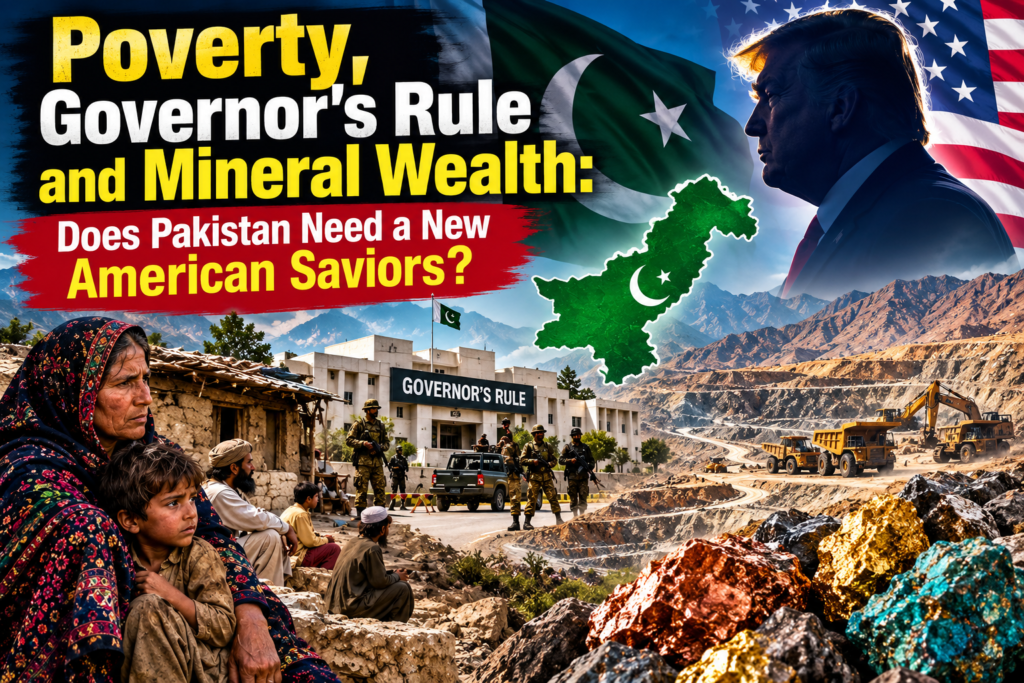
Pakistan is facing a crisis that cannot be understood through economic statistics alone. Rising poverty, an expanding debt burden, the erosion of purchasing power, political instability and growing international interest in the country’s mineral resources are converging at a critical moment. Meanwhile, the suspension of the elected provincial government in Khyber Pakhtunkhwa and the imposition of emergency rule have raised serious questions about democracy, provincial autonomy and the expanding role of the security establishment in political life.
These developments do not, by themselves, establish the existence of a single coordinated plan. Yet they raise an important question: who stands to benefit from Pakistan’s economic vulnerability, and who will ultimately pay the price?
A country’s poverty can be a genuine social emergency. It can also become part of a political narrative through which external intervention, economic restructuring and the transfer of control over natural resources are presented as necessary solutions. The challenge is to distinguish the reality of poverty from the political uses to which that reality may be put.
Pakistan’s people need an escape from poverty. But they do not need a model of development that leaves them dependent on foreign creditors, weakens their democratic institutions and transfers the benefits of their country’s natural wealth to powerful domestic and international interests.
The World Bank’s 48 Per Cent Finding: What Does It Actually Mean?
A report circulated by India’s Aaj Tak has drawn attention to a striking statistic attributed to the World Bank: approximately 48 per cent of the poor population in the Middle East, North Africa, Afghanistan and Pakistan (MENAAP) region, living on less than $3 a day, is in Pakistan.
The distinction is essential. The figure does not mean that 48 per cent of Pakistan’s population is poor. It means that, according to the reported comparison, Pakistan accounts for approximately 48 per cent of the people classified as poor within the specified regional grouping and poverty threshold.
The World Bank’s October 2026 regional economic update, From Divide to Opportunity: AI, Jobs, and Growth, examines economic pressures, employment and technological transformation across the MENAAP region. Its regional framework includes the Middle East, North Africa, Afghanistan and Pakistan—not Central Asia and East Africa as entire regions. These geographical distinctions matter when interpreting the statistic. “World Bank, October 2026” (https://www.worldbank.org/en/region/mena/publication/middle-east-north-africa-and-pakistan-economic-update)
Nevertheless, the reported figure raises a profound question. How has Pakistan, a country with substantial agricultural capacity, a large workforce, an important geographical position and significant mineral potential, reached a situation in which it accounts for such a large share of the region’s poor?
The answer cannot simply be that Pakistanis have failed to work hard enough, that the country lacks entrepreneurial talent, or that its population needs to be educated by foreign experts. Such explanations ignore the political and economic structures that shape people’s opportunities.
The World Bank’s September 2025 assessment, Reclaiming Momentum Towards Prosperity: Pakistan’s Poverty, Equity and Resilience Assessment, documented a major reversal in Pakistan’s poverty-reduction trajectory. The national poverty rate fell from 64.3 per cent in 2001–02 to 21.9 per cent in 2018–19, before rising again amid subsequent economic and environmental shocks. Its findings point to the limitations of a growth model that has struggled to translate economic activity into sustained improvements in ordinary people’s lives.
The distinction between national poverty and international poverty thresholds is important, and these figures should not be conflated. Yet both sets of evidence point towards a serious crisis of livelihoods and economic security.
The more important question is not whether Pakistan is poor. It is why economic growth, public policy and the country’s productive resources have failed to provide lasting economic security for such a large section of its population.
The IMF and the Political Economy of Austerity
Pakistan’s economic crisis cannot be understood without examining the direct role of the International Monetary Fund in shaping the country’s economic policies.
The IMF is not merely an institution that lends money during a balance-of-payments crisis. Its lending programmes attach conditions to financing, and those conditions influence taxation, exchange-rate management, monetary policy, energy prices, subsidies, public expenditure and the restructuring of state-owned enterprises.
During Imran Khan’s government, the IMF approved a $6 billion Extended Fund Facility in July 2019. The programme included commitments to increase revenue mobilisation, adopt a flexible market-determined exchange rate, strengthen central bank autonomy and move the energy sector towards cost recovery. Pakistan’s programme documents also recorded increases in electricity and gas tariffs and significant fiscal adjustment measures. “IMF, July 2019” (https://www.imf.org/en/news/articles/2019/07/03/pr19264-pakistan-imf-executive-board-approves-39-month-eff-arrangement)
Under Shehbaz Sharif’s government, the IMF approved another programme worth approximately $7 billion in September 2024. Its policy framework included further revenue mobilisation, energy tariff adjustments, targeted subsidy reforms, state-owned enterprise restructuring and privatisation. These were not merely recommendations discussed in passing; they formed part of the programme’s agreed policy framework and structural conditions. “IMF, September 2024” (https://www.imf.org/en/news/articles/2024/09/27/pr-24343-pakistan-imf-concludes-2024-aiv-consultation-pakistan-approves-37-mo-extended-arr)
This continuity across successive governments reveals an important feature of Pakistan’s political economy. Different political administrations have operated within a recurring framework of external financing, fiscal adjustment and market-oriented restructuring.
The IMF does not exercise unlimited authority over Pakistan, and elected governments retain responsibility for negotiating and implementing policies. Nevertheless, when access to urgently needed financing depends on meeting agreed targets, the creditor institution acquires considerable influence over the range of economic choices available to the borrowing state.
The central criticism is not simply that Pakistan borrows money. It is that the terms of economic adjustment can shift the costs of stabilisation onto people who have the least capacity to absorb them.
When governments increase indirect taxation, raise electricity and gas prices, reduce untargeted subsidies and constrain public expenditure, the distributional consequences depend on the design of those measures. If wealthy households, large property owners and powerful commercial interests remain inadequately taxed, while ordinary consumers pay more for essential goods and services, the result can be a deeply unequal adjustment.
The question is therefore not whether fiscal discipline is necessary in the abstract. It is whether the particular form of fiscal discipline being pursued is socially just, economically productive and democratically accountable.
Who pays for adjustment? Who receives protection? Who owns the productive assets that generate future income? And who benefits when public institutions are restructured in the name of efficiency?
These are questions of political economy, not merely technical economics.
A programme may improve selected macroeconomic indicators while leaving households struggling with food prices, electricity bills, transport costs and medical expenses. A reduction in the fiscal deficit does not automatically mean an improvement in living standards. Nor does an increase in investor confidence necessarily translate into secure employment or rising real wages.
For this reason, the IMF’s programmes should be judged not only by foreign-exchange reserves, debt repayments and fiscal targets, but also by their consequences for workers, farmers, small businesses and low-income households.
The IMF’s own programme documents provide a basis for examining its influence. The distributional consequences of that influence require further analysis of tax incidence, real wages, employment, public spending and household incomes. The burden of proof should not be replaced by the assumption that market-oriented reforms automatically benefit everyone.
Neoliberalism, Debt and the Privatisation of Economic Security
Pakistan’s recurring economic crises are part of a wider problem associated with neoliberal economic restructuring: the tendency to prioritise market confidence, fiscal consolidation, private investment and the commercial restructuring of public institutions, often without sufficient attention to inequality and social protection.
Neoliberalism is not a single policy, and every reform associated with markets or private investment is not necessarily harmful. The problem arises when market-oriented policies become dominant objectives in themselves, while the social costs of adjustment are treated as secondary or temporary.
In Pakistan, this tension is visible in the relationship between taxation and public services, energy prices and household incomes, privatisation and employment, and debt servicing and development expenditure.
A country that repeatedly borrows to meet external obligations, imports essential energy and industrial inputs, and struggles to expand productive employment remains vulnerable to external shocks. When another financing crisis emerges, the same cycle of borrowing and adjustment can begin again.
This is not simply a problem of bad individual decisions. It reflects a development model that has struggled to build sufficient domestic productive capacity and distribute economic gains broadly.
The result is a society in which the wealthy can often protect their assets, move capital, purchase private healthcare and education, and absorb rising costs more easily, while poorer households face immediate threats to their living standards.
Pakistan risks becoming a haven for wealth and privilege while becoming increasingly punishing for those who depend on wages, insecure employment and public services.
This is the fundamental class question: whose economic security does the state protect?
A serious alternative must go beyond rejecting austerity rhetorically. It must address the narrow tax base, exemptions and privileges enjoyed by powerful economic interests, weak industrial development, insecure employment, unequal land and asset ownership, and insufficient public investment in health, education and social protection.
Without these changes, economic stabilisation may repeatedly restore the conditions necessary for the next borrowing programme without resolving the underlying causes of vulnerability.
Climate Destruction, Technological Change and the New Geography of Poverty
Pakistan’s economic difficulties are also intensified by forces that extend beyond the immediate relationship between the government and the IMF.
The catastrophic floods of 2022 destroyed homes, crops, infrastructure and livelihoods. Climate-related disasters disproportionately affect people who lack savings, insurance, secure housing or access to state assistance. The poorest households frequently suffer the greatest losses while possessing the fewest resources for recovery.
Inflation, currency depreciation and expensive imported energy compound these pressures. The result is a vicious cycle: families lose income, reduce consumption, postpone healthcare and education, and become more vulnerable to future economic shocks.
Technological change introduces another challenge.
The World Economic Forum’s Future of Jobs Report 2025 projected that global economic, technological, demographic and green-transition trends could create 170 million jobs while displacing 92 million by 2030, resulting in a net increase of 78 million jobs globally. These are worldwide projections, not a prediction of Pakistan’s own employment balance. Nevertheless, they highlight the scale of labour-market transformation ahead. “World Economic Forum, 2025” (https://www.weforum.org/media/future-of-jobs-report-2025-78-million-new-job-opportunities-by-2030-but-urgent-upskilling-needed-to-prepare-workforces/)
Artificial intelligence and automation can increase productivity, improve public services and create new industries. But their benefits are not distributed automatically. Without investment in education, technical training, workers’ rights and social protection, technological gains can concentrate among firms and asset owners while workers face insecure employment or displacement.
For Pakistan, this challenge is especially serious. A country with a large young population needs an economic strategy that creates productive employment rather than relying indefinitely on low wages, informal labour and remittances.
It must also invest in climate resilience, agricultural adaptation, public infrastructure and industrial capacity.
Poverty is therefore not simply the result of individual circumstances. It emerges from the interaction of economic policy, unequal access to resources, environmental vulnerability, technological transformation and the distribution of political power.
The Iran Conflict and the Cost of Global Instability
Pakistan’s vulnerability is further exposed by instability in the Middle East and its consequences for global energy markets.
On 11 October 2026, Reuters reported Brent crude trading at approximately $106.76 a barrel amid heightened regional tensions and disruptions involving shipping and energy infrastructure. For an economy dependent on imported energy, sustained increases in international oil prices can place additional pressure on the import bill, transport costs, electricity generation and household budgets. “Reuters, 11 October 2026” (https://www.reuters.com/business/energy/oil-climbs-mideast-conflict-tanker-attacks-persist-2026-10-11/)
The consequences extend well beyond petrol prices. Higher energy costs can increase the price of agricultural inputs, food distribution, manufacturing and public transport. If the government passes these costs directly to consumers, households already struggling with inflation face another reduction in purchasing power.
The World Bank’s October 2026 regional economic update also describes the economic consequences of the conflict that began in the Persian Gulf in February 2026, including disruption to shipping through the Strait of Hormuz and wider regional economic uncertainty.
This is an example of how geopolitical conflict can intensify poverty in countries that have limited control over global energy markets.
The answer, however, cannot be to treat every international shock as an unavoidable reason to impose further hardship on the population. Governments must consider how costs are distributed, how vulnerable households are protected, and how dependence on imported energy can be reduced over time.
A just economic policy must account for both external pressures and domestic choices.
The Mineral Box at the White House: A Symbol of Pakistan’s Strategic Value
On 25 September 2025, Prime Minister Shehbaz Sharif and Field Marshal Asim Munir met US President Donald Trump at the White House. Official photographs from the meeting showed Trump examining an open box containing mineral samples while Munir pointed towards the display and Sharif stood nearby.
The Indian Express reported on 28 September that the Pakistani delegation had presented rare-earth mineral samples during the meeting. The same report noted Pakistan’s efforts to attract American investment in minerals, agriculture, information technology and energy. “The Indian Express, 28 September 2025” (https://indianexpress.com/article/world/pak-pm-shehbaz-sharif-asim-munir-flash-rare-earth-minerals-at-white-house-10276770/)
The image became politically significant because it placed Pakistan’s mineral potential directly in the context of a high-level diplomatic engagement with Washington.
Pakistan possesses important mineral resources, including copper and gold deposits at Reko Diq in Balochistan. Khyber Pakhtunkhwa also has significant mineral potential. The country’s geographical position and its potential access to international shipping routes add to the strategic importance of these resources.
Yet a critical distinction must be made between geological potential, proven reserves and commercially recoverable deposits. The existence of mineral resources does not automatically guarantee profitable extraction, industrial development or public prosperity.
Nor does the photograph establish that the United States has devised a plan to seize Pakistan’s resources. What it does establish is that mineral diplomacy and investment opportunities formed part of the broader context of Pakistan-US engagement.
That context warrants serious scrutiny.
The central question is not whether foreign investment should be rejected. Pakistan needs capital, technology, industrial capacity and access to international markets. The question is whether investment agreements strengthen Pakistan’s productive capabilities or deepen its dependence on foreign companies and external markets.
Will minerals be exported primarily in raw or minimally processed form, or will Pakistan develop domestic refining, processing and manufacturing capabilities? Will local communities receive meaningful employment and a fair share of the revenue? Will environmental protections be enforceable? Will contracts be transparent? Will provincial institutions and affected communities have a genuine role in decision-making?
A country can possess enormous mineral wealth and still remain poor if the benefits are concentrated among a small group of domestic elites and foreign investors.
This is the resource question at the heart of Pakistan’s economic future.
Khyber Pakhtunkhwa: Emergency Rule, Security and Provincial Autonomy
The suspension of the elected provincial government in Khyber Pakhtunkhwa has added another dimension to these concerns.
On 11 October 2026, President Asif Ali Zardari approved the imposition of emergency rule and the suspension of the Pakistan Tehreek-e-Insaf-led provincial government. The federal government justified the decision by citing deteriorating security conditions, militant violence and alleged failures of the provincial administration. PTI rejected the action, describing it as an attack on provincial autonomy and democratic representation.
The situation is serious. Khyber Pakhtunkhwa has suffered years of militant violence, and the security concerns of its residents cannot be dismissed. Civilians, police personnel and other security forces have paid a devastating price. The state has a responsibility to protect people from violence and restore security.
But acknowledging a genuine security threat does not mean that every extraordinary constitutional measure is necessarily justified.
The suspension of an elected government raises questions about proportionality, constitutional safeguards, political accountability and the availability of alternatives. What evidence supports the decision? Were political negotiations exhausted? Were the respective responsibilities of federal and provincial institutions clearly established? What mechanisms will prevent emergency powers from becoming an instrument of political control?
Reports surrounding the decision described a breakdown in talks and deep disagreements over security and political demands. It would therefore be inaccurate to claim, without qualification, that negotiations were entirely successful or that no deadlock existed. Nevertheless, the circumstances and necessity of such an extraordinary measure deserve transparent examination.
The larger issue concerns the relationship between security and political authority.
When an elected provincial government is suspended, the distribution of power changes. Decisions that would ordinarily involve provincial ministers, legislators and institutions may become concentrated in a smaller administrative structure.
Such a shift demands greater, not lesser, accountability.
The presence of security forces on roads and in public spaces must also be understood in context. Deployments may be necessary for particular operations, but their scope, duration and legal basis should be transparent. Security policy must protect communities without unnecessarily weakening democratic institutions or excluding local populations from decisions affecting their future.
It would be premature to conclude that the emergency was imposed to facilitate mineral extraction. No direct evidence has established that connection. Yet the political economy of security deserves investigation, particularly in resource-rich regions where decisions about land, infrastructure, investment and extraction can have far-reaching consequences.
The relevant question is whether exceptional security arrangements remain limited to legitimate public protection or begin to reshape political and economic decision-making in ways that undermine local accountability.
Resource Wealth, Security and the Risk of Dependency
Pakistan’s experience reflects a wider historical problem: resource-rich societies do not necessarily become prosperous when their resources attract international investment.
Across parts of Africa, Latin America and Asia, the extraction of natural resources has sometimes generated substantial export earnings without producing comparable improvements in local living standards. The reasons vary, but recurring problems include unequal contracts, limited domestic processing, profit repatriation, environmental damage, corruption and weak public accountability.
This history does not mean that every foreign investor intends to exploit Pakistan. Nor does it mean that foreign capital cannot contribute to development. It means that investment must be assessed through the distribution of its benefits and costs rather than the size of the announced financial commitment.
Pakistan must avoid becoming merely a supplier of raw materials to more industrialised economies. If minerals are extracted locally but processed elsewhere, the country may lose opportunities to develop technological expertise, create higher-skilled jobs and build industrial supply chains.
The same principle applies to energy, agriculture and information technology. Sustainable development requires domestic capacity, skilled labour, public institutions and the ability to negotiate investment agreements in the national interest.
his is particularly important when a country is financially vulnerable. A government under pressure to secure foreign exchange or attract investment may face incentives to accept agreements that appear attractive in the short term but limit its options in the long term.
The answer is not isolationism. It is economic sovereignty: the ability to engage internationally without surrendering meaningful control over development priorities and the distribution of national wealth.
Is Poverty Becoming the Argument for a New American Saviour?
The idea that Pakistan needs a foreign saviour deserves scrutiny.
International assistance, foreign investment and technological cooperation can be valuable. But a narrative that portrays a country as fundamentally incapable of solving its own problems can obscure the role of domestic political choices, unequal economic structures and historical relationships of dependency.
The language of development has often been used to justify external influence. In different historical contexts, powerful states have presented their interventions as necessary to modernise institutions, stabilise economies or unlock natural resources. The results have varied, but the underlying question remains relevant: who defines development, who controls its instruments, and who benefits from it?
The same questions should be asked of Pakistan’s current economic relationships.
Does the country’s dependence on repeated IMF programmes narrow the range of economic policies available to elected governments? Do mineral agreements strengthen domestic industry or primarily serve external supply chains? Does security policy protect local communities while preserving their political voice? Do international partnerships expand Pakistan’s choices or deepen its dependence on creditors, investors and geopolitical patrons?
These are legitimate questions even in the absence of evidence for a coordinated conspiracy.
It would be wrong to claim that the World Bank’s poverty statistics were deliberately produced to prepare the ground for an American takeover of Pakistan’s resources. The evidence presented so far does not establish such a connection. The more defensible argument is that economic vulnerability, strategic resources and international competition create circumstances in which the terms of external engagement deserve close public scrutiny.
A country does not need to reject international cooperation to defend its sovereignty. It needs the institutional capacity to negotiate on fair terms, protect its people and ensure that the gains from cooperation are shared.
Nor should the genuine suffering of poor people be dismissed as merely a propaganda narrative. Poverty is real. The political question is whether it will be addressed through structural reform and democratic accountability or used to justify policies that reproduce dependency.
An Alternative to Austerity and Dependency
Pakistan needs a different development strategy—one that places productive employment, social welfare and economic sovereignty at the center of policy.
First, the tax system must become more progressive. The state should reduce reliance on measures that disproportionately burden ordinary consumers and improve the effective taxation of wealth, high incomes, property gains and privileged economic interests.
Second, economic stabilisation must be connected to a credible industrial strategy. Pakistan needs investment in manufacturing, agricultural processing, renewable energy, technical education and domestic supply chains. A country cannot escape recurring external-financing crises if it remains dependent on imported essentials while failing to expand productive capacity.
Third, public services and social protection must be treated as foundations of economic development, not merely expenditures to be reduced whenever fiscal targets come under pressure. Healthcare, education, public transport and income support improve people’s ability to participate in economic life.
Fourth, the costs of technological change and climate damage must be shared fairly. Workers need retraining, employment protections and social insurance, while climate-vulnerable communities require resilient infrastructure and reliable public support.
Fifth, mineral policy must prioritise domestic value addition, transparent contracts, enforceable environmental safeguards, local employment and fair revenue-sharing arrangements. Provinces and affected communities must have a meaningful role in determining how their resources are used.
Finally, economic and security policies must remain subject to democratic oversight. Extraordinary powers should be justified by evidence, limited by law and accompanied by mechanisms of accountability.
These measures would not eliminate Pakistan’s economic difficulties overnight. But they would address the structural weaknesses that repeatedly make the country vulnerable to external pressure.
Conclusion: Whose Poverty, Whose Wealth?
Pakistan is not simply a poor country waiting to be rescued. It is a society with a large workforce, significant agricultural capacity, mineral potential and a population whose labour sustains the economy despite persistent hardship.
The real tragedy is that the existence of these resources has not translated into economic security for all.
The World Bank’s poverty statistics, the IMF’s policy conditionality, the mineral presentation at the White House and the emergency imposed in Khyber Pakhtunkhwa are distinct developments. They should not be presented as proof of a single hidden plan without further evidence. Yet each raises questions about the distribution of power, the purpose of economic policy and the control of national resources.
The IMF’s influence over Pakistan’s economic choices is documented in its own programme agreements. The social consequences of those policies require sustained scrutiny. The mineral presentation at the White House is documented in official photographs and contemporary reporting. The suspension of Khyber Pakhtunkhwa’s elected government is a significant constitutional and political development. The connections among these issues remain a matter for evidence-based investigation.
The fundamental challenge is to ensure that these separate developments are examined through a common democratic principle: economic decisions must serve the people whose labour, taxes and resources sustain the state.
Pakistan needs investment, but not at the cost of its capacity to determine its own development. It needs international cooperation, but not an unquestioned dependence on external creditors. It needs security, but not the unnecessary erosion of democratic representation. It needs economic stability, but not a version of stability that leaves millions struggling to afford food, energy, healthcare and education.
Above all, Pakistan needs a development model in which its mineral wealth becomes a source of public prosperity rather than another opportunity for concentrated private gain.
The ultimate question is not whether Pakistan is poor enough to require a saviour. It is why a country with substantial human and natural resources continues to leave so many of its people economically insecure.
And until that question is answered, the most important debate will remain unresolved: who owns Pakistan’s wealth in practice, who controls the decisions that determine its future, and who ultimately benefits from the labour and resources of its people .?

By Farhan Akhtar
Pakistan


