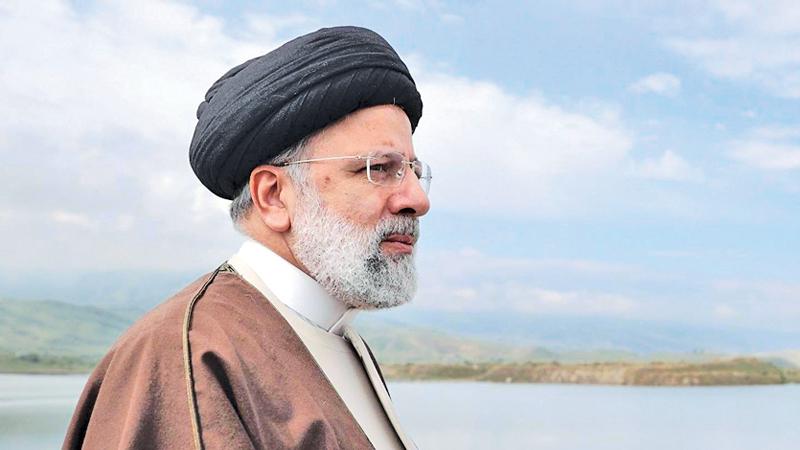
The eighth President of the Islamic Republic of Iran, Ebrahim Raisi, perished two years ago in a helicopter crash in the mountains of East Azerbaijan.
Raisi was returning from the launch of a dam on the Iran-Azerbaijan border. The fact that he was returning from an act of multilateralism, of South-South cooperation between two sovereign nations of Asia, tells us a lot about the man and the nation he represented.
Just 25 days before his death, Raisi stood on Sri Lankan soil, at a time when the country was navigating the harshest economic crisis in its modern history. He came to launch the Uma Oya Hydropower complex – another dam. What Raisi said during that inauguration is worth remembering today:
“The dominant system in the world tried to convince all other countries that without their presence, participation, and knowledge, it is not possible to realise development and progress. We believe that these words are rooted in colonisation, arrogance, and an unfair system and it is totally rejected.”
Those are powerful words coming from a sanctioned country to an indebted country. They capture the philosophy of Ebrahim Raisi, and the best principles of the Iranian Revolution.
Dams, debt and national liberation
Dams also symbolise State power – the ability to mobilise human and material resources to build great feats of engineering that bring people together under a common destiny. It’s no surprise that many great civilisations – from the Persian to the Sinhala – were based on dams and irrigation. The great revolutionary States of 20th century also sought to build State power through large scale hydroelectric projects. In other words, dams are feats of nation building.
But many countries ran into immense debt and technological dependency in building dams. Sri Lanka has had its fair share of experiences with this, from the Gal Oya project of the 1950s to the Accelerated Mahaweli Program of the 1970s. Dreams of energy and food sovereignty were turned against us by the policies of the IMF and World Bank. They became nightmares of debt and dependency.
Iran too had this problem. Before the Iranian Revolution, under the dictatorship of the Shah, dams were built through foreign loans and technology. Under the Shah’s ‘modernisation’ project, Iran’s oil was privatised to foreign corporations and the State was in debt.
It was only after the Iranian Revolution that the nation’s resources were taken back and the illegitimate debts repudiated. After the revolution, indigenous skills, technology, and financing were mobilised for dam development. It is these skills and technology that were put to work for Sri Lanka – without structural adjustment or austerity.
Justice-based multilateralism
Ebrahim Raisi, alongside many of Iran’s political leaders, are very much a product of the Iranian Revolution. Raisi, for example, was not born to power but into a poor clerical family in the city of Mashhad. When he was five years old, his father died and, as a child, he polished shoes on the streets to help his mother put food on the table. His arc from shoe shiner to Statesmen reflects the arc of the national liberations struggles of the 20th century. The Iranian Revolution is in that tradition, and Raisi was a product of it.
Raisi became President of Iran in 2021, a year of great global churning. It was the year of the Covid-19 pandemic and the first year of the Presidency of Joe Biden in the US. Iran had just been through the maximum pressure campaign of the first Trump administration, and though the Biden administration sought to restore a liberal rules-based imperialism, the mask had already slipped.
Raisi’s administration faced a profound contradiction. The US empire that had dominated the world since the fall of the Soviet Union was in palpable decline. It faced technological and financial competition from a rising Asia, buoyed by China. It’s control over natural resources was challenged by an assertive Global South. However, the US still had the tools for hybrid war: control over communications infrastructure and the flow of information, and – most dangerously – an overwhelming military power which it was not afraid to use.
Raisi not only navigated this dangerous conjuncture, but steered Iran into actively constructing an alternative framework for multilateralism and South-South cooperation. He sought to improve diplomatic relations with Saudi Arabia and the UAE. He signed a 25-year strategic cooperation pact with China, and deepened ties with Russia, Pakistan, Egypt, Turkey, India, and Uzbekistan.
In April 2023, Iran joined the Shanghai Cooperation Organisation, and in January 2024, Iran joined BRICS. Iran brought to both these forums a moral and ideological clarity beyond the economistic debates about trade.
Justice-based multilateralism meant the refusal to choose between principle and pragmatism. Raisi travelled to all kinds of Summits and Forums where he negotiated, signed agreements, and extended the hand. But in the same breath, he held firm to the core commitments of the Iranian Revolution – the sovereignty of Iran, the right of the Palestinian people to self-determination, and the support for the Axis of Resistance against US-Israeli interference in West Asia.
Building a resistance economy
Closer to home, Raisi sought to shore up Iran’s economic sovereignty. Perhaps, one of his most far-sighted policies was to emphasise the need to develop Iran’s digital abilities. For example, he promoted the development of the National Information Network – a domestic internet infrastructure, designed to reduce dependence on the US-dominated internet. He also promoted the creation of local software applications as alternatives for Northern Big Tech firms. In 2023, he set up the National Steering Committee and the National Artificial Intelligence Centre. These moves were clearly to counter US tech monopolies’ control over the flow of information.
These policies were part of Ebrahim Raisi’s adherence to the concept of the ‘resistance economy’, which was championed by the late Ayatollah Ali Khamenei. As a Republic that has spent most of its sovereign existence under sanctions by the global hegemon, Raisi and Khamenei understood the need to nurture self-sufficiency.
The core principles of the resistance economy were: First, to reduce oil dependence by diversifying the economy. Second, to promote domestic production and import substitution, especially in industries such as pharmaceuticals, steel, petrochemicals, and basic consumer goods. Third, to develop a knowledge-based economy, with investment in technology, biotech, nanotech, and higher education to move up the value chain. And fourth, to strengthen economic relations with the Global South.
Unfortunately, there are likely no Sri Lankan economists or policymakers who study these policies seriously, and how a country with a population of 90 million is able to ensure food sovereignty and basic technological self-sufficiency under a brutal sanctions regime.
Perhaps, what Raisi said in 2024, during the inauguration of the Uma Oya project, could be taken further. Not only is it possible for the countries of the Global South to achieve development and progress without the participation of the Global North, but also the exclusion of the Global North (even if partial) may be necessary for development and progress to be based on the principles of sovereignty and dignity.
If the Global North has nothing to offer other than tariffs, debt, sanctions, and bombs, it is better to work together and build together – from South to South.
This article is based on a speech delivered at a memorial for Iranian President Ebrahim Raisi and Foreign Minister Hossein Amir-Abdollahian at the Iran Cultural Centre, Colombo, on May 21, 2026. The writer is a journalist and political economist. He is a researcher at the Tricontinental: Institute for Social Research and a co-editor of Wenhua Zongheng: A Journal of Contemporary Chinese Thought.
( Source-Sunday Observer )