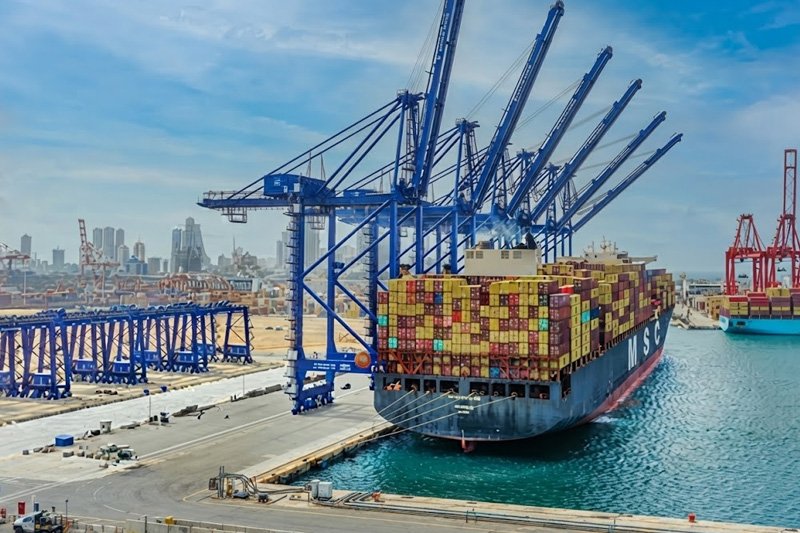
The Colombo West International Terminal (CWIT) is rapidly moving beyond its original role as a new container facility to become a central pillar of Sri Lanka’s maritime ambitions.
Its rapid throughput growth, deep-water capability and automation are now reshaping the competitive equation around Colombo Port, while simultaneously placing Sri Lanka at the intersection of commercial and geopolitical interests involving India, China, the United States and other maritime powers.
Speaking at the ceremony marking CWIT’s achievement of the two-million-TEU milestone and the launch of its second phase, Sri Lanka Ports Authority (SLPA) Chairman Dr. Parakrama Dissanayake said Colombo Port recorded 11.6% growth during the first eight months of 2026.
He said Colombo had emerged among the world’s top 20 container ports.
A port under pressure
The significance of that growth becomes clearer against the background of global shipping disruptions.
According to the SLPA Chairman, around four million TEUs are waiting at anchorages globally on a given day for berthing facilities.
Colombo, by comparison, has approximately 12,500 TEUs awaiting berths.
The difference highlights both Colombo’s competitive position and the pressure facing it.
Global container shipboard capacity has reached about 34 million TEUs, while the five largest shipping lines control approximately 65% of that capacity.
For Sri Lanka, therefore, expanding physical capacity alone will not guarantee future growth.
Colombo must provide shipping lines with faster vessel turnaround, reliability and integrated logistics.
CWIT’s fully automated operations are designed to address precisely this requirement, using remotely operated quayside and yard cranes to improve efficiency.
From transhipment hub to logistics centre
The next challenge is more ambitious.
Dr. Dissanayake said the SLPA plans to establish a common-user logistics centre inside Colombo Port, potentially transforming the port from a predominantly transhipment operation into a broader logistics hub.
That shift could have major economic implications.
A logistics hub can generate activity beyond container handling through warehousing, distribution, consolidation and other value-added services.
CWIT has already handled two million TEUs within its first 18 months.
Its USD 750 million investment is now entering Phase II, which is expected to increase the terminal’s annual capacity from 1.6 million to 3.2 million TEUs.
The expansion also supports Colombo Port’s broader target of reaching 13 million TEUs by 2028.
The geopolitical complication
Hitherto the terminal’s ownership structure creates another layer of complexity.
Adani Ports and SEZ holds 51% of the 35-year Build, Operate and Transfer consortium while John Keells Holdings and the SLPA hold 34% and 15% respectively.
Adani also operates India’s Vizhinjam transshipment hub, only about 220 kilometres from Colombo.
This presents a clear commercial challenge, as both facilities will need to expand without competing too aggressively for the same transshipment cargo.
CWIT therefore faces a difficult test.
Automation and capacity expansion may strengthen Colombo’s competitive position, but regional ports are simultaneously expanding.
The ultimate question is whether Colombo can convert CWIT’s impressive initial performance into sustained cargo growth, higher foreign-exchange earnings and a wider logistics economy—without allowing geopolitical competition or internal commercial overlaps to undermine the opportunity.


