
Sri Lanka has spent the past few years discussing one word more than any other – crisis. Economic crisis, political crisis, debt crisis, and cost-of-living crisis have dominated national conversations.
People discuss inflation, taxes, salaries, migration, and reforms almost daily. These concerns are real and unavoidable. But beneath these visible struggles, another quieter crisis may be developing – one that no financial package or policy reform alone can solve. It is the gradual erosion of civic ethics and social responsibility.
A country does not weaken only when its economy declines. Sometimes societies decline when people slowly stop caring about shared responsibility.
Today, many Sri Lankans ask why corruption exists, why public systems fail, and why disorder has become common. However, perhaps a more uncomfortable question should also be asked: what kind of everyday culture are we normalising within society?
Ethics and social trust
A nation’s ethics are not tested only in Parliament, courts, or corporate boardrooms. They are tested on roads, inside buses, in classrooms, at public institutions, in queues, and even on social media.
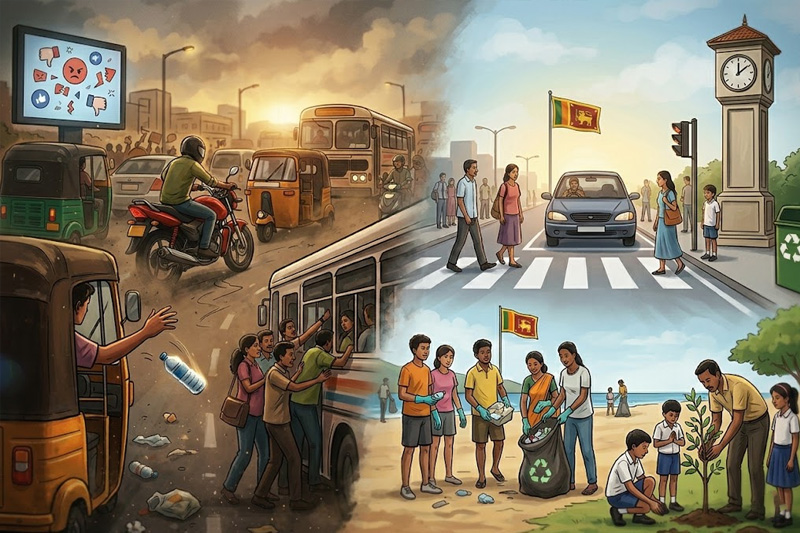
Consider a simple example. A person may strongly criticise corruption at the national level, but casually jump a queue, throw garbage from a vehicle window, offer a small bribe to avoid inconvenience, or ignore traffic laws. Individually, these actions may appear minor. But collectively, they slowly create a culture where rules become optional and responsibility becomes negotiable.
This may be one of the deeper challenges facing Sri Lanka today. Many people still imagine ethics as something grand – speeches about morality, patriotism, or honesty. In reality, ethics often appear in ordinary moments – returning excess change to a cashier, respecting pedestrians, arriving on time, protecting public property, speaking respectfully online, paying taxes honestly, or admitting mistakes. These actions rarely become headlines, but they shape whether trust survives within society.
Trust is one of the most valuable forms of national wealth. Countries with stronger social trust often experience safer environments, stronger institutions, better public cooperation, and healthier economies.
When trust weakens, everything becomes harder. Citizens stop believing in systems, suspicion increases, and rules are followed only out of fear rather than responsibility. Even good policies struggle to succeed when social cooperation itself becomes weak.
Sri Lanka’s recent years have shown how fragile public trust can become during times of crisis. However, rebuilding trust requires more than economic recovery. It also requires rebuilding civic culture from the ground up.
Interestingly, one contradiction often becomes visible among Sri Lankans living abroad. Many adapt quickly to disciplined systems in foreign countries. They obey traffic rules, avoid littering, respect public systems, and maintain discipline. This proves that Sri Lankans are fully capable of responsible behaviour. The issue is not inability. The issue may be that indiscipline has gradually become socially tolerated at home.
When unethical behaviour repeatedly occurs without consequences, society gradually begins lowering its moral standards. Over time, honesty may start to seem foolish, while shortcuts and unfair advantages are viewed as signs of cleverness. This creates a dangerous environment for any nation, because no society can achieve sustainable progress when intelligence is disconnected from ethics.
Ethics in the digital age
At the same time, technology and digital culture have made this challenge even more complicated.
Sri Lanka is becoming increasingly connected to the fast-moving digital world and global online trends. Social media often rewards speed, outrage, appearance, and attention more than patience, responsibility, or thoughtful behaviour.
As a result, many people become more focused on appearing successful rather than living responsibly. Young people especially grow up surrounded by carefully curated lifestyles, online approval, and constant comparison. The pressure to look wealthy, important, and accomplished can slowly weaken qualities such as humility, honesty, patience, and empathy.
Technology itself is not the problem; it is simply a tool. However, when strong ethical values are absent, even useful tools can deepen social problems.
Today, misinformation spreads rapidly because people frequently share content without checking facts. Public humiliation has become a form of entertainment, while aggressive online behaviour is increasingly normalised. Even minor disagreements can quickly turn into toxic personal attacks. In many ways, the way people behave online has now become part of broader civic behaviour.
This is why Sri Lanka must begin discussing ethics not as an outdated moral lecture, but as a modern development issue. A cleaner country requires ethics. A safer road system requires ethics. A stronger economy requires ethics. Environmental protection requires ethics. Public trust requires ethics. Democracy itself depends on ethical behaviour and civic responsibility. Without these foundations, laws alone become insufficient.
At the same time, the conversation should not become entirely negative. Sri Lanka still possesses many encouraging social strengths. During difficult times, ordinary citizens often demonstrate extraordinary compassion and resilience. Communities support one another during floods, economic hardships, and emergencies. Volunteers organise donation campaigns. Youth groups clean beaches and public spaces. Strangers help accident victims. Teachers continue serving despite numerous challenges.
These quiet acts of responsibility reveal something hopeful: the ethical foundation of society has not disappeared. It is simply competing against growing impatience, frustration, and self-interest.
Rebuilding national character
The goal, therefore, is not to create a perfect society. No country is perfect. The real goal is to rebuild a culture where responsible behaviour is once again socially respected.
This transformation cannot happen only through punishment or strict enforcement. Fear may temporarily control behaviour, but lasting civic culture develops through education, values, leadership, and collective example.
Schools must teach civic responsibility not only through textbooks but through practical experience. Parents must model ethical behaviour at home. The media must avoid glorifying unethical shortcuts and superficial success. Leaders must understand that public behaviour often reflects leadership culture. Religious and community institutions, too, have a responsibility to promote compassion, discipline, honesty, and social responsibility beyond ceremonial activities.
Most importantly, citizens themselves must recognise that patriotism is not merely emotional speeches or social media slogans during national celebrations. True patriotism appears in ordinary daily conduct. It is visible in whether a citizen litters or protects the environment, whether a driver respects pedestrians, whether public property is protected or destroyed, and whether people behave responsibly even when nobody is watching.
Sri Lanka’s future may ultimately depend less on how loudly people claim to love the country and more on how responsibly they behave towards it every day. Economic reforms can rebuild numbers. Infrastructure projects can rebuild roads. Policies can rebuild systems. But only ethical citizens can rebuild national character.
Perhaps that is the deeper challenge standing before Sri Lanka today – not only rebuilding the economy, but rebuilding the everyday ethics that allow a society to function with dignity, trust, discipline, and mutual respect.

By Dr. Nadee Dissanayake


