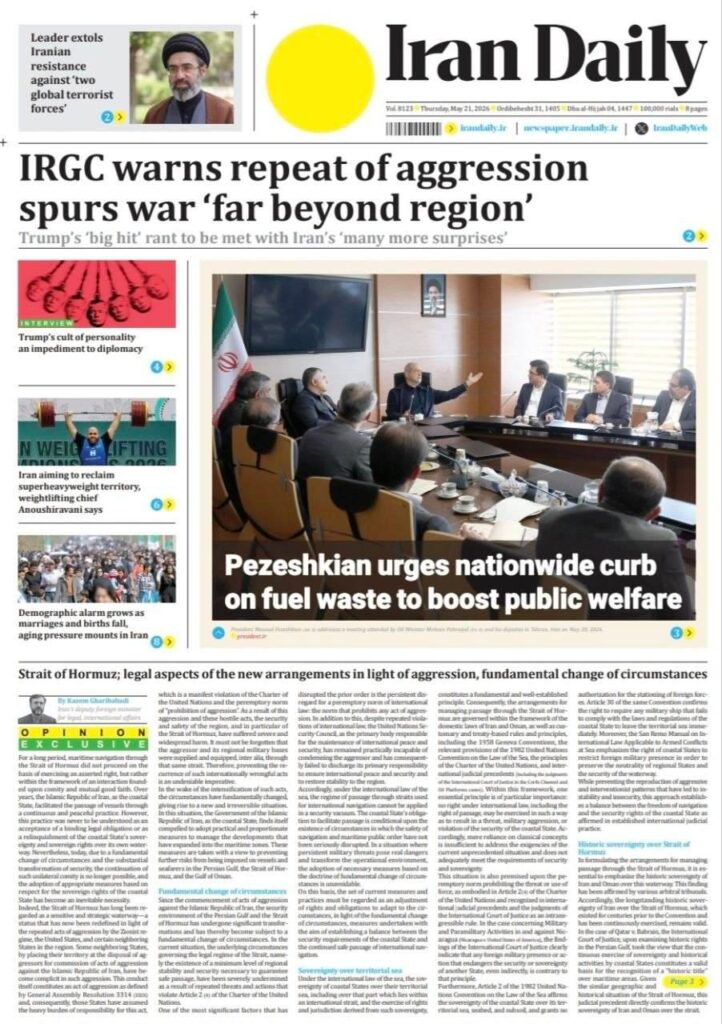

By Kazem Gharibabadi,
Deputy Foreign Minister for Legal and International Affairs
———————————————
Prelude
For a long period, maritime navigation through the Strait of Hormuz did not proceed on the basis of exercising an asserted right, but rather within the framework of an interaction founded upon comity and mutual good faith. Over years, the Islamic Republic of Iran, as the coastal State, facilitated the passage of vessels through a continuous and peaceful practice. However, this practice was never to be understood as an acceptance of a binding legal obligation or as a relinquishment of the coastal State’s sovereignty and sovereign rights over its own waterway. Nevertheless, today, due to a fundamental change of circumstances and the substantial transformation of security, the continuation of such unilateral comity is no longer possible, and the adoption of appropriate measures based on respect for the sovereign rights of the coastal State has become an inevitable necessity.
Indeed, the Strait of Hormuz has long been regarded as a sensitive and strategic waterway—a status that has now been redefined in light of the repeated acts of aggression by the Zionist regime, the United States, and certain neighboring States in the region. Some neighboring States, by placing their territory at the disposal of aggressors for commission of acts of aggression against the Islamic Republic of Iran, have become complicit in such aggression. This conduct itself constitutes an act of aggression as defined by General Assembly Resolution 3314 (XXIX) and, consequently, those States have assumed the heavy burden of responsibility for this act, which is a manifest violation of the Charter of the United Nations and the peremptory norm of “prohibition of aggression”. As a result of this aggression and these hostile acts, the security and safety of the region, and in particular of the Strait of Hormuz, have suffered severe and widespread harm. It must not be forgotten that the aggressor and its regional military bases were supplied and equipped, inter alia, through that same strait. Therefore, preventing the recurrence of such internationally wrongful acts is an undeniable imperative.
In the wake of the intensification of such acts, the circumstances have fundamentally changed, giving rise to a new and irreversible situation. In this situation, the Government of the Islamic Republic of Iran, as the coastal State, finds itself compelled to adopt practical and proportionate measures to manage the developments that have expanded into the maritime zones. These measures are taken with a view to preventing further risks from being imposed on vessels and seafarers in the Persian Gulf, the Strait of Hormuz, and the Gulf of Oman.
Fundamental Change of Circumstances
Since the commencement of acts of aggression against the Islamic Republic of Iran, the security environment of the Persian Gulf and the Strait of Hormuz has undergone significant transformations and has thereby become subject to a fundamental change of circumstances. In the current situation, the underlying circumstances governing the legal regime of the Strait, namely the existence of a minimum level of regional stability and security necessary to guarantee safe passage, have been severely undermined as a result of repeated threats and actions that violate Article 2 (4) of the Charter of the United Nations.
One of the most significant factors that has disrupted the prior order is the persistent disregard for a peremptory norm of international law: the norm that prohibits any act of aggression. In addition to this, despite repeated violations of international law, the United Nations Security Council, as the primary body responsible for the maintenance of international peace and security, has remained practically incapable of condemning the aggressor and has consequently failed to discharge its primary responsibility to ensure international peace and security and to restore stability to the region.
Accordingly, under the international law of the sea, the regime of passage through straits used for international navigation cannot be applied in a security vacuum. The coastal State’s obligation to facilitate passage is conditional upon the existence of circumstances in which the safety of navigation and maritime public order have not been seriously disrupted. In a situation where persistent military threats pose real dangers and transform the operational environment, the adoption of necessary measures based on the doctrine of fundamental change of circumstances is unavoidable.
On this basis, the set of current measures and practices must be regarded as an adjustment of rights and obligations to adapt to the circumstances, in light of the fundamental change of circumstances, measures undertaken with the aim of establishing a balance between the security requirements of the coastal State and the continued safe passage of international navigation.
Sovereignty over the territorial sea
Under the international law of the sea, the sovereignty of coastal States over their territorial sea, including over that part which lies within an international strait, and the exercise of rights and jurisdiction derived from such sovereignty, constitutes a fundamental and well-established principle. Consequently, the arrangements for managing passage through the Strait of Hormuz are governed within the framework of the domestic laws of Iran and Oman, as well as customary and treaty-based rules and principles, including the 1958 Geneva Conventions, the relevant provisions of the 1982 United Nations Convention on the Law of the Sea, the principles of the Charter of the United Nations, and international judicial precedents (including the judgments of the International Court of Justice in the Corfu Channel and Oil Platforms cases). Within this framework, one essential principle is of particular importance: no right under international law, including the right of passage, may be exercised in such a way as to result in a threat, military aggression, or violation of the security of the coastal State. Accordingly, mere reliance on classical concepts is insufficient to address the exigencies of the current unprecedented situation and does not adequately meet the requirements of security and sovereignty.
This situation is also premised upon the peremptory norm prohibiting the threat or use of force, as embodied in Article 2(4) of the Charter of the United Nations and recognized in international judicial precedents and the judgments of the International Court of Justice as an intransgressible rule. In the case concerning Military and Paramilitary Activities in and against Nicaragua (Nicaragua v. United States of America), the findings of the International Court of Justice clearly indicate that any foreign military presence or action that endangers the security or sovereignty of another State, even indirectly, is contrary to that principle.
Furthermore, Article 2 of the 1982 United Nations Convention on the Law of the Sea affirms the sovereignty of the coastal State over its territorial sea, seabed, and subsoil, and grants no authorization for the stationing of foreign forces. Article 30 of the same Convention confirms the right to require any military ship that fails to comply with the laws and regulations of the coastal State to leave the territorial sea immediately. Moreover, the San Remo Manual on International Law Applicable to Armed Conflicts at Sea emphasizes the right of coastal States to restrict foreign military presence in order to preserve the neutrality of regional States and the security of the waterway.
While preventing the reproduction of aggressive and interventionist patterns that have led to instability and insecurity, this approach establishes a balance between the freedom of navigation and the security rights of the coastal State as affirmed in established international judicial practice.
Historic sovereignty over the Strait of Hormuz
In formulating the arrangements for managing passage through the Strait of Hormuz, it is essential to emphasize the historic sovereignty of Iran and Oman over this waterway. This finding has been affirmed by various arbitral tribunals. Accordingly, the longstanding historic sovereignty of Iran over the Strait of Hormuz, which existed for centuries prior to the Convention and has been continuously exercised, remains valid.
In the case of Qatar v. Bahrain, the International Court of Justice, upon examining historic rights in the Persian Gulf, took the view that the continuous exercise of sovereignty and historical activities by coastal States constitutes a valid basis for the recognition of a “historic title” over maritime areas. Given the similar geographic and historical situation of the Strait of Hormuz, this judicial precedent directly confirms the historic sovereignty of Iran and Oman over the strait.
Both the 1958 Geneva Convention on the Territorial Sea and the Contiguous Zone and the 1982 United Nations Convention on the Law of the Sea recognize the full sovereignty of the coastal State over its territorial sea and preserve the historic rights of coastal States in gulfs and semi-enclosed waterways. Therefore, in light of the continuous and historic exercise of sovereignty by Iran and Oman over the Strait of Hormuz over many centuries, this strait possesses a historic title.
Hierarchy of applicable rules
In this regard, the rules governing this matter must be examined at three distinct but interrelated levels, given that each level possesses a higher rank and a more fundamental character, and rules at lower levels cannot be interpreted or applied in conflict with the principles of higher levels.
The first level relates to the fundamental principles of international law, including peremptory norms (jus cogens), that is the prohibition of aggression, and those enshrined in the United Nations Charter including prohibition of threat or use of force (Article 2(4)) and the inherent right of self-defence (Article 51). These principles stand at the apex of the hierarchy of international legal norms and establish the framework and limitations for all other rules.
The second level refers to international humanitarian law (the law of armed conflict), which governs conduct in armed hostilities and determines which conducts are permissible and which are prohibited in situations of armed conflict. This level of rules complements in hierarchical manner, the fundamental principles of the first level.
At the third level, the law of the sea applies as a specialized body of law. The rules governing the regimes of passage through international straits, the rights of coastal States over their territorial sea, and other provisions of the 1982 United Nations Convention on the Law of the Sea cannot be applied in a vacuum or by disregarding the higher levels. In other words, the law of the sea must not be analyzed separately from the “root causes” that have shaped the current situation (including aggression, continuous military threats, and the inability of the Security Council to maintain peace), nor separately from the fundamental principles of international law; otherwise, this branch of law would become a tool for justifying aggression and disregarding the sovereign rights of coastal States.
With respect to the third level, it must be noted that the Islamic Republic of Iran has not acceded to the 1958 Convention on the Territorial Sea and the Contiguous Zone, nor to the United Nations Convention on the Law of the Sea (UNCLOS). Therefore, Iran is not bound by their provisions, except insofar as they have become part of customary international law.
The regime of “transit passage” set forth in the 1982 Convention does not meet the established criteria of customary international law. The conclusions of the International Law Commission’s 2018 work on the identification of customary international law contain key elements generally considered for determining whether a practice has become customary. Two of these conclusions are particularly relevant: first, under Conclusion 5, “State practice consists of conduct of the State, whether in the exercise of its executive, legislative, judicial or other functions”. Second, Conclusion 15 provides that “Where a State has objected to a rule of customary international law while that rule was in the process of formation, the rule is not opposable to the State concerned for so long as it maintains its objection”.
Through its continuous and persistent objection to the regime of “transit passage” provided for in Articles 37 to 44 of the 1982 Convention, Iran has not recognized these rules as binding under customary international law. In this regard, Iran’s consistent legislative and diplomatic practice since 1982 has established its position as a persistent objector to the binding nature of these rules and has challenged the opinio juris necessary for the formation of a customary norm.
The first notable document registered in the United Nations Treaty Series is Iran’s interpretative declaration made at the time of signing the Convention, in which it explicitly stated that certain provisions, including the regime of “transit passage” in Part III (Articles 37 to 44), do not represent established customary international law. Iran’s Maritime Law of 1963 (1342), its 2012 (1391) amendment, and Iran’s Law on Maritime Zones of the Persian Gulf and the Gulf of Oman of 1993 (1372) are further evidence of this practice. The latter law makes no reference to transit passage and thus does not recognize that regime; rather, it establishes specific regulatory provisions for the strait, including the requirement to obtain prior authorization for the passage of warships, submarines, and vessels carrying dangerous or environmentally harmful substances.
Consequently, the applicable legal framework for passage through the Strait of Hormuz, in the absence of a binding treaty obligation and in the absence of a customary rule of “transit passage”, is the customary right of “innocent passage” through straits used for international navigation, as recognized by the International Court of Justice in the Corfu Channel case (1949). Within this framework, the coastal State has the right to regulate passage, collect fees for maritime services, require prior notification or authorization for the passage of warships, and adopt necessary measures for the protection of its security. The measures taken by the Islamic Republic of Iran are consistent with this customary framework.
Accordingly, any legal analysis of the situation in the Strait of Hormuz that proceeds directly to the specific provisions of the law of the sea without first examining peremptory norms, the fundamental principles of the Charter, and international humanitarian law is not only incomplete but also misleading. The law of the sea does not operate in a vacuum and cannot be used as a shield to justify aggression, extra-regional military presence, or the disregard of the historic and contemporary sovereign rights of coastal States.
(Source — Iran Daily )