
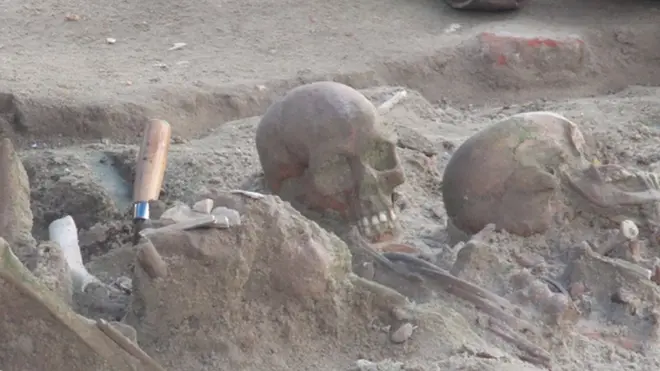
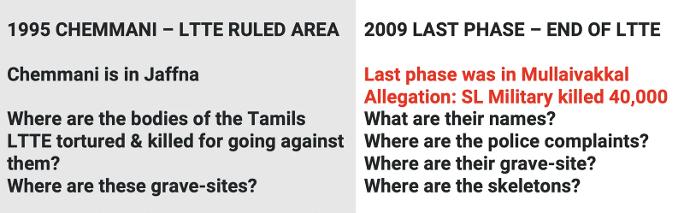
Before Chemmani is turned into an international symbol, one question must be answered: Why is the history of Jaffna under LTTE control missing from the conversation? Chemmani is located in the Jaffna peninsula — an area where for years the LTTE exercised extensive control. This was not an area where the LTTE was absent.
It was an area where the LTTE operated:
· military bases,
· intelligence networks,
· interrogation centres,
· detention facilities,
· courts,
· administrative structures,
· banks/currencies
· and cruel systems of punishment against Tamils.
Thousands of Tamil civilians lived under LTTE authority.
· Some supported the LTTE.
· Some feared the LTTE.
· Some opposed the LTTE.
· Some disappeared under LTTE rule.
Their families have a right to ask:
Where are our missing?
Could it be our missing in Chemmani?
The Question nobody wants asked
If Chemmani represents people who disappeared during the conflict years, then the investigation cannot begin and end with one assumption.
The questions must include:
· Were all missing persons in Jaffna victims of the State/military?
· Or were they victims of the armed group that controlled the territory?
· Where are those taken by the LTTE for interrogation/torture & killed?
· Where are those accused of collaborating with the government?
· Where are those who opposed LTTE ideology?
A genuine investigation must follow every missing person — not only those whose stories fit a particular political narrative.
Chemmani and the LTTE Detention System
During LTTE control of Jaffna, the organisation maintained an internal security apparatus.
Those accused of:
· dissent,
· betrayal,
· assisting the security forces,
· opposing LTTE decisions,
faced detention, severe interrogation and even death.
Where are these dead bodies of Tamils killed by LTTE?
Many Tamil families have spoken about relatives who were taken away and never returned. Nobody dared ask where are their family members buried.
Their grief is no less real because the perpetrator was not the State.
The perpetrators was the LTTE – who presented to the world that they were the sole-representative of Tamils.
No group aspiring to be a representative of their own goes and kills their own.
The Testimony of LTTE Victims cannot be erased
The account raised by Arun Siddharth and his wife brings forward another dimension of Chemmani.
Their argument is that the story of Jaffna cannot be separated from the years when the LTTE exercised power.
His wife has spoken about her own family’s experience, including the killing of her father by the LTTE in a detention setting.
Whether investigating Chemmani, disappearances or any conflict-era grave site, these testimonies raise an essential question:
Can truth exist if the victims of the LTTE are excluded?
The Map Matters
Look at the map.
Chemmani is in Jaffna.
The final battles of 2009 occurred in Mullaitivu.
Between these two locations lies more than a decade of history.
A person carrying a placard connecting Chemmani directly to Mullivaikkal must answer:
What forensic evidence connects these graves to 2009?
Not emotion.
Not political messaging.
Evidence – where is the evidence.
A Grave Does Not Carry a Political Label
A skeleton does not reveal:
· ethnicity,
· political affiliation,
· military association,
· or perpetrator.
Only science can.
The age of the remains.
The cause of death.
DNA identification.
Witness testimony.
Historical records.
All must be examined.
So far we have been hearing of 40,000 killed by Sri Lanka’s military – not a skeleton has been found to date. This says much!
The Uncomfortable Question
If international delegations visit Chemmani today, will they also listen to:
· Tamil families whose loved ones disappeared under LTTE control?
· families of political opponents eliminated by the LTTE?
· victims of LTTE detention facilities?
· civilians targeted because they refused LTTE demands?
Or will Chemmani become another place where some victims are remembered and others are deliberately forgotten?
Chemmani must not become a monument for selective memory.
If the purpose is justice, then every victim matters.
If the purpose is truth, then every perpetrator must be examined.
The dead deserve justice.
But justice demands the whole story.
For years, one of the most repeated allegations against Sri Lanka has been that 40,000 civilians were killed during the final phase of the conflict in 2009.
Seventeen years have now passed since the end of the war.
Yet fundamental questions remain.
· Where is the forensic evidence supporting that specific claim?
· Where are the identified victims?
· Where are the corresponding skeletons or mass graves linked to the final phase of the conflict?
· How many police complaints were lodged identifying these alleged victims?
· How many cases before the relevant authorities establish that these individuals disappeared during the final months of the war?
Note: they must be proven civilians – not LTTE (in uniform or civilian clothing)
Instead, international attention has now shifted to Chemmani—a site historically associated with events from the 1995–1996 period in Jaffna where LTTE ruled.
This raises an important question.
· Why is a grave site connected to the mid-1990s being invoked in discussions about the final phase of the war in 2009?
· is a new narrative being constructed to compensate for the inability to substantiate earlier claims of 40,000 killed?
These are legitimate questions that deserve answers.
But history cannot be rewritten by collapsing different periods of the conflict into a single narrative.
· Chronology matters.
· Location matters.
· Territorial control matters.
· Forensic science matters.
· Most importantly, truth matters.
If Chemmani is to become a symbol of justice, then let it be a place where every victim is identified, every line of inquiry is pursued, and every possible perpetrator is investigated based on evidence—not politics.
The search for truth must never become the search for a convenient narrative.
Who is constructing these narratives—and for what purpose?
BY Shenali D Waduge


