Fifty years ago, in August 1976, Colombo hosted the fifth Non-Aligned Movement (NAM) Summit. The summit’s declaration embodied the Bandung Spirit, and its resolve for peace, sovereignty, and development in the Third World. Among the many points of emphasis was the militarisation of the Indian Ocean during the Cold War. In 1971, Sri Lanka had succeeded in pushing for the UN Declaration of the Indian Ocean as a Zone of Peace. The peace zone proposal, therefore, loomed large in the final declaration of the fifth NAM summit.
The conference highlighted the concern that as a result of recent developments, the Indian Ocean area could become the main focus of great power rivalry in Asia. Such a development would lead to tension and conflict in the Indian Ocean through growing great power competitions for naval superiority in the area. In these circumstances, it is imperative that the Indian Ocean Peace Zone (IOPZ)Proposal be implemented with the least possible delay as a contribution to international peace and security.
The proposal was never implemented. The US military bases in Diego Garcia, just South of Sri Lanka, have been a launch pad for US wars of aggression against Afghanistan, Iraq, and most recently Iran. On March 4, US submarines torpedoed the unarmed Iranian vessel IRIS Dena in Sri Lanka Exclusive Economic Zone, killing at least 80 sailors who were returning home after participating in naval exercises in India. Neither the Indian nor the Sri Lankan Government had the strength to condemn this unprecedented act of aggression, which has turned what should be a zone of peace into a zone of war. What the Sri Lankan side could do was to rescue the survivors, provide safe haven for a second ship IRIS Bushehr, and ensure the safe passage for the sailors to return home.
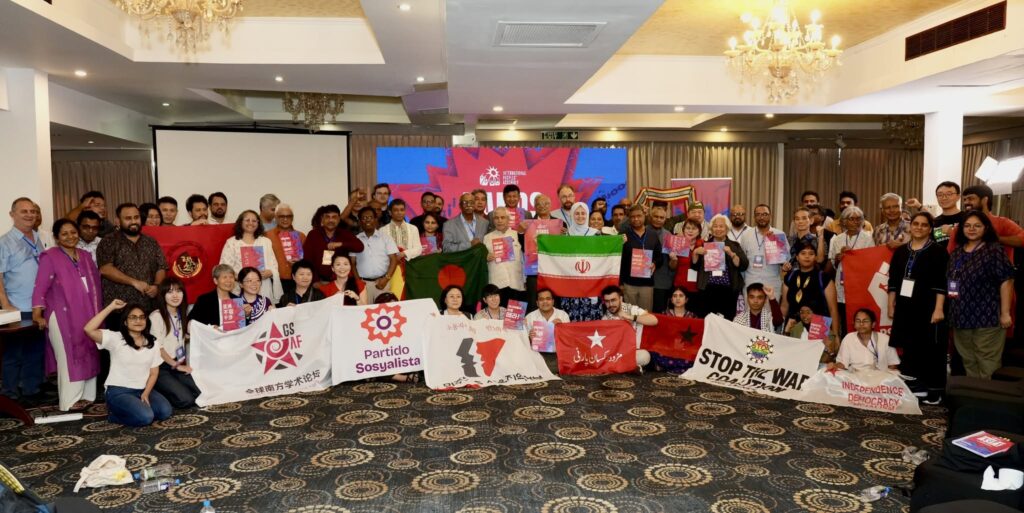
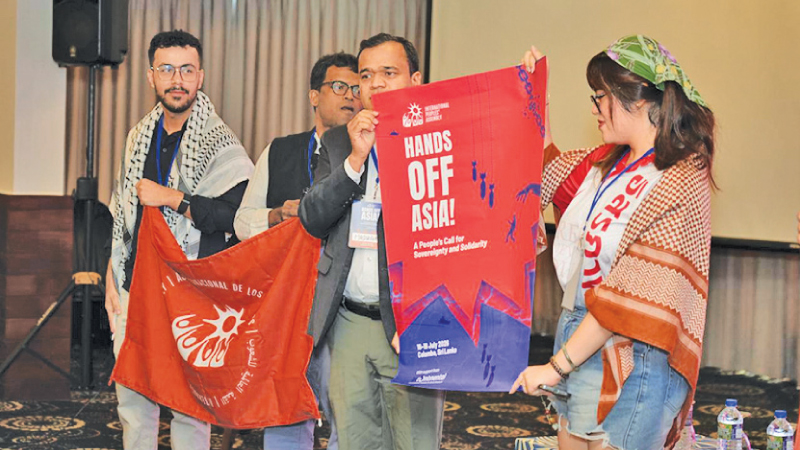
In the backdrop of the US war on Iran, and just a month ahead of the anniversary of fifth NAM summit in Colombo, over 80 delegates representing over 40 organisations from 15 countries across Asia gathered in Colombo for ‘Hands Off Asia: A Peoples Call for Sovereignty and Solidarity’ – a conference organised by the International Peoples’ Assembly (IPA) with the support of Tricontinental: Institute for Social Research. Over three days, from July 16–18, movement leaders, diplomats, and intellectuals deliberated and debated the issues that define the present conjuncture in Asia – from debt to militarisation.
Advancing but ‘not yet’ advanced Asia
The Hands Off Asia conference was historic for a few reasons. First, it was the first meeting of IPA Asia in eight years (the last meeting was held in Dhaka, Bangladesh in 2018). Much has changed since in the global conjuncture, especially in South Asia. In 2018, the Prime Minister of Pakistan was Imran Khan, the Prime Minister of Bangladesh was Sheikh Hasina, and the communists held a comfortable and seemingly immovable majority in Nepal’s Parliament.
In the time that has passed, Imran Khan was arrested and now is languishing in jail, Sheikh Hasina was forced to resign and now lives in exile in India, the Nepali communists were routed in the recent elecwtions following the so-called ‘Gen Z’ phenomenon. Only the right-wing Government of Prime Minister Narendra Modi has survived in South Asia, though even this has come under strain following an outburst of youth and student-led protests. Across South Asia, the air is heavy with expectation as a generation waits for their lives to begin. Politics churns but economics remains stagnant as the case of Sri Lanka exemplifies.
Second, the Western flank of Asia is in an active state of war, a direct consequence of US imperialism and Zionist aggression in the region. Since October 2023, Israel has conducted what can only be described as a genocide in Gaza, killing over 70,000 people and injuring multiples more including children. That genocide has expanded in scope with Israeli strikes targeting Southern Lebanon, Syria, and Iran – all with the backing of the United States and Europe.
The conflagration has also revealed the limits of US-led imperialism and Zionism – it can mobilise destructive power to level cities and infrastructure, but it cannot achieve its political goals and build stable political alternatives. The Palestinian, Iranian, and Yemeni people resist. The comprador monarchies in the Persian Gulf States have discovered that their hosting of US military bases have made them a target in a war they cannot control.
Third, the Eastern flank of Asia has reached a critical mass of industrial development and regional integration. However, these countries continue to bleed their finances under dollar hegemony, tariff blackmail, and a web of military alliances. The centre of gravity of the global economy has shifted to Asia, with China’s full spectrum industrial chain acting as an integrator.
But trade partners such as Japan, South Korea, and the Philippines are caught in a double bind, as the US forces them to divert more and more resources towards military build-up to encircle and isolate China. The weaponisation of the access to the US dollar and the US consumer market has revealed the weakness of local elites, and the speed at which their patriotism collapses under economic sanction. The narrative of the rise of Asia is by no means guaranteed without protracted peoples struggle.
The Colombo Declaration
The Hands Off Asia conference is perhaps the most significant international gathering of progressive and Left forces on Sri Lankan soil in recent memory. It comes at a crucial conjuncture, with Sri Lanka under the helm of a Government with a Left-wing party, but hemmed in by an aggressive and unpredictable US-led imperialism and an international financial architecture of debt and austerity. The conference featured participation from a range of local organisations including the Janatha Vimukthi Peramuna (JVP), the Communist Party of Sri Lanka, the Democratic Left Front, the Frontline Socialist Party, and the Free Palestine Movement Sri Lanka.
The innovation of the Hands Off Asia campaign is that it is not only about military bases and wars, but about economic coercion, political intervention, and ideological control (what Tricontinental: Institute for Social Research calls brain capture). It is not only about political sovereignty, but about economic and intellectual sovereignty. It is not only about State-to-State cooperation, but solidarity between peoples.
The following is the text of the Colombo Declaration, which was read out at the closing session of the conference:
Gathered in Colombo for ‘Hands Off Asia: A People’s Call for Sovereignty and Solidarity’, a conference organised by the International Peoples’ Assembly (Asia) and supported by Tricontinental: Institute for Social Research, we – representing movements, political parties, trade unions, and people’s organisations from 15 countries across Asia – commit ourselves to a single call that echoes across our continent:
Hands Off Asia, which means:
Militarily.
Hands off our seas. Hands off our lands. Hands off our skies.
No US or allied military bases on our sovereign territory. No AUKUS. No Quad. No war on Iran. No genocide in Palestine.
An end to the encirclement of Asia.
Economically.
Hands off our economies. Hands off our resources. Hands off our livelihoods.
No sovereign debt bondage. No IMF conditionalities. No tariff coercion. No technology blockades.
The right of Asian peoples to build economies of our own choosing.
Politically.
Hands off our politics. Hands off our elections. Hands off our movements.
No regime change or far-right proxies.
The right of Asia’s peoples to determine our own political future.
Ideologically and culturally.
Hands off our histories. Hands off our media. Hands off our imagination.
No colonisation of the ways we know ourselves and each other.
The right of Asia’s peoples to tell our own story and build our own peoples’ culture.
The enemy is one and indivisible. So must our answer be. We commit to peoples’ solidarity across the continent – towards the sovereignty, peace, and socialist horizon our peoples have always fought for.
The future of Asia will be decided by its peoples. Hands off Asia!
————-
Writers –
Atul Chandra and Tings Chak are co-coordinators of Tricontinental Asia.
Shiran Illanperuma is a researcher at Tricontinental Asia.


