
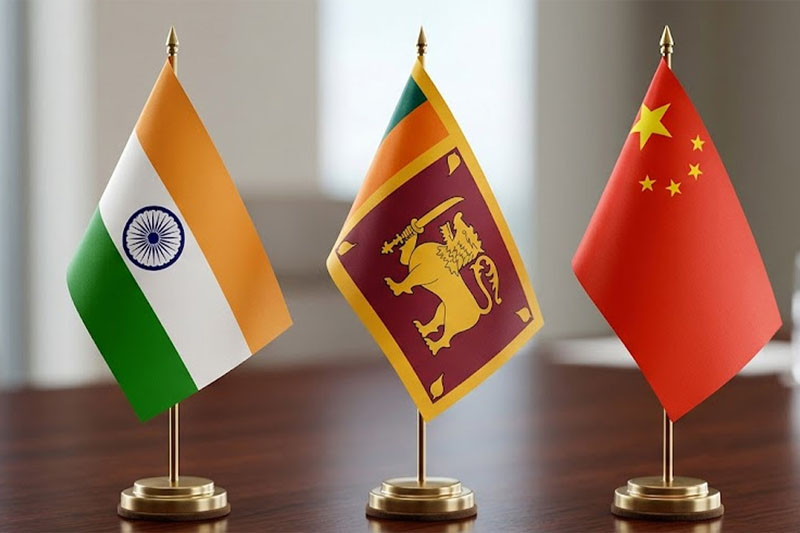
For decades, Sri Lanka’s Northern and Eastern provinces represented a region where external influence followed a familiar pattern.
India’s role was deeply connected to history, politics and community-level engagement, while China’s involvement remained largely centered in Colombo through infrastructure projects and government-to-government relations. That established geography is now evolving, with Beijing slowly extending its attention towards areas where India has traditionally held stronger influence.
The shift does not represent an immediate challenge to India’s longstanding position. Instead, it reflects a broader transformation in Sri Lanka’s strategic environment, where multiple powers are increasingly seeking relevance in regions once viewed primarily through a domestic political lens.
India’s influence in the North remains anchored in decades of involvement. The legacy of the Indo-Lanka Accord, the debate surrounding provincial autonomy and the continuing importance of the 13th Amendment have ensured that New Delhi remains closely associated with questions of governance, reconciliation and political expectations among communities.
Beyond diplomacy, India’s presence has been reinforced through practical initiatives. Housing assistance, railway reconstruction, educational links, religious exchanges and fisheries-related engagement have created sustained connections that operate beyond official state relations. This long-term involvement has given India a level of familiarity and acceptance that cannot easily be replicated through short-term initiatives.
China’s approach has developed differently. During and after Sri Lanka’s civil war, Beijing’s relationship was largely centred on the national government, providing diplomatic support and later expanding its role through major infrastructure investments. Projects linked to ports, highways, energy and urban development transformed China into an important economic partner for Colombo.
However, this influence was historically concentrated around national-level decision-making rather than local engagement. In the Northern and Eastern provinces, China had limited visibility in political discussions, community interactions and regional development conversations.
That pattern is gradually changing. Chinese diplomatic outreach, visits to northern areas, engagement with local representatives and interest in sectors such as fisheries, energy and connectivity indicate a move towards a wider regional presence. Although these efforts remain limited compared with India’s established network, they reveal Beijing’s recognition of the strategic value of the region.
The changing importance of the North is closely linked to its evolving economic and maritime role. Mannar’s renewable energy potential, Kankesanthurai harbour development, Palaly airport connectivity and possible transport links with southern India are reshaping perceptions of the province. The East, particularly Trincomalee, adds further strategic significance due to its harbour, energy potential and location along major maritime routes.
At the same time, ocean research and maritime data collection have become new areas of competition. Modern influence is no longer measured only through ports or military presence but also through knowledge of seabed resources, shipping routes and marine ecosystems.
For local communities, these geopolitical shifts are becoming visible through everyday concerns, especially in fisheries. Disputes involving Indian fishing vessels have highlighted how local livelihood issues can become connected to wider regional rivalries.
Sri Lanka’s North is therefore entering a new strategic phase. The emerging reality is not a simple contest between India and China but a more complex environment where different forms of influence overlap. The challenge for local leaders and policymakers will be managing these competing interests while ensuring that regional development remains connected to community priorities.
Source-The Leader


