
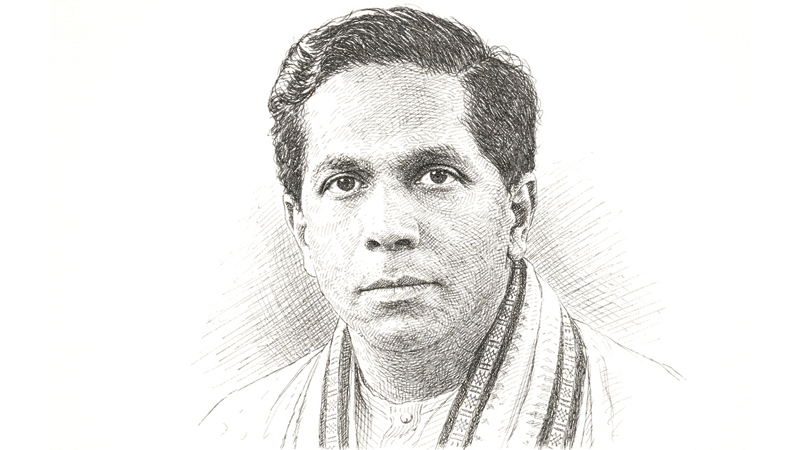
(On the occasion of the 125th birth anniversary of Mr. S. A. Wickramasinghe)
———————————————————————————————————————
April 13 marked the 125 birth anniversary of S.A. Wickramasinghe, a national freedom fighter and founder of the Communist Movement in Sri Lanka. Wickramasinghe remains a pivotal, if somewhat underrated, figure in the pantheon of the first generation of Sri Lankan national and leftist leaders.
Stories of Wickramasinghe’s politicisation often begin with his experiences of 1915 riots at the young age of 14. Wickramasinghe was appalled by the brutality with which the colonial administration treated the Sinhalese. But at the same time, he organised fellow students at his school Mahinda College to protect Muslim students from reprisals by the Sinhalese.
Like many South Asian anti-colonial nationalists of his generation, Wickramasinghe’s stint of higher education in England was formative.
During his time in England, Wickramasinghe moved with figures from the Indian freedom struggle as well as the British Communist Movement – these included India’s Defence Minister Krishna Menon (with whom Wickramasinghe shared the position of Joint Secretary of the Indian Majlis), Communist journalist and theoretician Rajani Palme Dutt, Communist politician Shapurji Dorabji Saklatvala, and Harry Pollitt who served as General Secretary of the Communist Party of Britain from 1929 to 1939.
Crucially, Wickramasinghe also met Doreen Young in England, who he later married. Doreen was a formidable socialist and anti-imperialist in her own right. After her arrival in Sri Lanka, she promoted the national culture leading the Suriya Mal Movement and later got elected to the Parliament.
Morawaka Ata Massa
Wickramasinghe’s political career precedes the foundation of the Lanka Sama Samaja Party (LSSP) by four years. He was elected to the Ceylon State Council from the Morawaka seat in colonial Ceylon’s first elections in 1931. Given the fact that Sri Lanka was the first country in Asia to receive universal franchise, it is possible that Wickramasinghe was the first democratically elected socialist politician in all of Asia.
In the 1931 State Council election, Wickramasinghe was one of two Mahinda College graduates that were elected, the other being H.W. Amarasuriya from the Udugama seat. A story goes that during a felicitation event at Mahinda College, the contrast between Wickramasinghe, clad in simple white national dress, and Amarasuriya, clad in full Western coat and hat, caused quite a debate.
In these years, Wickramaisnghe campaigned on a range of issues, including the use of vernacular in rural courts and helping lead an anti-malaria relief campaign when the colonial administration had neglected rural society. Sarath Muttettuwegama had said that Wickramasinghe’s activism in the State Council earned him the ire of rightists like D.B. Jayatilleke, who dubbed Wickramasinghe the Morawaka atamassa (gadfly).
Alongside his duties as an elected representative, Wickramasinghe also served as General Manager of the BuddhistTheosophical Society schoolsfrom 1931.
Wickramasinghe represented an almost lost tendency of anti-colonial and anti-communal nationalism that was nonetheless able to appreciate the civilisational contributions of the Sinhala Buddhist Society. Even decades after the founding of the Ceylon Communist Party, he was able to give complicated figures such as Anagarika Dharmapala and A.E. Goonesinha their due credit, while recognising the need to push forward.
The way ahead
Despite being the first democratically elected socialist politician in Sri Lanka, Wickramasinghe never occupied major Government positions like his peers Philip Gunawardena (who was Minister of Agriculture), N. M. Perera (who was Minister of Finance), or even his fellow Communist Pieter Keuneman (who was Minister of Housing and Local Government).
Though Wickramasinghe did not leave behind any buildings or monuments with his name, he left something far more valuable: an analysis of the colonial plantation economy, its contradictions, and an outline for an alternative economic policy.
The Way Ahead: An Economic Policy for Ceylon was published under Wickramasinghe’s name in 1955. The roughly 50-page pamphlet provided what is possibly the most comprehensive analysis from the left of the structure and limitations of the colonial plantation economy.
The text should be contextualised in its conjuncture. Commodity prices had collapsed following the end of the United States’ war on Korea, resulting in a decline in Sri Lanka’s terms of trade. The 1953 Hartal had shaken the United National Party Government, with the resulting momentum favouring the Left and the Sri Lanka Freedom Party. Finally, the Soviet Union and China were consolidating agrarian reform and large-scale industrialisation in the 1950s.
The breadth of the text is remarkable, with 17 chapters on topics ranging from the character of the ruling class, the structure of plantation economy, the agroecological disasters resulting from soil erosion, a survey of Sri Lanka’s natural resources, and a critique of Western-backed development projects.
Despite the breadth of analysis, the focus is razor sharp, depicting that Sri Lanka’s economic crisis is structural and colonial in origin, and cannot be remedied through piecemeal policies and foreign aid. Three recurring diagnoses of the text remain relevant today.
First, that the plantation economy – now supplemented by tourism, remittances, and low-value added manufacturing – is the root cause of underdevelopment. Second,that the domestic capitalist class are primarily comprador rentiers and not entrepreneurial industrialists. Third, that a State-led program, with technical and financial assistance from anti-hegemonic states, is necessary to break the ‘paralysing inertia’ of a colonial economy.
Pulse of the people
Many episodes of S. A. Wickramaisnghe’s political career remain under-researched. His contributions to a sovereign pharmaceutical policy, in collaboration with pharmacologist Senaka Bibile (an LSSP member), is one example. The 1971 Bibile-Wickramasinghe report, commissioned by then Prime Minister Sirimavo Bandaranaike, was key to the establishment of the State Pharmaceutical Corporation.
Much of the planning for the report was at Wickramasinghe’s home in Bawa Place, Borella. The report helped introduce the concept of ‘essential drugs’, later adopted by the World Health Organization. Wickramaisnghe’s political backing was pivotal for Bibile to advance the argument that essential drugs should be sold under generic chemical names to smash the profiteering by pharmaceutical corporations.
Wickramasinghe cuts an interesting figure in the history of the Sri Lankan freedom struggle and the Communist Movement. In the few pictures that remain of him, he presents a serene almost Buddha-like composure.
He is not really remembered for fiery speeches, technocratic statecraft, or scholarly contributions of high-theory. He stands rather, as a figure of humility and compassion – a Communist with Sri Lankan characteristics.
N. Sanmugathasan, who led the pro-Beijing faction during the 1964 split in the Ceylon Communist Party, described Wickramasinghe as a ‘pragmatist’ who was ‘able to feel the pulse of people correctly’. Premalal Kumarasiri, another leader of the pro-Beijing faction, called Wickramasinghe the person who came nearest to the designation of ‘Father of Socialism’ in Sri Lanka.
Wickramasinghe also deeply affected and influenced the political-economic outlook of JVP founder Rohana Wijeweera. In fact, Wijeweera’s critique of the plantation economy is in some ways a continuation of the analysis in The Way Ahead.
With the relative decline of the LSSP and its derivative tendencies in mainstream politics today, much of the actually existing Left in Sri Lanka descends directly from the line that Wickramasinghe began. Branches have diverged, but the root remains – and so does the task of building economic sovereignty.
(The writer is a Sri Lankan journalist and political economist. He is a researcher at the Tricontinental: Institute for Social Research and a co-editor of Wenhua Zongheng: A Journal of Contemporary Chinese Thought. He is also a visiting lecturer at Bandaranaike Center for International Studies.)
Quote – Sunday Observer
April 19, 2026


