
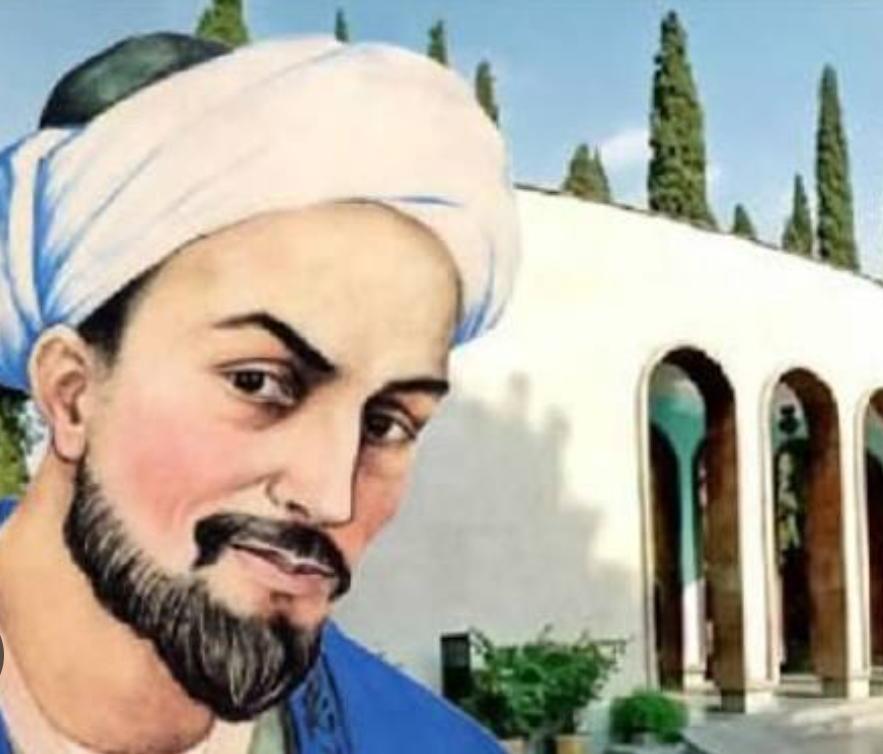
(On the occasion of Saadi Shirazi Memorial Day, which falls on April 21st)
————————————————————————————————————-
He was a poet, a writer, and an outstanding thinker—an intellectual giant whose name alone is recognized across the world of literature. He is one of the few Iranian scholars whose fame has spread beyond the Persian-speaking world and the borders of Iran. He is Saadi of the beautiful city of Shiraz, also known as Muslih al-Din Abdullah Saadi Shirazi.
Saadi was born in Shiraz in the early 7th century Hijri, around 1207–1209 CE. In his own words, he was born into a family in which all members were devoted to religious and moral principles.
His childhood and early youth were spent in his hometown of Shiraz, where he gained a foundation in the knowledge and sciences of his time.
Later, he traveled to Baghdad for higher education, where he studied at the Nizamiyya. He spent more than twenty years there, deeply engaging in the study of theology and literature. After completing his studies, he embarked on a long journey of travel.
He traveled through Iraq, Syria, and North Africa. According to some accounts, during these journeys he also visited India and Azerbaijan. Through these travels, Saadi not only gathered a wealth of valuable experiences, but also had the opportunity to meet great figures such as Jalal al-Din Rumi, Shams Tabrizi, Sheikh Safi al-Din, and Amir Khusrau.
Driven by his deep love for his homeland, he eventually returned to Shiraz around the middle of the 7th century Hijri, corresponding to the 13th century CE.
Drawing from both his formal education and the rich experiences he gained during his travels—along with the diverse individuals he encountered—he presented his knowledge in two major works. One of them is Bustan (“The Orchard”), published in 655 AH, and the other is Gulistan (“The Rose Garden”), completed in 656 AH.
Thereafter, he spent the latter part of his life in a more ascetic and contemplative manner. During this period, he produced many other literary works, including ghazals (lyric poetry), mavā‘iz (moral sermons), marsiya (elegies), rubaiyat (quatrains), and qasidas (panegyric odes), composed in both Persian and Arabic.
As one of the greatest poets in Persian literature, Saadi’s works have inspired people across the world for centuries. He was not merely a poet, but also a philosopher, a traveler, and a profound observer of human nature. Although his writings were composed centuries ago, their meaning and relevance remain fully applicable even in the 21st century.
At the core of Saadi’s works lies a deep understanding of human behavior, ethics, and social responsibility. His writings emphasize timeless values such as compassion, justice, devotion, and wisdom.
In today’s world—where technology is rapidly advancing, global connections are expanding, and cultural diversity is increasing—Saadi’s principles offer meaningful guidance for addressing modern challenges. His insights provide a moral and human-centered framework that remains highly relevant in navigating the complexities of the 21st century.
Saadi Shirazi was a person who was consistently admired and respected by others. He excelled equally in both eloquent speech and literary mastery. People from all walks of life, regardless of social status, praised his virtues. His poetry and sayings spread across the world, and he himself often referred to the fame and recognition he received through them. The following are a few instances where he expressed this:
“ *Never has there been a gathering*
*Across the seven regions of the world* ,
*Where the verses and sayings of Saadi*
*Have not echoed in every land* .”
“ *You know well these words of mine*
*That attracts the people of the world* ,
*Just as musk draws attention* ,
*Carried from China by a trader* .”
“ *If my name has become renowned*
*Across the world for my scholarship,*
*It is only because your name*
*Has always remained upon* *my lips* .”
Saadi Shirazi became renowned not only in his homeland but across the entire world due to his virtue, wisdom, and insight
*“As a ship sails toward* *distant Khurasan* ,
*His verses spread throughout the world* ,
*Flowing and dispersing everywhere* ,
*Like a stream of water in motion* …”
Saadi was not merely a powerful and unmatched poet; he was also a scholar endowed with profound wisdom in religious studies, ethics, philosophy, and social thought. His works, which remain available even today, stand as valuable testimony to his vast knowledge. He presented these ideas through strong moral teachings, instructive stories, lyrical poetry, and panegyric compositions. The manner in which he expressed them clearly demonstrates his mastery of these subjects.
Composing works of such excellence is no easy task. Yet Saadi succeeded in presenting them in a simple, elegant, and engaging language that could be easily understood by all.
Among his many works, Bustan and Gulistan are the most famous. From the time they were written up to the present day, they have been used as educational texts in Persian-speaking regions and have been translated into nearly all living languages of the world.
The following is a famous passage from the Gulistan
“ *Never shall this garden*
*Fall prey to the passage of time* ,
*Nor be scattered by the autumn wind* ,
*Nor turn into sorrow—*
*This beauty shall endure* …”
*“This joy and delight* ,
*As long as Persian literature lives* ,
*Will continue to bear flowers and fruits* ,
*Forever and ever* …”
The Gulistan and Bustan can be seen as comprehensive guides that present both worldly knowledge and spiritual wisdom. In these works, Saadi Shirazi conveys the essence of his reflections drawn from self-examination, ethical principles, religious teachings, and a deep understanding of human character. With a balanced and moderate perspective, and by using expressions that clearly communicate intended meanings, he presents these ideas in a captivating and engaging manner.
Saadi not only showed deep respect for religious principles, but also stood firmly against injustice and narrow-mindedness this being a defining trait of his character. He demonstrated compassion toward all humanity, showing equal kindness to both friend and foe. He opposed no one except cruel rulers and hypocrites who exploited religion for personal gain. In this way, he acted as a messenger of peace and humanism.
In his vision of an ideal world, he regarded all human beings as parts of a single body, originating from the same essence. He recognized the profound importance of humanity and the concept of freedom, and his ultimate wish was to see divisions removed from human society, allowing all nations to live together in unity and harmony.
He also expressed deep sympathy for the weak and the helpless, emphasizing that caring for them is the responsibility of kind-hearted individuals and reformers—as reflected in the following words
*“O Saadi* …
*There is no end to the* *sweetness*
*Within your garlands of words* ;
*Your wisdom overflows*
*Like the song of a bird* .
*The birds you have inspired to sing*
*Fall silent and still* ,
*Humbled to the ground*
*If you do not care*
*For the suffering of others* ,
*You have no claim*
*Even to humanity…”*
One of the most famous teachings of Saadi Shirazi is the idea that “human beings are like parts of a single body.” This message has become globally recognized and remains deeply relevant today. In the 21st century where wars, inequalities, and social divisions still persist Saadi’s vision of unity with mankind to be more empathetic toward one another and to work collectively for peace.
His works also offer profound lessons on leadership and governance. Through the stories found in the Gulistan, he clearly illustrates that justice, responsibility, and honesty are essential qualities for any leader. In today’s political and corporate worlds, these values are more important than ever. According to Saadi’s philosophy, power should be exercised with wisdom and compassion. True leadership is not merely about authority, but about serving others with fairness, understanding, and moral integrity
Furthermore, Saadi Shirazi’s views on education remain highly relevant today. He believed that acquiring knowledge alone is not enough it is equally important to use that knowledge for the benefit of society. In today’s technological world, where information is easily accessible, Saadi’s perspective guides us to apply knowledge wisely and responsibly.
Saadi also paid deep attention to human relationships and communication. His works emphasize the importance of speaking to others with kindness, respect, and understanding. In an age dominated by social media and digital communication, these lessons are especially valuable.
Moreover, Saadi’s ideas about simple living hold great significance for modern society. He warned against excessive greed and materialism, encouraging a calm and balanced way of life. In today’s world—marked by intense economic competition and the pursuit of material comfort—his teachings offer a path toward inner peace and mental well-being.
Saadi’s works are not confined to the past; they remain a living guide for the present world. Within the pages of his books lies a timeless wisdom that continues to illuminate our path. His ideas on humanity, ethics, leadership, and relationships are profoundly relevant even in the 21st century.
If we read and reflect upon these works repeatedly, and apply their teachings to our lives, we can cultivate the mindset needed to build a peaceful, just, and compassionate world. There is no doubt that Saadi’s poetry and literary contributions hold a distinguished place in world literature, and that his noble thoughts, humanistic values, and eloquence have touched all of humanity.
Indeed, the natural brilliance of this great thinker and poet has left a lasting impact not only on Persian literature but also on the literary traditions of both Iranian and non-Iranian poets and writers. His name is inscribed—indelibly—among those immortal figures who are remembered across all ages of the world.

By Zamaa Shifani


