
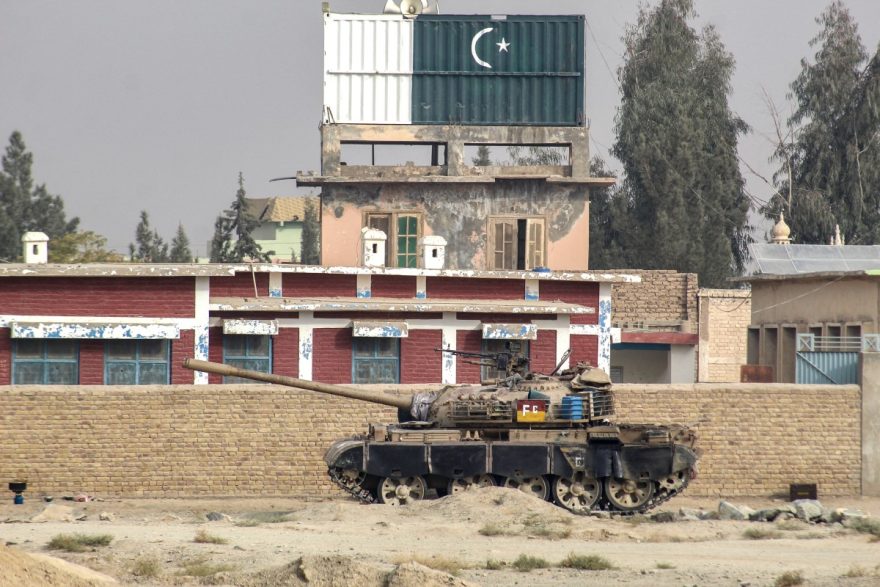
(Photo by Abdul BASIT / AFP)
Renewed violence along the Afghanistan–Pakistan border in recent months has underscored not only the fragility of relations between Kabul and Islamabad, but also the constraints facing China’s role as a regional diplomatic actor. Exchanges of fire near major crossings, Pakistan’s airstrikes that resulted in civilian casualties inside Afghanistan, Kabul’s retaliatory responses, and repeated border closures mark a departure from the sporadic incidents of previous years. What has emerged instead is a more entrenched cycle of escalation, with both sides attempting to assert red lines along the disputed Durand Line.
At the core of this confrontation lies a structural impasse that has resisted external mediation. Pakistan continues to demand that the Taliban authorities take decisive action against the Tehreek-e-Taliban Pakistan (TTP), which Islamabad says operates from Afghan territory. The Taliban, for their part, have either been unwilling or unable to meet the scale of enforcement Pakistan seeks. Any large-scale crackdown risks internal fragmentation within the Taliban, whose cohesion depends on a delicate balance among competing factions. From Islamabad’s perspective, however, insufficient action is interpreted as tolerance or complicity. Within Afghanistan, resistance to Pakistani military pressure has also become a rare point of nationalist consensus, particularly in relation to a border that many Afghans have historically rejected as illegitimate.
China entered this landscape with reason to believe it possessed meaningful diplomatic leverage. It remains Pakistan’s closest major-power partner and one of the few countries to have maintained consistent engagement with the Taliban since 2021. Beijing’s economic and strategic interests—ranging from the China–Pakistan Economic Corridor (CPEC) to emerging mining and connectivity projects in Afghanistan—make sustained instability along the border a direct concern. In theory, China has both access to key decision-makers and incentives to promote de-escalation. In practice, however, its impact has been limited.
Beijing’s response has largely followed a familiar pattern: calls for restraint, dialogue, and consultation among neighbouring states, coupled with expressions of readiness to play a “constructive role” if requested. Yet China has not initiated or led a substantive trilateral mechanism capable of addressing the underlying drivers of the crisis. Its preference for quiet, behind-the-scenes diplomacy has not altered the strategic calculations of either Kabul or Islamabad. Violence has persisted, grievances have deepened, and China’s engagement has remained largely declaratory rather than transformative.
One key limitation of China’s approach lies in its state-centric assumptions. Beijing tends to treat both the Taliban leadership and Pakistan’s security establishment as coherent actors capable of implementing commitments once agreements are reached. This perspective underestimates the internal dynamics shaping decision-making on both sides. The Taliban’s governance structure is fragmented and continuously negotiated among rival networks with differing priorities. Pakistan’s military establishment, meanwhile, is not merely a mediator in the crisis but an active participant. These realities complicate efforts to “manage both sides” through traditional diplomatic engagement, as neither party operates as a single, unified actor, nor views China as a neutral guarantor.
A second constraint is China’s reluctance to deploy incentives or pressures at a scale that could meaningfully influence elite decision-making. Beijing has been cautious about offering political recognition or significant economic inducements to the Taliban, just as it has avoided publicly challenging Pakistan or conditioning strategic support. When close partners face criticism or security pressure, China’s instinct has been to shield them from reputational costs rather than to exert restraint. While understandable within the logic of alliance politics, this posture has limited China’s credibility as an impartial mediator, particularly in the eyes of Afghan authorities, who view Beijing’s neutrality as conditional.
The most significant challenge, however, is structural. China is attempting to facilitate stability in a conflict where its closest regional ally is also a central actor. Effective mediation requires a degree of distance—both perceived and real—from the parties involved. Pakistan’s cross-border strikes, coercive border policies, and military posture toward Afghanistan place China in a difficult position: balancing its strategic partnership with Islamabad while presenting itself as a stabilizing force. This perceived imbalance shapes how Chinese diplomacy is received in Kabul and constrains its effectiveness in a dispute where questions of sovereignty and legitimacy remain highly sensitive.
Together, these factors illustrate the limits of China’s ability to prevent escalation in the Afghanistan–Pakistan context. Beijing retains influence, but not the kind required to resolve conflicts driven by deep-seated security anxieties, non-state armed groups, and unresolved border disputes. While it has access to decision-makers, access alone cannot substitute for a diplomatic strategy willing to apply pressure, assume risk, and engage with the political realities on the ground. Stability, in this case, is not a shared objective but a contested one, shaped by divergent threat perceptions and unequal bargaining power.
The Afghanistan–Pakistan standoff thus offers a clearer view of China’s diplomatic ceiling. It highlights Beijing’s effectiveness in financing infrastructure, sustaining political partnerships, and offering strategic insulation to allied governments, while also revealing its limitations when conflict management requires confronting allies, engaging fragmented actors, or navigating nationalist politics resistant to transactional solutions. Unless China reconsiders the assumptions underlying its regional diplomacy—moving beyond quiet mediation and the expectation that economic logic alone can ease political conflict—it is likely to remain a prominent regional actor, but not the stabilizing force many have anticipated.
Disclaimer: The views expressed in this analysis are those of the author and do not necessarily reflect the editorial position of Khaama Press.
Source -The Khaama Press News Agency


