
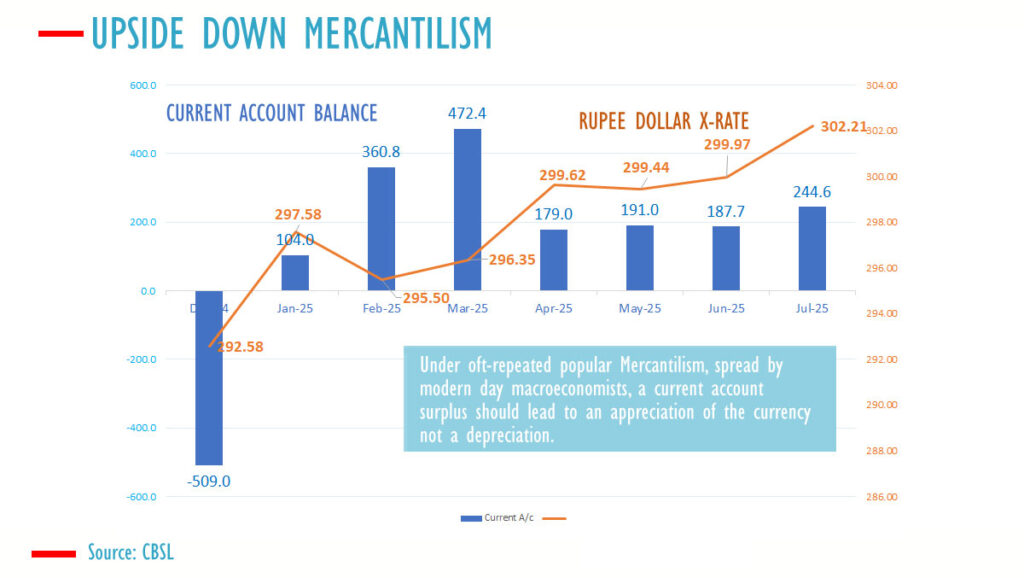
State-run Sri Lankan Airlines groups has made a group net loss of 12.6 billion rupees up to August 2025, up from 4.2 billion rupees a year ago due to a large forex loss, a Finance Ministry report said as the rupee depreciated amid current account surpluses.
SriLankan Airlines revenue grew 7 percent to 95.4 billion rupees, amid a passenger volume growth of 22 percent which boosted load factors to 82.6 percent from 76.4 percent.
But cargo revenues had fallen 1.8 billion rupees and other income fell 2.5 billion checking overall revenue growth.
Operating expenses had grown only 3 percent, with fuel prices also declining.
SriLankan had reported a loss of 4.1 billion rupees from air transport but ground handling and training revenues had helped the airline post a profit of 4.9 billion rupees before forex losses and financing costs.
Forex losses in the period were 8.5 billion rupees and the rupee depreciated in 2025.
Pre-tax losses of Sri Lanka were 15.2 billion rupees up to August 2025. compared to 7.5 billion rupees for the full year 2024.
Srilankan has large dollar debt owed to foreign bondholders and local banks, which trigger losses when the central bank depreciates the rupee.
The rupee was depreciated from around 292.58 in the spot market in December 2024 to 302.44 by end August 2025 and has since depreciated to around 308 to the US dollar.
Sri Lanka’s central bank has depreciated the rupee from 4.77 to the US dollar at its creation to around 308.
RELATED
SriLankan Airlines group loses Rs10.7bn in three months, operating losses up
Sri Lanka rupee depreciates amid record current account surplus : analysis
Sri Lanka should control the pressure on the exchange rate: President
What is wrong with Sri Lanka’s flexible exchange rate
Most of the depreciation took place after the IMF’s Second Amendment to its Articles in 1978, which allowed macro-economist to pursue un-checked inflationary policy and escape accountability critics say, even as the US and UK got inflation under control through deflationary policy.
The IMF was originally set up to prevent the depreciation of the 1930 which spread among developed nations after the invention of indiscriminate open market operations by the Federal Reserve.
Critics have pointed out that the flexible exchange rate is one of deadliest intermediate regimes ever devised by macro-economists which can depreciate a currency despite mild deflationary policy with the generation of confidence shocks and the selective denial of convertibility to private citizens.
SriLankan and other SOEs which had borrowed in US dollars made massive losses in 2022 as the rupee collapsed amid float failed by a surrender rule after aggressive rate cuts and the national debt also expanded overnight.
Meanwhile the Treasury report said accumulated losses increased to 631.5 billion rupees by August 2025.
“The Cabinet of Ministers has approved a restructuring proposal addressing the airline’s local debt obligations, enabling the conversion or deferment of selected government and state-owned bank loans,” the Finance Ministry report said.
“This measure is expected to ease liquidity pressures and improve the airline’s financial stability, while broader restructuring efforts continue to address its long-term sustainability.”
Quote- ECONOMYNEXT (Colombo/Nov20/2025)


