Vietnam is getting ready to hold the 14th Party Congress from January 14, as the country marks four decades of development and progress after the launching of Doi Moi (renewal).
Vietnam grew 8.01 percent in 2025 to an estimated 514 billion US dollars, and is now believed to be the 32nd largest economy in the world, an online portal on the Party Congress said.
Over 2021 to 2025, growth had averaged 6.1 percent, and per capita gross domestic product was 5,026 dollars, putting Vietnam among upper middle-class nations.
The Party Central Committee has followed President Ho Chi Minh’s thoughts on building a State of the people, by the people, and for the people, while drawing on the lessons of 40 years of renewal, to formulate policies with new thinking, the portal said.
Vietnam started on a new economic strategy called Doi Moi (renewal) in 1986 abandoning central planning for a socialist-oriented market economy.
The 2026 14th Party Congress is coming as the country is marking almost four decades as a market economy and the country is looking for innovation based growth.
Stability First
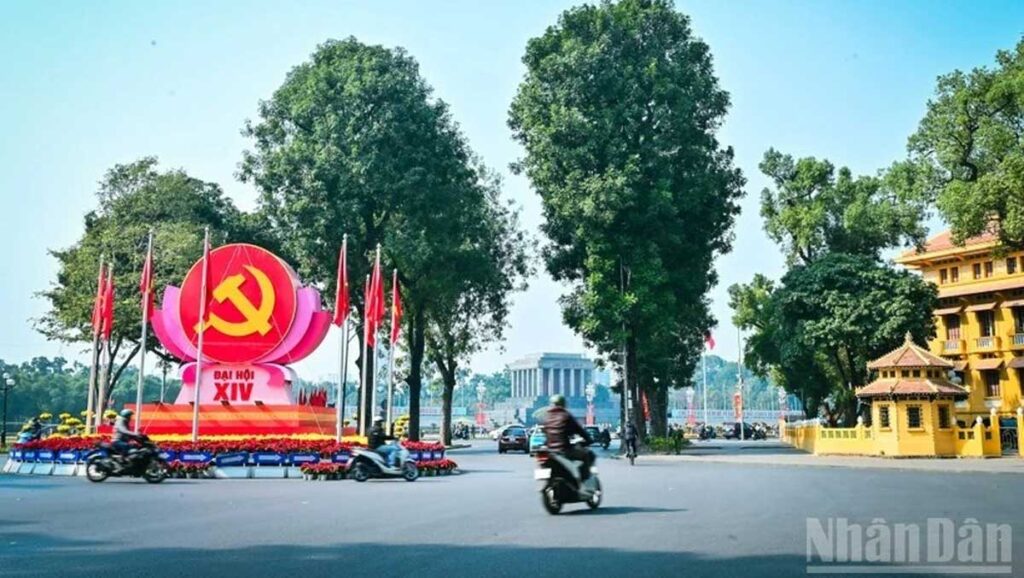
Party General Secretary To Lam has urged the Government’s Party Committee to direct the Party Committee of the Ministry of Finance and relevant agencies to prioritize macroeconomic stability and inflation control to attract maximum domestic and foreign investment for national development.
The General Secretary has called for “a proper understanding of the dialectical relationship between stability and development,” in a key speech ahead of the Party Congress.
“High growth must be built on a foundation of stability, with macroeconomic stability and the maintenance of major economic balances as top priorities,” he said.
A 16 billion dollar economy in 1985, Vietnam expanded fast after Doi Moi and contracted to 6.39 billion US dollars as the currency slid steeply, according to World Bank data.
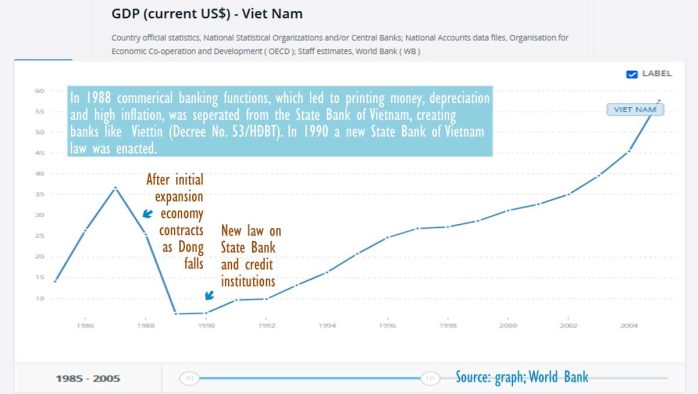
In 1988, after the Vietnam dong collapsed, commercial banking functions were separated from the central bank. A formal law reforming the State Bank of Vietnam was passed in 1990.
After stability was achieved, Vietnam started to grow as free trade agreements were signed and foreign investors came.
Vietnam is now a free trading nation where businesses have to compete with imports to give the best quality and best price for the people. Vietnamese products which can compete on its home ground can now compete anywhere in the world.
The state economy will play a guiding and enabling role, while the private sector serves as the most important driving force of the national economy, General Secretary To Lam has said.
The Party leader, who is also head of the central steering committee, had called for management and efficient use of state capital in enterprises, for mechanisms and policies for the development of an international financial centre, free trade zones, and digital assets.
Science and Technology, Lean Government
The new growth model will be driven by science and technology and a lean government.
Science, technology, innovation and digital transformation has been identified as the primary drivers of the new growth model and fundamental factors for achieving long-term double-digit growth, according to the party leader.
In 2025, Vietnam has also reformed the administrative structures to a ‘two tier’ model eliminating district administration and making the state smaller.
“At the core is a decisive shift from an administrative management mindset to one focused on service, development facilitation, and modern governance; alongside the identification of new driving pillars, including breakthroughs in the development of science and technology,” a report quoting draft congress documents said.
The reforms reduced the number of units directly subordinate to the central level by 34.9 percent; 100 percent of Party-affiliated committees and Party civil affairs committees were eliminated, administrative boundary adjustments led to a 46 percent reduction in the number of provincial-level units, it said.
The merger of commune-level administrative units reduced their number by 66.9 percent compared with the period before October 2024. From July 1, 2025, the two-tier local government model officially came into operation.
Reforms will reduce legal compliance costs and create a transparent and favourable investment and business environment for all economic sectors in accordance with the Politburo’s guidelines and directions, the portal said.
A development model driven by science and technology is not only an economic requirement, but a comprehensive strategic issue, involving improving governance, institutions,developing human capital, ensuring national defence and security, while enhancing Vietnam’s international standing, it said.
It was an indispensable path to realising the country’s goals set for 2030 and 2045, and building a peaceful, independent ,democratic, prosperous, civilized and happy Viet Nam, General Secretary To Lam had said. (Source- ECONOMYNEXT)


