
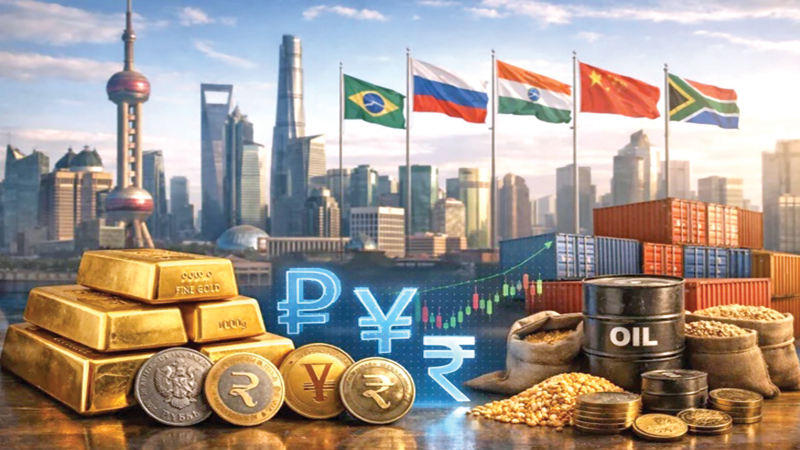
The supply chains and international relations upon which the neoliberal order was built are shifting beneath our feet. But our ideas remain frozen in the unipolar moment. There is, in a sense, a dissonance between a rapidly changing base and a stagnant superstructure – we are in a neoliberal hangover. The wave of tariffs and decapitation strikes launched by the Trump administration no doubt inspires fear and paralysis among intellectuals and policymakers – they have, as intended, stopped us from thinking.
Specific set of premises
The neoliberal order was built on a very specific set of premises. First, the United States would run a structural current account deficit to provide dollar liquidity to the Global South and hegemonise the global financial system. Second, the countries of the Global South would de-regulate their economies and abandon State intervention to allow foreign capital to lead the development process. Third, the dollars accumulated by the surplus countries in the Global South would be recycled into US Treasury Bills (and in some cases, US military hardware, civilian aircraft, and agricultural products).
This international social contract was intended to maintain US technological and financial dominance, while enabling an acceptable rate of economic growth in the periphery which would raise living standards and hinder the advance of communism and other counter-hegemonic ideologies.
That neoliberal order is being torn up by its chief architect – the United States. The trend began with the first administration of President Donald Trump which launched a trade war with China – the only country that was able to navigate the neoliberal order to achieve what the US National Security Strategy 2025 calls ‘near-peer’ status. However, we could trace this tendency even further back, to the 1985 Plaza Accord which compelled US allies France, West Germany, and Japan to appreciate their currencies against the dollar to reduce the competitiveness of their exports. The US-led neoliberal order could tolerate economic growth but not real competition.
Unlike previous US administrations, the Trump administration has been honest about the rationale behind the neoliberal order and the reasons for tearing it up. On March 18, 2025, in a speech at the American Dynamism Summit in Washington, US Vice President JD Vance said, ‘The idea of globalisation was that rich countries would move further up the value chain, while the poor countries made the simpler things… We assumed that other nations would always trail us in the value chain, but it turns out that as they got better at the low end of the value chain, they also started catching up on the higher end’. Vance was talking about China, which was the only real exception to the US assumption.
Our neighbour, India did not get this message and has deviated from its core foreign policy positions in order to cultivate closer economic links with the US. India may have expected to replace China as the main recipient of foreign investment for export-oriented manufacturing. The reality check recently came from US Deputy Secretary of State Christopher Landau at the 2026 Raisina Dialogue – India’s flagship forum on geopolitics. Landau said, ‘India should understand that we [the US] are not going to make the same mistakes with India that we made with China twenty years ago in terms of saying, “You will be able to develop all these markets, and then the next thing we know, you are beating us in a lot of commercial things”.’
In 1993, the World Bank published a report titled The East Asian Mircale: Economic Growth and Public Policy. By this time, there was already a significant literature analysing economic developments in East Asia. Chalmers Johnson published MITI and the Japanese Miracle in 1982 and Alice Amsden published Asia’s Next Giant: South Korea and Late Industrialisation in 1989. These two books laid the foundation for theories of the developmental state and industrial policy. But their findings were eclipsed by the World Bank report, which treated the success of these State-led models as exceptions to the rule, emphasising instead the importance of macroeconomic stability and pro-business policies.
Import substitution
As the developmental state literature receded into the background, the idea of the East Asian model became a spruced-up version of the standard IMF prescription. After the oil crises of the 1970s and debt crises of the 1980s had exposed the limits of import substitution, the World Bank version of the East Asian model was held up as the gold standard. Opening to capital flows from the Global North and aligning with US foreign policy were implicitly or explicitly considered necessary conditions for development. The experiences of the 1997 Asian Financial Crisis challenged this orthodoxy, but were soon forgotten in the wave of structural adjustments that followed.
For Sri Lanka, Singapore became – and still remains – the gold standard for what development should look like. But due to a misunderstanding about the facts of the East Asian model, Sri Lankan intellectuals and policymakers are often more interested in Singapore’s start-up incubators than its semiconductor foundries. We have benchmarked ourselves against a fictional version of Singapore that is purely a financial services enclave, ignoring the role of the State and the manufacturing sector. This is not just ignorance, but a sad reflection of the rentier and trading mentality of our intellectuals and business class.
There are other inconveniences of reality when squaring up to the Singapore benchmark. The fact that Singapore is a city State without a rural hinterland and the weight of 2,000 years of accumulated history and culture is ignored. The fact that Singapore has been complicit in almost every US war of aggression in Asia, from Korea to Vietnam to Iraq, is erased. For Sri Lanka to be like Singapore it would have to not only renounce its geography, history, and sociocultural make-up, but also do away with its historic commitment to the anti-colonial principles of the Non-Aligned Movement.
Ultimately, the East Asian model was never replicated outside those frontline States in the Cold War that integrated themselves under the US military umbrella and geostrategy. Most countries were not able to achieve systematic economic diversification and technology upgrading under the neoliberal order – Africa faced several lost decades of development and Latin America suffered from a prolonged deindustrialisation. The main exception has been China.
The China exception
Until recently, the narrative on China’s development was tightly controlled by Western economists. China was either a paradigmatic case study of liberalisation and the virtues or free markets or an over-invested, highly unequal, State-led economy on the verge of collapse. The reality is much more complex, as China was able to maintain double-digit growth for decades and raise 800 million people out of poverty while avoiding major recessions and retaining public ownership over land, finance, and heavy industry.
China cannot neatly be included under the East Asian model, primarily because of its autonomous security infrastructure and the fact that it did not receive a boost from US military procurement and logistics in the same way that post-war Japan and the East Asian Tigers did. Moreover, Chinese economic policy has always pivoted around strengthening economic sovereignty and resilience to external shocks. This has enabled it to weather measures of economic warfare and technological embargo that exceed those applied to the Soviet Union during the Cold War.
By diversifying trade partners, relying more on the home market, focusing on indigenous technology innovation, and building sovereignty and resilience in food and energy – including a complex system of strategic commodity reserves – China has built an economy that is both globally integrated and domestically insulated. This model defies the false dichotomy between import substitution and export orientation.
What is the real situation of the Sri Lankan economy today? The over 150-year-old tea sector has proven itself incapable of providing wages sufficient to reproduce its own workers. The State has had to step in to subsidise wages, while the next generation of estate workers continue to leave the plantation for better opportunities. The apparel sector is also in a crisis, with factory closures costing thousands of jobs. The US-Israeli war on Iran has further destabilised West Asia and is once again revealing Sri Lanka’s structural dependency on hydrocarbon and fertiliser imports, and foreign currency revenue from tourism and remittances. Rethinking Sri Lanka’s development model is more urgent than ever.
Traumatic experiences
The pandemic and debt crisis taught us that two fundamentals were required to maintain a minimum standard of human dignity: food and energy. The hoarding and price gouging of dry rations during the pandemic, and the long queues for petrol and gas during the debt crisis are now permanent scars in Sri Lanka’s national psyche. These traumatic experiences continue to shape social contagion – such as panic buying and queueing – today.
Repairing social trust will take decades of rebuilding State capacity and challenging rentier interests that profit from crisis. Now is the time to begin that work.
As the neoliberal order implodes, our economy must be put on a war footing to weather what comes next. Priorities and incentives have to be set according to social and political needs; resources have to be allocated according to a plan. Such a transformation cannot be done administratively from the top-down alone; people must be organised from the bottom-up in a struggle for economic sovereignty.

(Shiran Illanperuma is a Sri Lankan journalist and political economist. He is a researcher at the Tricontinental: Institute for Social Research and a co-editor of Wenhua Zongheng: A Journal of Contemporary Chinese Thought. He is also a visiting lecturer at Bandaranaike Center for International Studies.)
(Source -Sunday Observer)


