
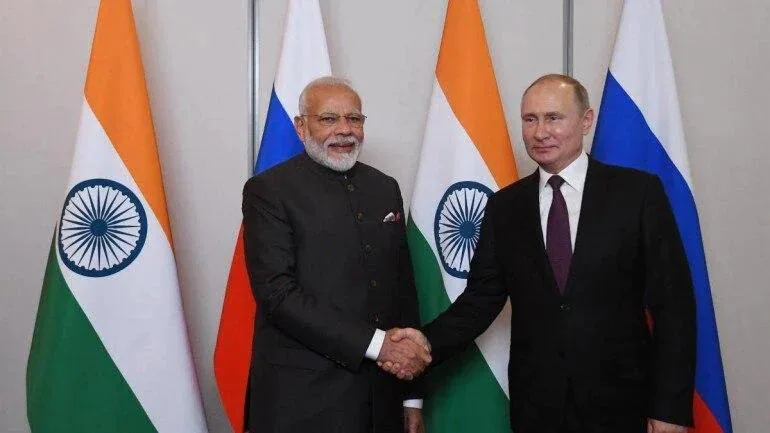
Russian President Vladimir Putin’s state visit to India on 4–5 December 2025 for the 23rd India–Russia Annual Summit comes at a moment when the international system is shaken by great-power war, sanctions-driven fragmentation, energy disruptions and renewed contestation over the rules governing global politics. As formally stated by the Ministry of External Affairs, India, the visit is positioned as a renewal of the “Special and Privileged Strategic Partnership” through the resumption of the annual summit format, with a declared emphasis on strategic coordination in defence, energy, trade, and regional and global affairs.
Beneath this official framing, however, lies a deeper strategic question: can India and Russia recalibrate their long-standing partnership to a world reshaped by the Ukraine conflict, Europe’s deliberate disengagement from Russian hydrocarbons, a more assertive NATO posture, a volatile Eurasian security environment, and a post–Operation Sindoor South Asia where India has demonstrated its readiness to impose conventional deterrence on Pakistan-sponsored terrorism? The answer will shape not only bilateral relations but also the architecture of emerging multipolar stability and the strategic positioning of the Global South in an era of intensifying power competition.
Historical Depth and Civilisational Trust
India and Russia arrive at this summit as civilisational states with a deep reservoir of mutual trust. Indo–Russian ties have spanned defence-industrial cooperation, nuclear energy, space collaboration, higher education and cultural exchange since the Indo–Soviet Treaty era. The memory of Soviet diplomatic and military support in 1971, the role of Russian technology in shaping India’s strategic deterrent and blue-water navy, and the practice of annual summits since 2000 have together created a sense of reliability that is rare in contemporary great-power politics.
This shared past is not mere nostalgia. It continues to inform elite perceptions in both capitals that the partnership is structurally different from India’s newer alignments with the United States, Europe and various Indo-Pacific coalitions. When Putin and Modi sit across the table, they do so as leaders who know that their countries have stood by one another through difficult phases. Yet they must also recognise that both their external environments and domestic imperatives have changed, and that the friendship must now be expressed through a more modern and demanding strategic grammar.
A Changed Global Context and India’s Strategic Autonomy
The world into which Putin lands in New Delhi is dramatically altered from his last visit in 2021. Russia’s full-scale invasion of Ukraine triggered the most far-reaching sanctions regime imposed against a major power in decades. NATO has reinforced its eastern flank and identified Russia as the principal threat to Euro-Atlantic security. The European Union, once heavily dependent on Russian gas, has embarked on a painful decoupling, sharply cutting pipeline imports and pledging to end reliance on Russian fossil fuels. In response, Moscow has turned east and south, seeking markets, investment and political recognition across Asia, Africa and Latin America to compensate for shrinking access to Western capital and technology.
India stands at the intersection of these transformations. It is simultaneously a strategic partner of the United States and Europe, a central actor in the Quad and Indo-Pacific deliberations, a founding member of BRICS and the Shanghai Cooperation Organisation (SCO), and a country that has deliberately preserved and even deepened its engagement with Russia in the domains of defence and energy. During and after the outbreak of the Ukraine war, New Delhi increased purchases of discounted Russian crude to cushion domestic inflation and anchor energy security at a time of global volatility, even as it expressed discomfort with the conflict and repeatedly invoked the UN Charter and principles of sovereignty.
This dual posture—combining a normative emphasis on dialogue and territorial integrity with an unapologetically interest-based energy policy—has become emblematic of India’s contemporary doctrine of strategic autonomy and multi-alignment. India has resisted the demand to choose camps, insisting instead on its right to engage all major powers on terms that protect its security, support its growth, and enhance its diplomatic space. Putin’s visit becomes a test of whether this autonomy can be sustained under intensifying coercive asymmetries and attempts to weaponise interdependence.
Operation Sindoor and the Security Lens
The summit also unfolds against a profound shift in India’s continental security environment. The 2025 India–Pakistan crisis, sparked by the Pahalgam terror attack and India’s precision strikes under Operation Sindoor, marked a watershed in New Delhi’s doctrine of cross-border conventional response. Sindoor targeted terrorist infrastructure in Pakistan and Pakistan-occupied territory through tightly sequenced missile and air campaigns, while carefully managing escalation and keeping objectives limited. Official statements and parliamentary interventions have consistently framed the operation as a responsible yet resolute assertion of India’s right to neutralise externally sponsored terrorism.
For Indo–Russian relations, Operation Sindoor is both signal and test. It underscores India’s readiness to use calibrated military power against Pakistan’s terror ecosystem and reinforces its role as a security provider in its immediate neighbourhood. At the same time, it sharpens Indian expectations that major partners, including Russia, must take India’s security dilemmas with Pakistan—and the broader China–Pakistan strategic axis—far more seriously in their regional calculations. Moscow’s expanding dependence on Beijing and its parallel efforts to engage Pakistan complicate any assumption of automatic convergence with New Delhi’s threat perceptions.
Putin’s visit thus gives India an opportunity to convey that a truly “special and privileged” partnership cannot remain indifferent to the security consequences of China’s and Pakistan’s behaviour in South Asia and the Indian Ocean. For this old friendship to retain meaning, Russia must recognise that India faces a potential two-front challenge and that its counter-terrorism and deterrence doctrines, including operations like Sindoor, are central to its national security, not episodic departures.
Energy Security and Economic Statecraft
Energy will be another central axis of discussion, sitting at the intersection of geopolitics and macroeconomics. As Europe accelerates its separation from Russian hydrocarbons, Russia has become more reliant on Asian markets, particularly China and India, for its oil exports. India has used Russian crude as a buffer against global price spikes and as an instrument of domestic economic stability, but this arrangement now operates within a new layer of pressure politics. Recent rhetoric in Western capitals has floated punitive tariffs and other measures, explicitly linking market access to continued purchases of Russian oil.
New Delhi therefore confronts a dual challenge: defending its sovereign right to choose energy partners while steadily broadening its import basket, investing in renewables, and deepening LNG and Middle Eastern crude linkages to avoid excessive dependence on any single source. In this setting, the energy agenda with Russia is about much more than discounted crude. It encompasses long-term contracts, potential cooperation in gas and petrochemicals, possible joint ventures in upstream assets, and the design of financial and payment mechanisms that can reduce exposure to secondary sanctions and unilateral regulatory shocks.
From an Indian foreign policy perspective, this energy conversation is intimately linked to its wider role as a voice of the Global South. During its G20 presidency, India worked hard to keep the focus on development, debt relief, climate finance and food and energy security, even as the Ukraine conflict threatened to dominate the agenda. India has repeatedly argued that isolating Russia in multilateral institutions would fracture the very global governance mechanisms needed to negotiate peace, manage climate transitions, and stabilise markets. By keeping channels open with Moscow, New Delhi is not endorsing aggression; it is asserting that responsible states must help prevent the world economy from being held hostage to any single theatre of conflict.
Defence Cooperation and Atmanirbhar Imperatives
Defence cooperation remains a pillar of the India–Russia partnership. A significant proportion of India’s military inventory—fighters, tanks, submarines, air defence systems and missiles—is of Russian origin. Historically, this dependence provided India with affordable and robust platforms when many Western suppliers were politically constrained or reluctant. At the same time, it created structural vulnerabilities: periodic delays in delivery, a complex ecosystem of spares, and dependence on a single external industrial base for critical assets.
The Ukraine war and the sanctions regime have magnified these vulnerabilities. Russia’s defence industry is under pressure, and some projects have been slowed by constraints on components and logistics. The Indian strategic community is acutely aware that excessive reliance on a constrained Russian military-industrial base could undermine long-term readiness. Consequently, New Delhi is likely to use the summit to push the defence relationship away from a traditional buyer–seller model and towards genuine co-production, technology absorption, secure access to spares, and closer alignment with India’s Atmanirbhar Bharat objectives in defence manufacturing.
For India, this means seeking more assembly and production lines on its own soil, joint development of next-generation systems rather than simple imports, and clearer assurances on lifecycle support insulated as far as possible from external restrictions. For Russia, it means recognising that its value as a partner will increasingly be measured by its willingness to invest in India’s industrial capacities and to treat India as a co-creator of security rather than merely a customer. In effect, two old friends are being called to upgrade their habits of cooperation: to design ventures that allow both to grow stronger together, share burdens and risks, and respond jointly to emerging security challenges.
Global South Leadership and the Future of the Partnership
In essence, Putin’s visit must be read through the prism of India’s wider diplomatic trajectory. India’s claim to leadership in the Global South rests on its refusal to accept externally imposed binaries, its readiness to stabilise energy markets and supply chains, and its insistence that great-power rivalries should not foreclose developmental opportunities for other countries. Russia sees India as pivotal to its long-term strategy: a large and relatively fast-growing market for energy, defence equipment and high technology; an influential voice in BRICS and other forums that question over-reliance on Western-dominated institutions; and a gateway to a broader non-Western coalition that resists the use of sanctions as a routine instrument of political coercion.
From an Indian vantage point, realism insists that national interest override comfort with historical narratives. Russia’s economy is under sustained sanctions stress; its defence sector is strained by the demands of the Ukraine front; and its strategic overlap with China has grown. Over-investment in Russian links without diversification risks delays, reduced technological quality and exposure to secondary sanctions. Likewise, excessive romanticisation of past solidarity can obscure the fact that India’s own convergences with the United States, Europe, Japan and Australia have deepened in response to the Indo-Pacific balance and Chinese assertiveness along the Line of Actual Control.
Put differently, both sides need a prudent and pragmatic partnership that recognises real convergences in Eurasian stability, energy security, counter-terrorism and multilateral reform, yet candidly acknowledges divergences on China, Europe and the future architecture of the Indo-Pacific. For India, this means using the summit to press for defence co-production in India, clearer political recognition of its security concerns regarding Pakistan and China, greater market access for Indian exports into Russia, and more resilient payment mechanisms that safeguard Indian entities. For Russia, the visit is a chance to demonstrate that it can still offer India credible, long-term defence and energy cooperation that is not completely subordinated to Chinese preferences, and that it continues to see India as a central, autonomous pole in a genuinely multipolar order.
The ultimate value of this summit will be measured less by the number of agreements signed than by the depth and clarity of the strategic language the two sides craft together. If the joint statement and subsequent actions reflect a shared understanding of the current world-order crisis—one that integrates the trauma of Ukraine, Europe’s energy transition, NATO–Russia confrontation, sanctions pressure, Operation Sindoor’s message in South Asia, and the aspirations of the Global South—then the India–Russia relationship will have taken a meaningful step towards updating its conceptual foundations.
For India, the core task remains constant: to exercise strategic autonomy in a fractured world, safeguard national security against hostile neighbours like China and Pakistan, preserve energy security amid coercive trade instruments, and expand its leadership role in the Global South without being drawn into any rigid camp. For Russia, the challenge is to show that it can engage India not just as a buyer or a diplomatic shield, but as a genuine partner in shaping a more balanced and plural global order.
If New Delhi can convert Putin’s visit into an opportunity to reshape this all-weather axis in line with India’s twenty-first-century strategic interests, the outcome will be a mature, interest-based relationship that honours a rich shared past while opening fresh vistas of cooperation. Two old friends will have met, not merely to reminisce, but to think, plan and act together—so that they may grow, prosper and confront emerging challenges side by side in an increasingly uncertain world.
European Times
Dr. Maheep Posted on


