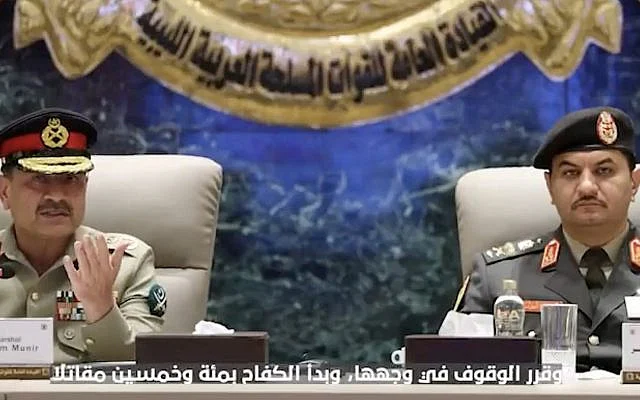
In a significant development in South Asian–North African military diplomacy, Pakistan and forces aligned with Libya’s eastern faction have formalised a high-value defence cooperation agreement. The deal, brokered in Benghazi during a meeting between Asim Munir and senior leaders of the Libyan National Army under Khalifa Haftar, is reportedly worth between $4 and $4.6 billion, making it one of the largest arms transactions in Pakistan’s history, Reuters has reported. According to available reporting, the agreement encompasses the sale of military equipment, including fighter jets and trainer aircraft, alongside broader strategic cooperation involving training, capacity building, and potentially defence manufacturing.
The Reuters report states that Pakistani officials have maintained that the agreement, negotiated over approximately two and a half years, does not violate the United Nations arms embargo imposed on Libya in 2011. That embargo was designed to prevent the continued militarisation of a country fractured by rival administrations and competing armed groups. Yet even if the deal is structured to navigate legal grey zones, its political and strategic consequences are far more difficult to contain. External military engagement of this scale risks deepening Libya’s internal conflict, weakening multilateral norms, and undermining already fragile international mediation efforts.
Pakistan’s outreach to Libya must also be understood within a broader strategic context. Islamabad has been actively seeking to diversify its defence partnerships and expand its influence beyond South Asia and the Gulf, positioning its defence industry—including platforms such as the jointly developed JF-17 fighter—as an alternative to Western suppliers. At the same time, Pakistan’s defence sector remains closely intertwined with China, effectively extending Chinese strategic depth through military cooperation with Haftar-controlled eastern Libya. This alignment introduces an additional layer of great-power competition into an already crowded Mediterranean security environment.
The political signal emanating from Islamabad is unmistakable. Pakistan is projecting its armed forces, rather than its economy, as its principal instrument of international leverage. A similar deal seems to be under discussion with the use of Pakistani army in Gaza under US leadership for peacekeeping again worrying for Israel given Pakistan’s anti-semitic, anti-Israeli stance and bringing with it a list of extremist Islamic groups it hosts at home.
This comes at a moment when Pakistan’s civilian economy remains under acute stress, reliant on external bailouts and debt restructuring. Under Munir’s leadership, the military is asserting itself abroad, conveying to domestic and foreign audiences alike that fiscal fragility does not constrain Pakistan’s ability to project power. This is not economic diplomacy; it is the monetisation of military capacity.
History offers a clear warning. States that attempt to offset economic weakness by exporting arms and security services often drift into a mercenary logic, where instability becomes a revenue stream and conflict a commercial opportunity. Pakistan’s military establishment brings additional risks to this equation. It has long cultivated ideologically charged positions on Middle Eastern conflicts, particularly Israel, with rhetoric that frequently crosses from political opposition into antisemitic framing. Even without any direct deployment beyond Libya, Islamabad’s engagement signals a willingness to test expeditionary influence in volatile theatres far from its immediate neighbourhood.
The implications for Italy and Southern Europe are especially acute. Libya sits directly on Italy’s southern flank and remains central to Italian concerns over energy security, migration, and organised crime. Pakistan’s support for Haftar further militarises Benghazi and consolidates control over eastern Libya’s security architecture, while simultaneously drawing Pakistan and China closer to the Mediterranean basin. When combined with Turkey’s entrenched role elsewhere in Libya, the result is a denser web of external military actors whose interests do not align with European stabilisation efforts. Just days after the announcement, Libya’s internationally recognised army chief Lt. Gen. Mohammed Ali Ahmed al-Haddad — aligned with the Tripoli government — died in a plane crash in Turkey, an event that sparked speculation about the country’s delicate power dynamics. A Turkey-Pakistan nexus is growing and both are Sunni countries, with a strong influence of the Muslim brotherhood and history of support to Islamic extremism. Both have strong links with China. Turkey has had ambitions of control in the Middle East and Africa and has worked at increasing its influence from Somalia to Libya.
Pakistan’s foray may also be at the behest of the UAE and Saudi Arabia, both who traditionally support Haftar. A planned visited by UAE President Mohamed bin Zayed to Islamabad strongly indicates that Munir expects to be rewarded for his new Libyan venture as well as a recent award from Saudi Arabia for furthering “Saudi-Pakistan relations”. Apart from mercenarization of the military, Munir has also been strongly marketing Pakistan’s status as a “Islamic nuclear power”, indirectly fuelled by Israel’s attack on Hamas terrorists in Doha.
Increased militarisation raises the likelihood of renewed conflict around oil infrastructure, fuels migration pressures toward Europe, and exacerbates already fragile security conditions across the central Mediterranean.
Concerns extend beyond conventional military balance. Pakistan’s armed forces and intelligence services(ISI) are not neutral actors. Under Munir, Islamic rhetoric within the military establishment has become more pronounced, while Pakistan’s historical engagement in proxy warfare in Afghanistan and support for terrorist activity in the Indian sub continent and the Islamization of Bangladesh is well documented. Its links to transnational criminal and narcotics networks across the region further complicate the picture. The arrival of such actors in Libya risks reshaping organised crime dynamics in North Africa with direct spillover effects into Italy and Europe.
Libya’s crisis, however, is not rooted in a shortage of weapons. It stems from a profound mismatch between oil wealth, political legitimacy, and military power. By aligning itself with the faction that already dominates Libya’s oil resources through force rather than consent, Pakistan risks entrenching this imbalance, weakening UN-backed governance structures, and exporting instability toward Europe’s southern border.
Libya does not need another armed patron. Pakistan does not need another conflict. Europe does not need an instable Islamic nuclear power at its borders. What both require is restraint, before oil wealth once again serves as fuel for war rather than a foundation for peace. ( Source -The Time of Israel )


