“Regardless of India and the fuss it is making, you must sign a military pact with Pakistan. Once military aid starts flowing, the first people you should arm are these mullahs. They would also need American-made rosaries and prayer mats. That should keep these fellows happy and in business.”
— Saadat Hasan Manto, Fourth Letter to Uncle Sam (1954)[1]
Introduction
When Saadat Hasan Manto wrote his celebrated Letters to Uncle Sam in the early 1950s, Pakistan was only a few years old. The country had not yet become a major Cold War ally of the United States, nor had Afghanistan become the epicentre of one of the twentieth century’s largest proxy wars. Yet Manto’s biting satire captured a profound anxiety shared by many intellectuals of the newly decolonized world: that political independence could quickly be compromised if newly independent states surrendered their sovereignty to the strategic priorities of competing great powers.
His famous remark about military aid, mullahs, and American prayer mats was not a historical prediction in the literal sense. Rather, it was an ironic critique of the political logic of Cold War alliances and the ways external patronage could reshape domestic institutions, ideological discourse, and state priorities. Looking back from the twenty-first century, the letter has acquired remarkable historical resonance. Pakistan’s subsequent trajectory, from its incorporation into the U.S.-led alliance system in the 1950s, through the Afghan jihad of the 1980s, and later the Global War on Terror, illustrates how military alliances and geopolitical competition profoundly transformed its political economy, civil-military relations, and social landscape.
This report examines that historical process. It does not argue that Pakistan’s history can be reduced to American intervention alone, nor does it ignore the agency of Pakistani political actors, military elites, religious organizations, social movements, or neighbouring states. Rather, it investigates the interaction between domestic political developments and wider structures of global power. It asks how Pakistan became embedded within successive phases of American strategic planning in Asia and what long-term consequences this produced for democracy, sovereignty, labour, education, development, and regional peace.
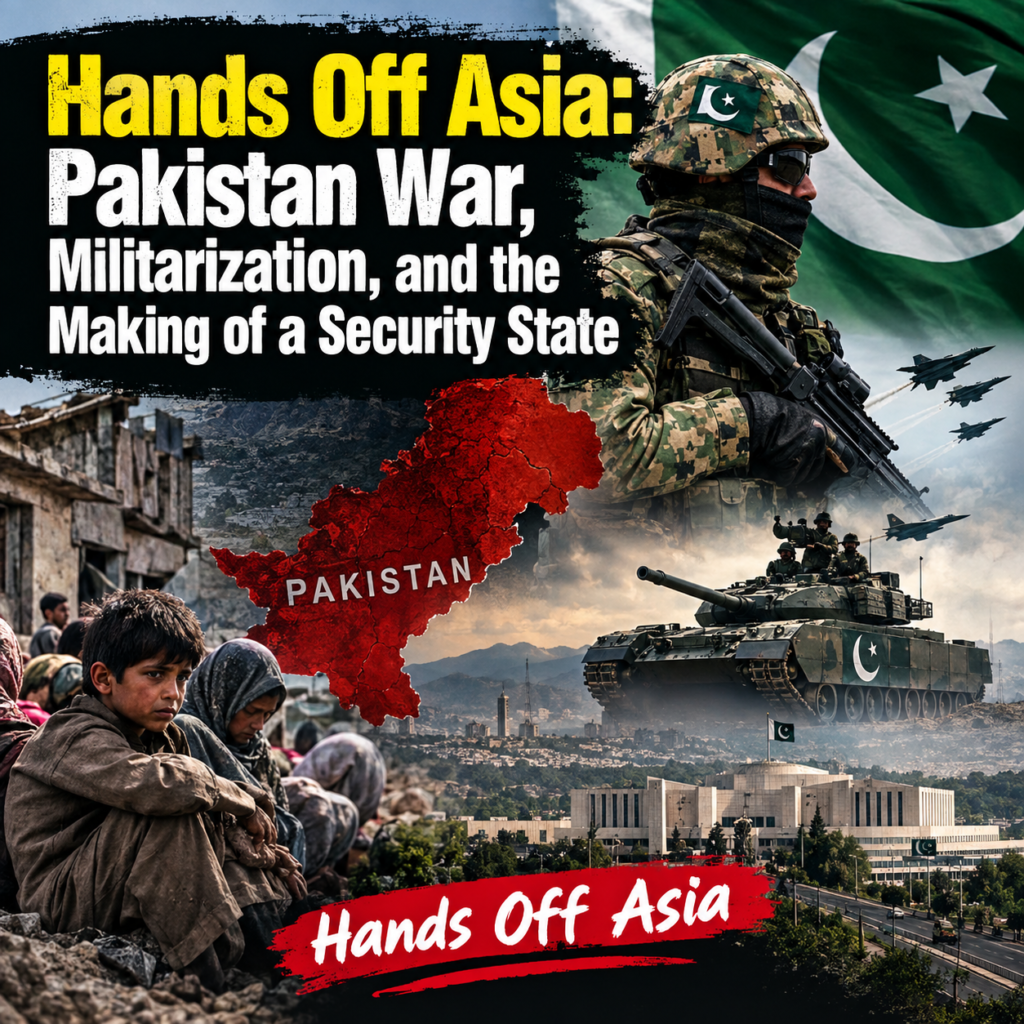
The report has been prepared as a contribution to the Hands Off Asia Campaign, initiated by Tricontinental: Institute for Social Research and the International People’s Assembly (IPA) together with movements, trade unions, political parties, and people’s organizations across the continent. While focusing specifically on Pakistan, the study situates the country’s experience within broader patterns of military intervention, alliance-building, economic dependency, and geopolitical competition that have shaped post-war Asia.
Hands Off Asia: A People’s Call for Sovereignty
The Hands Off Asia Campaign emerges from a historical understanding that Asia has repeatedly been transformed into a theatre of great-power rivalry. From the Korean War and the division of the peninsula to Vietnam, Afghanistan, Iraq, Syria, Palestine, Yemen, and contemporary tensions in the South China Sea and Taiwan Strait, military competition has repeatedly redirected political development across the continent.[2]
The Colombo Declaration, adopted by movements participating in the campaign, presents a comprehensive understanding of sovereignty. It argues that foreign domination extends beyond military occupation to include economic coercion, debt dependency, political intervention, technological monopolies, media influence, and cultural domination. Accordingly, the campaign calls not only for the removal of foreign military bases and opposition to expanding military alliances, but also for the right of Asian peoples to determine their own political, economic, and cultural futures.[3]
The declaration rejects the normalization of permanent militarization in Asia. It opposes the expansion of military blocs, sanctions regimes, regime-change operations, coercive economic policies, and new Cold War strategies that increasingly define relations among major powers. Instead, it advocates regional cooperation, peaceful coexistence, social justice, democratic participation, and popular sovereignty as the foundations of lasting peace.
Within this broader continental framework, Pakistan occupies a uniquely significant position. Few countries illustrate as clearly the cumulative effects of prolonged geopolitical competition on domestic political institutions, development priorities, and state formation.
Why Pakistan Matters
Pakistan occupies one of the most strategically significant geographical positions in Eurasia. Located at the intersection of South Asia, Central Asia, the Middle East, and the Indian Ocean, it borders Afghanistan, Iran, China, and India while providing access to the Arabian Sea through one of the world’s busiest maritime regions. This geographical position has repeatedly elevated Pakistan’s strategic value for competing global powers.
Since independence in 1947, Pakistan assumed different roles within successive international orders. During the early Cold War, it increasingly became an important component of the United States’ strategy of containing Soviet influence. Washington signalled Pakistan’s growing strategic importance by extending an invitation to Prime Minister Liaquat Ali Khan, who paid the first official visit by a Pakistani head of government to the United States in May 1950, a visit widely regarded as symbolising Pakistan’s gradual alignment with the Western bloc rather than the Soviet Union.[4] Shortly after this period of strategic realignment, Pakistan’s security establishment moved against a group of military officers and progressive intellectuals in what became known as the Rawalpindi Conspiracy Case (1951). Those arrested included the distinguished poet Faiz Ahmed Faiz, Major General Akbar Khan, and left-wing political activist Major Ishaq Muhammad, who would later become one of the founders of the Mazdoor Kisan Party.[5] The conspiracy case became one of the earliest and most consequential episodes of anti-communist repression in Pakistan’s history, occurring within the wider context of intensifying Cold War politics and the state’s growing concern over left-wing influence. During the early 1950s, Pakistan increasingly aligned itself with the United States as Cold War rivalries intensified across Asia. Viewing Pakistan’s strategic location as critical to its policy of containing both the Soviet Union and the People’s Republic of China, Washington sought to incorporate the country into its expanding network of military alliances. The signing of the Mutual Defense Assistance Agreement in 1954, followed by Pakistan’s membership in the Southeast Asia Treaty Organization (SEATO) in 1954 and the Baghdad Pact (later CENTO) in 1955, firmly integrated Pakistan into the U.S.-led security architecture. In return, Pakistan received military equipment, economic assistance, and security guarantees, while the United States gained an important strategic partner positioned between the Middle East, Central Asia, South Asia, and China’s western frontier. These agreements marked Pakistan’s formal incorporation into the American Cold War system and laid the foundations for decades of military and strategic cooperation.[6] During the Soviet-Afghan War it became the principal logistical and intelligence hub for Operation Cyclone, one of the largest covert operations in modern history. After the attacks of 11 September 2001, Pakistan again became a frontline ally in the U.S.-led Global War on Terror.[7] More recently, its location has acquired renewed significance amid changing geopolitical competition involving China, the Belt and Road Initiative, the Indian Ocean, and evolving American strategic priorities in Asia.
Yet understanding Pakistan merely as a strategic ally overlooks the deeper historical consequences of these successive alignments. Military assistance, intelligence cooperation, security partnerships, and foreign aid profoundly influenced Pakistan’s civil-military relations, state institutions, development priorities, and democratic evolution.[8] The country’s experience therefore provides an important lens through which to examine broader questions about militarization, sovereignty, and the political economy of security in Asia.
Pakistan is not simply a passive object of external intervention. Throughout its history, political parties, labour unions, student organizations, women’s movements, intellectuals, journalists, lawyers, peasant associations, and progressive cultural movements have continuously debated, contested, and resisted various forms of authoritarianism, militarization, and foreign influence.[9] Their histories constitute an equally important part of Pakistan’s modern political development and will be examined in the second part of this report.
[1] Manto, Saadat Hasan. اوپر نیچے اور درمیان, Upper, Lower and the Middle. Gosha i Adab, Anarkali, Lahore, 1954. P. 227-234
[2] The Peoples of Asia Know the Cost of War: Hands off Asia! (2026)
[3] International People’s Assembly, The Colombo Declaration: Hands Off Asia (Colombo: International People’s Assembly, 2026).
[4] Kux, Dennis. The United States and Pakistan, 1947-2000. Woodrow Wilson Center Press, 2001. P. 33-47
[5] WHO WAS MAJOR ISHAQ?Raza Naeem Published April 4, 2021, Dawn Newspaper.
[6] McGarr, Paul M. The Cold War in South Asia: Britain, the United States and the Indian Subcontinent, 1945–1965. Cambridge University Press. Cambridge: Cambridge University Press, 2013. P. 21-22
[7] Coll, Steve. Ghost Wars: The Secret History of the CIA, Afghanistan, and Bin Laden, from the Soviet Invasion to September 10, 2001. Penguin UK; Penguin Books, 2005. P. 353
[8] Haq, Rahim Ul. De-securitize, De-colonize, Industrialize, Gehra Hota Riasti Bohran or Uska Hal (Urdu), Sanjh Punlications, Lahore, 2025. P. 48-55
[9] Muhammad Qasim Sodhar, “A Historical Study of Role of the Left in the Movement for Restoration of Democracy,” Pakistan Journal of Social Research 3, no. 2 (June 2021): 1–9
By Farhan Akhtar
(Pakistan)


