
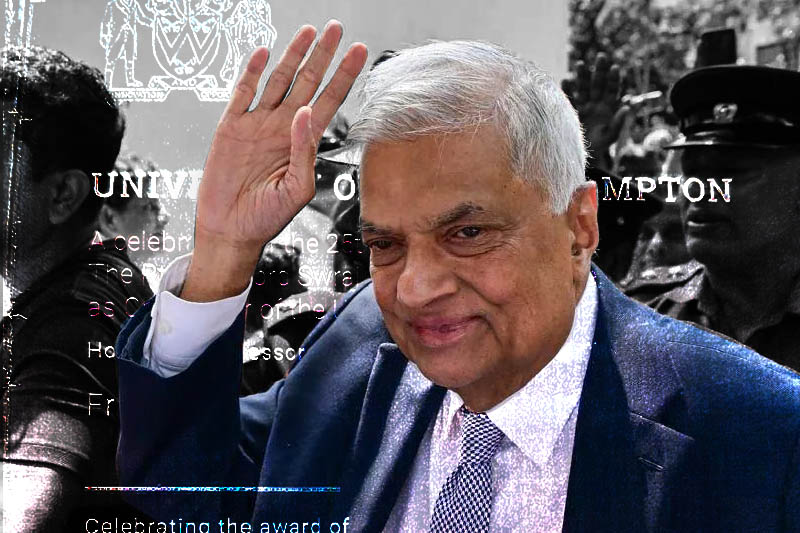
A high-stakes legal dispute has emerged in Sri Lanka over an investigation into former president Ranil Wickremesinghe’s 2023 visit to the United Kingdom, raising fundamental questions about the limits of presidential authority and the immunity of the country’s highest officials.
At the center of the inquiry is Rs. 16 million paid through the Sri Lankan High Commission in London to a private agency, Sky Wings Ltd., for services related to a stopover in Wolverhampton.
While investigators are examining whether these public funds were misused, legal experts say the case could set a far-reaching precedent affecting the constitutional protections afforded to past, present, and future heads of state.
The visit took place in September 2023, following Mr. Wickremesinghe’s attendance at the United Nations General Assembly in New York.
During a transit stay in the UK, the then-president attended an event hosted by Lord Swaraj Paul.
Critics of the probe argue that under Article 33(h) of the Constitution, the president holds residual powers to engage in international customs and diplomatic protocol.
They contend that official overseas travel falls within these norms and cannot be summarily classified as a criminal misuse of state property.
Furthermore, constitutional scholars point to Articles 42 and 43, which dictate that a president is accountable to Parliament regarding executive decisions and public finance, rather than to a magistrate’s court.
This suggests that disputes over official expenditure should be handled through administrative law or parliamentary oversight rather than criminal proceedings.
Investigators have cited potential violations of Finance Ministry circulars governing foreign travel.
However, analysts note that such regulations typically do not apply to the “four highest office holders”—the president, prime minister, speaker, and chief justice—whose logistical and security arrangements are managed under distinct protocols.
Under the Vienna Convention on the Law of Treaties, provisions relating to international treaty law recognise the right of a head of state to transit through another country.
In September 2023, after attending the United Nations General Assembly in New York, former president Ranil Wickremesinghe stopped in the United Kingdom for several hours while returning to Sri Lanka.
The brief stay, which was reportedly undertaken on medical advice among other considerations, constituted a transit visit.
During that period, he attended an official event hosted by Lord Swaraj Paul, a prominent figure regarded as a longstanding friend of Sri Lanka. Such engagements are widely described in diplomatic practice as “bilateral transit visits” — brief but purposeful interactions held while a head of state is in transit between destinations.
Furthermore, French president Emmanuel Macron and South African president Cyril Ramaphosa have both conducted bilateral discussions while transiting through Sri Lanka, reflecting an established and accepted diplomatic convention.
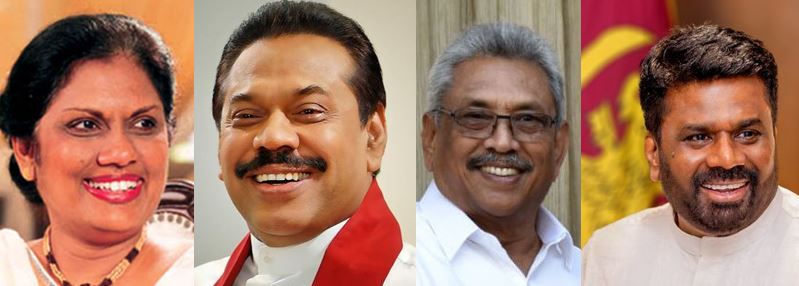
The investigation has also drawn comparisons to the foreign travels of previous presidents, including Chandrika Bandaranaike Kumaratunga, Mahinda Rajapaksa, and Gotabaya Rajapaksa, as well as recent international engagements by current president Anura Kumara Dissanayake and prime minister Harini Amarasuriya.
There is no law requiring that public funds be spent only for overseas travel at the invitation of a foreign government.
It is a long-standing practice for heads of state to travel abroad at the invitation of universities, private organisations, or non-governmental bodies, with government funding covering official arrangements.
A review of historical precedent illustrates this:
*In 2001, president Chandrika Bandaranaike Kumaratunga travelled to the UK at the invitation of the Oxford Union.
*In 2008 and 2010, former president Mahinda Rajapaksa similarly attended Oxford Union events using state resources.
*In 2021, former President Gotabaya Rajapaksa attended the Dubai Expo.
*In 2025, incumbent Anura Kumara Dissanayake attended an Osaka Expo in Japan, while prime minister Dr. Harini Amarasuriya travelled to Davos at the invitation of the World Economic Forum.
Beyond these examples, government funding has historically covered state leaders’ travel to sacred sites such as Tirupati and Buddhagaya for ceremonial purposes.
Are any of these instances considered criminal? If not, analysts ask why criminal law was suddenly applied in the case of Ranil Wickremesinghe’s transit stop in London, when comparable historical practice has never been treated as an offence.
Legal analysts suggest that reclassifying established diplomatic spending as a criminal offense could leave future leaders vulnerable to prosecution for routine official duties.
Allegations have surfaced that, in connection with this incident, a sum of approximately Rs. 16 million was paid through the Sri Lankan high commission in London to an agency identified as “Sky Wings Ltd.”
Questions have been raised as to how such an amount was incurred, particularly given that vehicles had reportedly been provided by the British government for the president’s transport. If invoices were inflated, critics ask, how should that be properly investigated?
Under Article 154 of the Constitution, the auditor general is vested with the authority to audit the finances of all state institutions, including the President’s Office.
If the expenditure in question was unreasonable or in breach of financial regulations, the applicable legal framework would be the National Audit Act No. 19 of 2018.
The Act empowers the auditor general to impose a surcharge on responsible officials where public funds have been improperly spent.
What has drawn particular attention, however, is that to date the auditor general has not issued any audit query to the President’s Office in relation to this matter.
Legal analysts question how what appears to be, at most, an administrative/financial issue — one prepared and processed by officials at the High Commission — could be abruptly reclassified as a criminal offence and made the basis of a prosecution against a president, rather than being addressed through the mechanisms provided under audit law.
Furthermore, analysts note that a criminal conviction would require proof of mens rea, or criminal intent—a threshold supporters argue is not met by a publicly recorded diplomatic visit involving high commission staff.
They warn that bypassing established constitutional and administrative frameworks — and redefining routine diplomatic engagements as criminal conduct — could create a precedent with significant constitutional implications.
Such an approach, they argue, may constrain not only the present office holders but also future presidents and prime ministers, potentially restricting their ability to manage foreign relations and perform official responsibilities without fear of prosecution.
In their view, the matter extends beyond former president Ranil Wickremesinghe as an individual.
They note that it could lay the groundwork for a far-reaching legal standard under which future heads of state might face criminal liability over decisions traditionally regarded as part of the executive function.
The resolution of this case is expected to define the future balance of power in Sri Lanka, determining whether presidential spending remains a matter of parliamentary accountability or becomes subject to the jurisdiction of the criminal courts.
(Source -The Leader-)
By- Keshal Jayasinghe)


