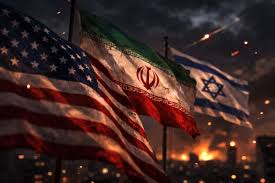
Israel and USA launched coordinated strikes against Iran on 28 February 2026. They attacked multiple Iranian cities, including Tehran, Isfahan, Qom, Karaj, and Kermanshah.
The targets included nuclear infrastructure, missile facilities, government sites, and military command centers. The strikes reportedly resulted in the death of Iran’s Supreme Leader, Ali Khamenei, along with a number of high-ranking officials. The main aims of the USA–Israel attacks were, inter alia, to destroy Iran’s missile and military infrastructure, prevent Iran from developing nuclear weapons, eliminate Iran’s leadership and military command structure, and force regime change in Tehran.
Iran responded with hundreds of ballistic missiles and drones against Israel and USA bases in the Middle East, including bases in Qatar, Bahrain, Iraq, and the UAE, as well as other Gulf states hosting American forces. The conflict escalated across the region: Hezbollah launched attacks from Lebanon against Israel, Iran struck regional infrastructure, and the Strait of Hormuz, a critical global oil chokepoint was closed. The fighting continued to intensify day by day.
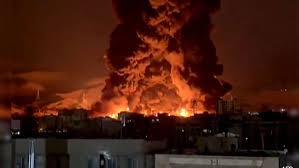
As of 17 March 2026, according to mass media reports, though unconfirmed, USA–Israel forces have struck over 7,000 targets inside Iran, with around 1,000 targets hit in the initial days. They have conducted continuous multi-wave air campaigns using 2,000-lb bunker-buster bombs (including B-2 bombers) and thousands of sorties. Iran, in turn, has fired hundreds of missiles and thousands of drones overall. Reportedly, 182 missiles in a single day during the opening phase, and over 90 missile/drone attack attempts within the first five days. USA has lost 12 MQ-9 Reaper drones, while Iran has lost more than 30 ships. Israel has reportedly suffered 15–19 fatalities; Iran around 1,300; and USA 13–15 killed and approximately 200 wounded. Lebanon has also suffered 600–850 fatalities, Iraq around 65, and Gulf states (Kuwait, UAE, Bahrain, Saudi Arabia, and Oman) 20–30. Around 10,000 civilian sites have reportedly been hit in Iran due to air attacks. USA also bombed Kharg Island, Iran’s main oil export terminal. According to the latest information, USA is weighing pros and cons of deploying an expeditionary force to invade the island.
This combined US–Israel attack was not a surprise in itself; only its timing was unknown. Nor was it an isolated incident or a hasty decision. Rather, it represents an escalation of long-standing tensions over Iran’s nuclear program, regional proxy networks, and Israel’s security concerns. How did Iran, Israel, and the United States become bitter enemies when the same trio maintained relatively cooperative relations in the 1950s?
The Early Twentieth Century: Foreign Influence and Political Upheaval
Between 1900 and 1980, Iran underwent three major political transformations: the collapse of the Qajar monarchy, the authoritarian modernization of the Pahlavi dynasty, and the creation of the Islamic Republic. Weak central authority and heavy foreign influence from Britain and Russia during the Qajar dynasty in the early twentieth century provoked political unrest. The Persian Constitutional Revolution (1905–1911) forced the monarchy to accept a constitution and establish the Majlis (parliament).
However, a military coup led by an officer named Reza Khan seized power in 1921 and established the Pahlavi dynasty in 1925. During World War II, Britain and the Soviet Union, fearing that Reza Shah was too close to Nazi Germany, invaded Iran and forced him to abdicate. His son, Mohammad Reza Pahlavi, became Shah in 1941. Mohammad Mosaddegh became Prime Minister in 1951 through parliamentary politics and strong nationalist support, largely due to the movement to nationalize Iran’s oil industry.
However, the CIA–MI6 coup d’état in 1953, “Operation Ajax”. removed him from power.
Although the Shah later pursued an ambitious modernization program known as the White Revolution, his pro-Western orientation and increasing political repression generated growing opposition. The 1954 Consortium Agreement allocated 40% of Iran’s oil shares to five American companies, 40% to Anglo-Iranian interests, 14% to a Dutch company, and 6% to a French company, including firms such as Exxon, Mobil, Royal Dutch Shell, and others.
The 1979 Revolution
Resistance to the Shah grew from multiple directions: secular intellectuals, leftist organizations, students, and religious leaders—particularly the exiled cleric Ayatollah Ruhollah Khomeini. In 1978, a government-aligned newspaper published an article criticizing Khomeini. Religious students responded with demonstrations, and security forces replied with violence. What followed was a cycle of protests, mourning ceremonies, and further repression that spread nationwide. Long-term political repression, economic grievances, and religious opposition fueled the mass protests later known as the Iranian Revolution. The Shah left Iran in January 1979. Khomeini returned from exile in February, and a referendum in April established the Islamic Republic.
The new leadership perceived that Western powers had historically exploited Iran, controlling its oil resources and supporting the Shah, particularly by USA. Israel, in particular, was viewed as an illegitimate state occupying Palestinian land. Consequently, Iran severed diplomatic and commercial relations with Israel in 1979 and began supporting militant groups. The seizure of the USA Embassy in Tehran the same year, during which 52 American diplomats were held hostage for 444 days, led to the severing of USA–Iran relations and the imposition of sanctions. Mutual hostility became entrenched. The Iran–Iraq War (1980–1988), though devastating, further strengthened the revolutionary state and militarized Iranian politics.
Proxy Wars and the Nuclear Issue
Diverging ideologies and regional rivalries transformed the relationship into a long-term geopolitical confrontation. This evolved through several phases: 1979–1989: ideological conflict, 1990–2010: proxy wars and terrorism, 2010–2020: cyberwarfare and nuclear tensions, AND 2020–2024: increasing direct military exchanges. During the Iran–Iraq War, the US supported Iraq. In 1988, the US launched Operation Praying Mantis after an American warship struck an Iranian mine. In the 1990s, Iran supported proxy operations against Israel through Hezbollah and Hamas. In 2002, secret nuclear facilities were revealed. In 2010, the Stuxnet cyberattack was attributed to USA and Israel, which damaged Iran’s nuclear infrastructure. The 2015 nuclear deal (JCPOA) sought to limit Iran’s nuclear program in exchange for sanctions relief. However, USA withdrew from it in 2018 under President Trump, and reimposing sanctions. In 2020, a US strike killed General Qassem Soleimani. Iran retaliated with missile strikes on US bases. Tensions escalated further through covert operations, cyberattacks, and regional conflicts.
The Twelve-Day War
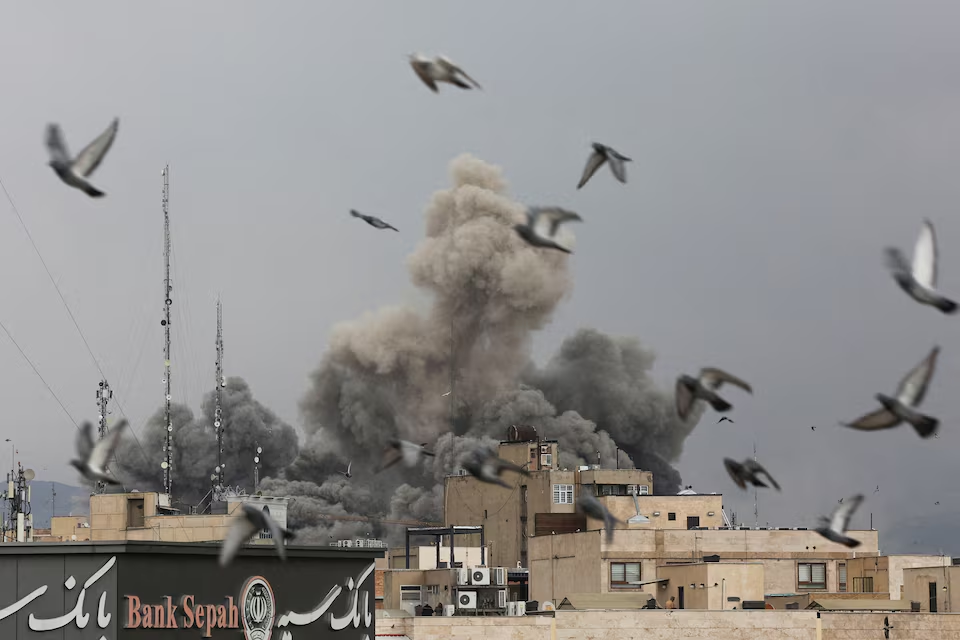
A direct large-scale war finally occurred in June 2025. Israel launched “Operation Rising Lion,” targeting over 100 sites in Iran. Iran retaliated with missile and drone strikes, including attacks on USA bases. Despite Israel’s advanced missile defense systems, the damage appeared more significant than initially reported. After nearly two weeks of conflict, a ceasefire was declared on 24 June 2025.
A Region at a Crossroads
The 2025 war set the stage for the 2026 conflict. Two key patterns emerged. First, Iran’s retaliation challenged the long-standing perception of Israeli military invulnerability. Second, both conflicts raised questions about US diplomatic credibility, as military actions occurred while negotiations were ongoing. The global consequences are already visible: oil shocks, supply chain disruptions, air travel interruptions, and economic instability. Although the US and Israel maintain air superiority, Iran remains strategically resilient. The world now appears to be entering a dangerous cycle driven by fear, suspicion, and miscalculation, one that could escalate into the first global conflict of the 21st century.
References
“FIRING BLANKS Iran ‘DAYS away from running out of missile launchers’ – but regime has chilling ‘wild card’ still to play, experts warn”. Gergana Krasteva, The US Sun. 10 Mar 2026. https://www.the-sun.com/news/16062274/iran-missile-launchers-wild-card-experts-warn/?utm_source=chatgpt.com
“Iran Tells Oil Consortium Pact Will Not Be Renewed”. The New York Times. 24 January 1973. . https://www.nytimes.com/1973/01/24/archives/iran-tells-oil-consortium-pact-will-not-be-renewed-companies.html
Why Iran and Israel Are Enemies: The Historical Roots of Their Rivalry Since 1979. The Living Draf. 8 March 2026.
“The US and Israel’s attack may have left Iran stronger”. Associated Press. 02 July 2025. https://theconversation.com/the-us-and-israels-attack-may-have-left-iran-stronger-260314
Reuters (2026)
WHO via Reuters (2026)
Associated Press (2026)
Al Jazeera / UN statements (2026)
Washington Post (2026)
By – Dr. Prathap Thilakaratne – (Major General (Retd) Sri Lanka Army)


