

The explosion near the Red Fort in the old quarters of Delhi on 10 November 2025, and the suicide bomb explosion on the next day near the Islamabad’s judicial complex emit warning signals to all, especially to South Asia: relative calmness on the surface during short periods doesn’t signify that enduring and long-lasting peace is finally dawning on the horizon.
Unlike in the previous occasions, the two nuclear-armed neighbors are not threatening each other, nor are they on the brink of conflict, for the second time this year, to be specific. But the statement from Indian cabinet that killing at least 8 people and injuring 20 others as a “terror incident, ….. the perpetrators, their collaborators, and their sponsors are identified and brought to justice without delay”, and Pakistan’s Prime Minister Shehbaz Sharif’s blame on Indian’s “terrorist proxies” for killing of at least 12 people and injured 27 others, might not serve an opening for a discussion between two countries to curb this menace at least in the future.
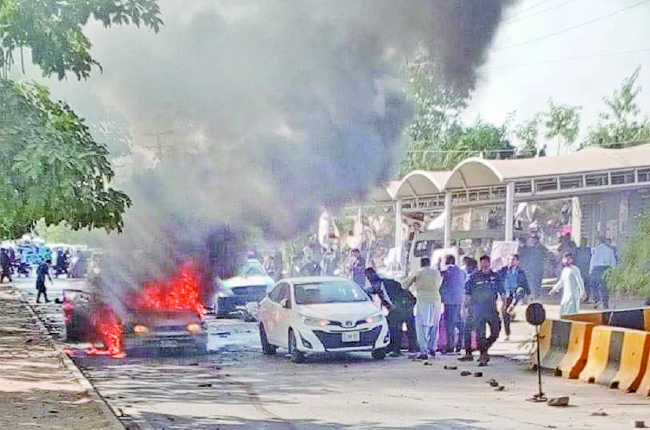
There is a different twist to these twin bombings, which wasn’t common in other bombing attacks in recent years. One is that these attacks targeted not the usual border areas but the two capitals, which are heavily surveilled and have widespread security arrangements. Another is, whilst Pakistan accused Afghanistan – “Indian-backed elements and Afghan Taliban proxies (TTP)” for its explosion, Indian investigators declared they uncovered, not an alleged terrorist cell backed by Pakistan, but a ‘terrorist module’ operated by ‘white collar’ professionals, a new modus operandi.
The Indian investigators say they found this bombing in New Delhi as a part of a 6-phase ‘revenge’ attack targeting 6 locations in New Delhi, to be activated on 06 December 2025, the day the Babri Masjid was demolished by Hindu nationalist mobs (6 December 1992). Aljazeera reported that Kashmir Police seized close to 3000 kg of explosive material and arrested 7 people; including a Muslim scholar from the Shopian district of South Kashmir, a doctor living in Wanpora village who kept an assault rifle in his locker in Government Medical College Anantnag (in Kashmir), a Kashmiri doctor working in Al-Falah University in Faridabad, and a woman from Lucknow in Uttar Pradesh state. Before the investigators arrested another suspect, a doctor named Umar Nabi, he reached the Red Fort driving a car laden with explosives, detonated, and made the headlines. Now authorities suspect this is a “transnational terror module” with links to Jaish-e-Muhammad & Ansar Ghazwat-ul-Hind (AGuH) of al-Qaeda. But some reports claimed that the National Investigation Agency (NIA) suspects this was a work of JeM, a Pakistan-based jihadi group.
However, there are many uncertainties and questions not addressed; why no group claimed the responsibility, any proof for foreign state(s) Involvement, the type explosion – conventional IED, or another mechanism using gas/fuel, the funding source, the ‘mastermind’ or chain of command, any non-state cross-border sponsorship or involvement, etc.
In contrast, Jamaat-ul-Ahrar (TTP) claimed responsibility for the Islamabad bomb attack. It targeted lawyers, judges, and officials, who enforced “un-Islamic” laws, instead of Islamic (Sharia) law, according to TTP. Although Pakistani officials implied that India was involved, no any intelligence or proof was found yet to substantiate the allegation. Seven (7) facilitators were arrested, and Pakistani believed that the planning, training and all ‘rear base’ activities were carried on in the Afghan territory, which denied by Afghanistan.
These two incidents have deep strategic implications. The target of both perpetrators were the capitals of the targeted country and a place of highly symbolic i.e. Red Fort – a national pride in India, Islamabad Judicial Complex – a symbol of Pakistan’s judicial system and the rule of law. The message was symbolic and unmistakable: “you are still vulnerable where you most powerful, in all sense”. If Delhi explosion found to be connected with to a cross-border militancy and Pakistan found proofs for any Indian involvement in Islamabad explosion, as they alleged, it might give rise in increased proxy wars and in low-intensity asymmetric warfare, aggressive counterterrorism operations, further distancing of diplomatic ties, and most alarmingly, the rise in nationalism and extremists in these both nuclear power countries.
Strategic implications would be felt even across seas, oceans and lands. It would pose a further challenge on the South Asian neighbours to maintain a non-aligned foreign policy. If some world powers or regional powers visualized and determined that this situation poses a danger to their national interests, or an opportunity to enhance it, especially in the backdrop of contemporary turmoil political and military dimensions in the international domain, only the military industrialists would enjoy a peace of mind in the coming years.
Dr Prathap Tillekerathne
References:-


