On February 28, 2026, in response to US-Israeli military aggression, Iran effectively closed the Strait of Hormuz through which around a quarter of seaborne oil trade passes.
Over 80 percent of the oil and gas that travels through Hormuz goes to economies in Asia. This bodes badly for the world economy, as it is Asia that has been propping up global growth rates – the IMF’s January 2026 World Economic Outlook had projected five percent growth in emerging and developing Asia compared to 2.5 percent in the US and 1.3 percent in the Euro Area.
Asia is likely headed for an economic crisis, but the impact will be uneven, reflecting different trajectories in industrialisation and statecraft. South Asian countries like Sri Lanka, Pakistan, and Bangladesh have consistently been named as some of the most vulnerable due to a high dependency on oil imports and large external debt overhangs.
East and Southeast Asia are also facing hardships but have more room to manoeuvre. China and South Korea are tapping into their strategic oil reserves – both have enough in storage to survive over 200 days. Vietnam does not have a significant reserve capacity, but it does have a price stabilisation fund worth over 200 million US dollars, which it can draw down from to subsidise prices.
Sri Lanka does not have such options due to decades of underinvestment. So far, the Government has responded by rationing fuel, raising prices, and fine tuning preferential access to strategic sectors. Worryingly, there has been growing pressure to further privatise the petroleum sector amid the current crisis.
On March 16, the Ceylon Chamber of Commerce lobbied the Government to allow licensed local bunkering companies to procure fuel independently and sell it to export-oriented companies. The Government seems to have accepted this proposal by allowing 11 private companies to import fuel.
This move towards privatisation is celebrated by some advocacy groups with the reasoning that private companies are more likely to sell fuel at market rates, thereby preventing shortages. But privatising the petroleum sector will not take the economy forward. Rather, it takes us back to the 1950s, when fuel was an oligopoly of three foreign companies.
Historic rationale for nationalisation
Before the 1960s, the import and distribution of fuel in Sri Lanka was an oligopoly of three private Western companies – Standard Vacuum Oil Company, California Texas Oil Company or CALTEX, and Royal Dutch Shell Group.
Shell alone controlled 60 percent of the market, while Standard and CALTEX controlled the remaining 40 percent.
Discussion about Sri Lanka’s dependency on fuel imports and vulnerabilities to external price shocks had been ongoing since at least the 1950s. After the end of the US war on Korea and the associated commodity price boom, Sri Lanka’s foreign currency reserves began to decline due to deteriorating terms of trade.
The problem of declining terms of trade – famously identified by Argentinean economist Raúl Prebisch’s 1949 report, The Economic Development of Latin America and its Principal Problems – brought the question of industrialisation to the centre of economic policy. But industrialisation cannot be accomplished without an affordable and stable supply of energy.
The three private fuel suppliers functioned as a price-fixing cartel, charging high prices that were draining foreign currency and increasing the costs of industrial development. The companies refused to cooperate with Government requests to lower the price of fuel.
Meanwhile, the Soviet Union was offering Sri Lanka fuel at rates 25 percent below the world market price, but the US and British companies refused to facilitate this due to the politics of the Cold War. It is in this context that the process of nationalisation began with the enactment of the Ceylon Petroleum Corporation Act No. 28 of 1961.
The political-economic case
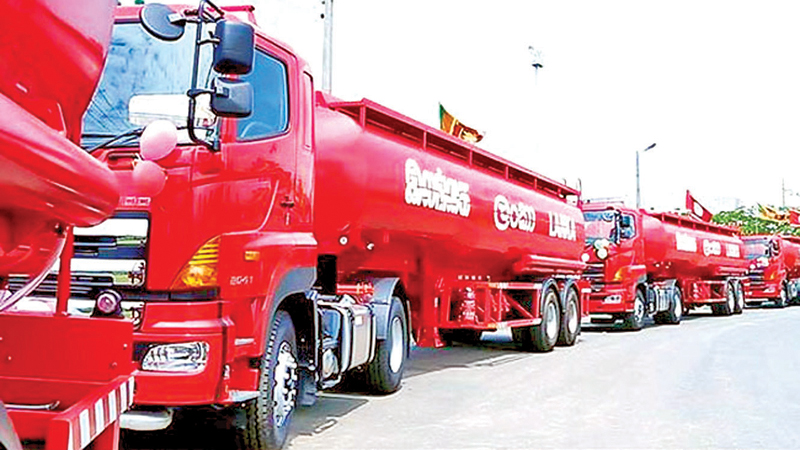
Following the 2022 debt crisis, Sri Lanka’s petroleum sector has undergone creeping privatisation. The expanded presence of entities such as Indian Oil Company and Sinopec has eroded the Ceylon Petroleum Corporation’s market share from roughly 80 percent to around 53 percent.
This shift has made it increasingly difficult for the Government to impose price caps without risking private suppliers withholding fuel.
National ownership of the petroleum sector is vital for the long-term economic growth, stability, and equity of the Sri Lankan economy.
The following are four reasons why the Government must hold the line on public ownership:
1. Capturing resource rents
The petroleum sector is a classic natural monopoly: the scale of infrastructure investment required makes it most efficient for a single firm or a small number of firms to operate. This structural tendency towards monopolisation allows private players to extract super-profits, or economic rents.
Instead of allowing private actors to exploit rent-seeking sectors at public expense, the State should capture these rents and direct them towards national development.
2. Price and supply stabilisation
Hydrocarbons remain central to Sri Lanka’s energy mix and, by extension, to the cost of production across the entire economy. Price shocks, therefore, have wide-ranging effects on households and industries alike.
During crises, profit-seeking firms are frequently incentivised to withhold supplies in anticipation of further price increases, fuel hoarding, shortages, and price gouging.
A State with significant market share can act as a price setter, either by directly enforcing price controls or by releasing strategic reserves to bring prices down – compelling private operators to follow suit. This stabilising function is unavailable to a Government that has ceded market dominance to private players.
3. Demand triage in the public interest
State control over fuel provision enables policies that allocate supply according to social and economic need rather than private profit.
Unlike private firms constrained by profit incentives, a public operator has the flexibility to prioritise demand that is foundational to social reproduction – cooking gas for low-income urban households, energy for agriculture, or supplies for strategic industries – rather than directing fuel solely to the highest bidder.
4. Enabling the transition to new energy
Private capital accumulation readily converts into political influence. Lobbies representing narrow sectoral interests not only distort democratic processes but actively obstruct broader development goals by blocking investment in competing technologies. This dynamic is most visible in the United States, where the oil and gas lobby has long impeded a meaningful transition to new energy.
By contrast, in China and across many Gulf states, public ownership of the energy sector permits rational, long-horizon decision-making when diversifying the energy base and investing in new technologies – free from the short-term pressures that drive private incumbents to defend existing assets at the expense of the future.
The Hormuz stress test
The underinvestment and mismanagement of the Ceylon Petroleum Corporation, combined with creeping privatisation since 2022, has weakened Sri Lanka’s ability to weather external shocks like the ongoing closure of Hormuz. Further privatisation will make things worse, leading to a deadly spiral that will only lead to the plantation economy-style oligopoly of the 1950s.
The closure of the Strait of Hormuz is a stress test that exposes the structural vulnerabilities of economies that have surrendered strategic sectors to market forces. The record of industrialising Asia shows that it is public ownership, not private enterprise, that gives the State the tools to manage energy supply in the national interest.
Reinstating and strengthening that ownership is a practical necessity. In a world of intensifying geopolitical instability and transition to new energy, the countries best positioned to survive and adapt will be those that have retained sovereign control over their most critical sectors.
Shiran Illanperuma is a journalist and political economist and also a researcher at the Tricontinental: Institute for Social Research and a co-editor of Wenhua Zongheng: A Journal of Contemporary Chinese Thought. He is also a visiting lecturer at the Bandaranaike Centre for International Studies.
( Source -Sunday Observer )