
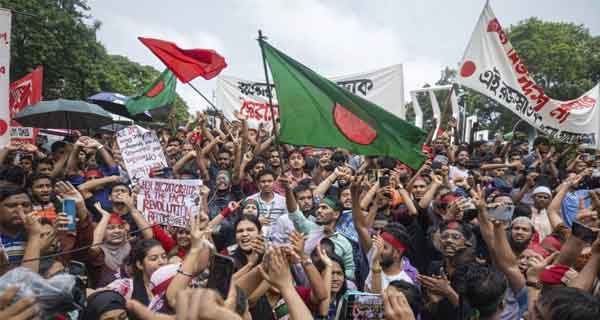
Bangladesh is in turmoil. It has fallen into an unprecedentedly bleak and violent situation, reversing much of its decades of development within days. How was that promising economy and trajectory of social development struck by such an unexpected shock?
The protests (April–July 2018) were initiated by students in Bangladesh over the public-sector job quota system (which reserved 56% of government jobs for freedom fighters’ descendants, women, minorities, districts, and persons with disabilities). The system disproportionately favoured the descendants of 1971 freedom fighters, many of whom had assisted in the formation of the Awami League, which ruled Bangladesh for over two decades after independence. Students viewed the governance under Sheikh Hasina as unfair and politicized. They argued that the exclusionary nature of the quota system resulted in high graduate unemployment, shrinking private-sector opportunities, and inflation.
The government abolished most quotas through an executive order in October 2018, attempting to defuse the crisis tactically rather than institutionally. Although this led to a considerable subsiding of protests, structural resentment persisted among students due to the absence of merit-based recruitment, necessary legal reforms, and transparency. This, in turn, increased distrust toward the government’s intentions. As protests gained momentum, broader demands emerged, including the rollback of digital security laws used to silence critics, accountability for killings, restoration of free and fair elections, and an end to the politicization of institutions such as the police, courts, and election bodies.
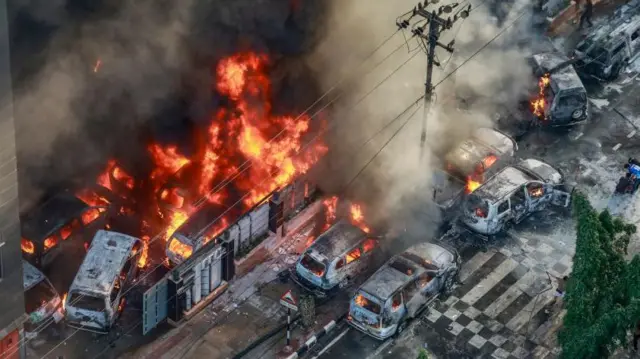
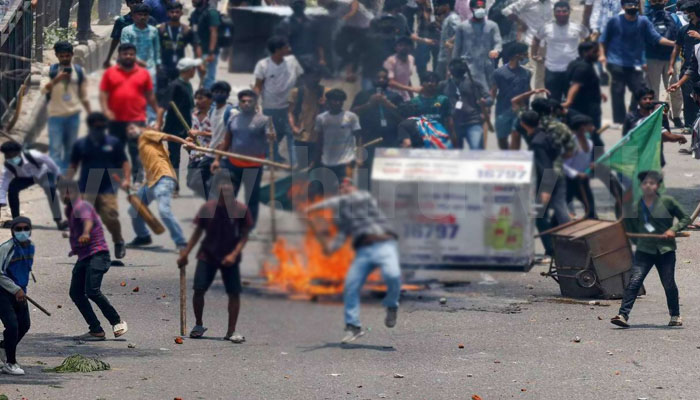
Court rulings on petitions challenging the abolition of quotas during 2022–2023 led to the reinstatement of significant quotas, including those for freedom-fighter categories. This not only deepened public distrust but was also perceived as political manipulation through judicial overreach. By late 2024, mass student-led protests rapidly evolved into nationwide demonstrations demanding political accountability. These were met with baton charges, tear gas, mass arrests, and surveillance by police and other government agencies, which allegedly allowed ruling-party student wings to attack protesters. A large number of students were killed or seriously injured.
The situation triggered economic disruption, international pressure, and elite defections, undermining the regime’s governing capacity. On 5 August 2024, sustained protests forced long-time Prime Minister Sheikh Hasina to flee to India. Bangladesh subsequently became largely leaderless and decentralized, driven by youth-movement networks rather than established party structures, although opposition parties were later drawn into the momentum. This period was followed by a series of killings of politicians and senior officials, controversial trials and convictions—including Sheikh Hasina’s death sentence in absentia—and deepening societal divisions over governance, elections, and rights.
Tasked with stabilizing the country and preparing for elections, Nobel Laureate Muhammad Yunus was appointed head of a caretaker/interim government on 8 August 2024. However, the banning of the Awami League and the suspension of its registration under laws amended in 2025 were widely seen as exacerbating polarization between political parties and their supporters. The Bangladesh Nationalist Party (BNP) warned that delays beyond late 2025 or early 2026 would push the country toward even greater instability.
Bangladesh, still engulfed in uncertainty and violence, experienced another shock on 12 December 2025. Sharif Osman Hadi—a prominent youth activist with strong anti-India and anti-establishment views—was killed in an assassination. His death triggered another round of violent unrest nationwide, during which media offices and political premises were also attacked.
Although security forces were deployed nationwide and a period of state mourning was declared during Hadi’s funeral, further shootings of political activists, protests, riots, arson, and clashes followed across multiple cities. This continued suppression of civil liberties and civil disorder contributed to widespread insecurity and raised serious doubts about whether Bangladesh could hold its scheduled general elections in February 2026 in a free and fair manner—particularly given the exclusion of major parties such as the banned Awami League, thereby calling into question the legitimacy and inclusiveness of the electoral process.
Bangladesh thus presents the picture of a country that failed to transition smoothly toward a more open electoral system after the end of a long-serving government widely alleged to have presided over institutional breakdown and widespread public frustration. This failure appears to stem largely from clashes between multi-agenda reformist movements led by inexperienced youth groups, loosely affiliated interim authorities, and sidelined political parties. Together, these dynamics resulted in fragile law and order, protracted legal battles, and deep political polarization.
Diplomatic and Security Arena
One of the most striking features of the ongoing turmoil is a renewed and intensified anti-Indian sentiment. Opposition groups and some analysts in Bangladesh have long accused India of influencing Bangladesh’s domestic politics, particularly through its favourable posture toward the Awami League and Sheikh Hasina, as well as through deep diplomatic, security, and political ties aligned with India’s strategic interests. Given India’s geopolitical imperatives as a regional power—such as securing its borders, countering insurgent groups in its Northeast, and containing regional rivals—neither Bangladesh nor India can be easily faulted: the former for harbouring suspicions and the latter for pursuing such policies, if these allegations hold true.
Against this backdrop, tensions between the two neighbours appear to be escalating toward a broader political crisis. Bangladesh suspended visa services at its High Commission in New Delhi, citing concerns over violence targeting Indian diplomatic interests. A scaling back of diplomatic ties with India has also been discussed, reportedly linked to unfavourable circumstances surrounding Hadi’s assassination.
International media outlets have presented divergent narratives, often without substantive evidence or reliable sources. Some claim that China—already a strategic partner, major arms supplier, and investor in infrastructure, military, and economic projects well before the 2024–2025 turmoil—is now deeply involved in Bangladesh. According to these reports, China has maintained diplomatic leverage after the 2024 change of government by engaging not only with the interim authorities but also with opposition forces such as the BNP. This engagement is allegedly part of a broader Indo-Pacific strategy aimed at counterbalancing India’s regional influence by cultivating ties with both economic elites and emerging political leadership in Bangladesh.
Other media sources allege that Pakistan has used its intelligence services to influence unrest in Bangladesh through ideological allies and Islamist groups. Another version attributes the unrest to domestic Islamist organizations, such as Jamaat-e-Islami and its student wing, accused of organizing protests and social mobilization—again, without credible sourcing.
However, from a national security perspective, a country’s own interests invariably take precedence. How does the current situation in Bangladesh affect its neighbours and shape their responses? New Delhi has consistently viewed Bangladesh as critical to its security perimeter, particularly in relation to insurgent movements in India’s Northeast. An India-aligned government in Dhaka provides strategic depth; conversely, an unfriendly or unstable Bangladesh poses a persistent security concern. Another argument suggests that continued instability in Dhaka provides India with justification for intervention to preserve an India-centred regional order and prevent rival influence. Beyond security considerations, India may also gain relative economic leverage, as Bangladesh’s political crisis affects trade routes, energy infrastructure, and connectivity projects such as pipelines and transit rights—areas where India can protect or renegotiate favourable terms.
What about China? Some argue that China could also benefit from a weakened Bangladesh, enabling the expansion of its Belt and Road Initiative, the strengthening of military ties, and the balancing of Indian influence in South Asia—key objectives of Chinese regional policy. Pakistan’s involvement, by contrast, is generally viewed as limited, driven primarily by its rivalry with India rather than by any direct benefit from Bangladesh’s instability.
With the return of Tarique Rahman in December—the son of Khalida Zia and acting chairman of the BNP, who had resided in London since 2008 and is regarded by some as a key architect of Sheikh Hasina’s ouster—the future of the youth-led reformist movement and its political trajectory now hangs in the balance.
Thus, Bangladesh’s internal crisis, though domestic in origin, appears to be unfolding across multiple layers of South Asia’s geopolitical landscape—subtly and steadily. Assumptions and contested claims regarding covert intelligence operations, foreign assistance and regime change, religious factions acting as foreign proxies, and the strategic incentives allegedly sought by external powers remain unproven. Nevertheless, they warrant deeper and more rigorous analysis.
All of these factors will shape the future of a fragile, reactive, institutionally weak, and politically polarized Bangladesh.
————————— The rest next week ————
Written by, Dr. Prathap Tillekerathne is a former Flag Officer of the Sri Lanka Army. He has represented Sri Lanka in UN peacekeeping missions and conferences at UN Headquarters in New York and is a recipient of the Alumni Achievement Award from the Asia-Pacific Center for Security Studies, USA. He is a lecturer in International Relations, Defense and Security, and UN Peacekeeping Missions, as well as an accredited international mediator and a member of the Singapore International Mediation Centre.


