
Sharif Osman Hadi, spokesperson for Inqilab Mancha and a prominent student leader who played a key role in the 2024 uprising that ousted Sheikh Hasina, died on December 18, 2025, while undergoing treatment in Singapore after being shot in Dhaka on December 12.
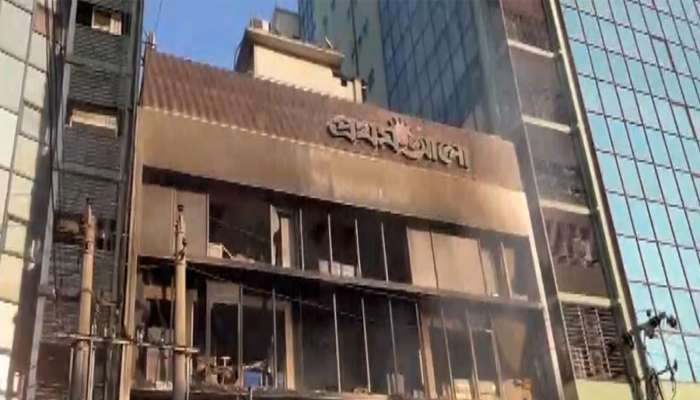
In the overnight hours into December 19, enraged protesters stormed and vandalized the offices of two leading Bangladeshi newspapers Prothom Alo (the country’s largest daily) and The Daily Star in Dhaka’s Karwan Bazar area, who were critical of the current interim government.
The attackers smashed windows, looted equipment, destroyed furniture and documents, and set fires on multiple floors, trapping journalists inside. The violence, widely attributed to outrage over Hadi’s death has forced both publications to suspend print and online operations temporarily.
When Sheikh Hasina’s extended tenure was disrupted by last year July’s turmoil, many anticipated that Bangladesh would embark on a new journey: an opportunity to restore the rule of law, ease the stifling control over dissent, and rejuvenate an independent media that has suffered from years of intimidation.
However, under the temporary leadership of Nobel Laureate Muhammad Yunus, the nation’s press freedom – already under strain – has further deteriorated into a state of suffocation. What started as legal harassment and selective prosecutions has evolved into a systematic pattern of administrative exclusion, criminalization of journalism, and a troubling resurgence of hard-line figures that now influence the media landscape. The outcome is a professional exile: journalists imprisoned, others fleeing, and entire media outlets silenced or coerced into submission.
The most striking instance is procedural, making it particularly alarming. Between late October and early November 2024, the interim government rescinded press accreditation for 167 journalists – a blunt bureaucratic tool that strips them of their rightful access to official briefings and institutions, effectively sidelining them from mainstream reporting overnight.
This action was defended by obscure policy references, yet its impact is overtly political: it disconnects large segments of the press from the essential sources and environments needed to perform their duties. International media observers labeled it a direct assault on pluralism and cautioned about the cascading effects on independent journalism.
Legal tools have been transformed into instruments of fear.
The Digital Security Act of Bangladesh, along with an increasing application of anti-terror laws – both of which existed before the current government – are now frequently used against journalists, editors, and even entire media organizations.
Human Rights Watch and Amnesty International have recorded cases where the terminology used to criminalize ‘fake news’ or ‘incitement’ effectively leads to the prosecution of standard reporting or critical analysis, while anti-terror laws are employed to instill maximum dread and the looming threat of lengthy prison sentences.
The implication is clear: the boundary between journalism and criminality can be breached at the state’s whim.
The human impact is far from theoretical. For instance, the case of Ekattor TV journalists Shakil Ahmed and Farzana Rupa stands out: they were detained at Dhaka’s international airport in August 2024 while attempting to travel, later facing politically motivated criminal charges related to protest fatalities – charges that rights organizations and their international legal representatives claim were fabricated and punitive. Their extended detention, restricted access to legal counsel, and ongoing legal challenges have led to appeals to UN human rights bodies and ongoing condemnation from the Committee to Protect Journalists.
Their experience is not unique; it reflects a rising number of journalists facing detention, frozen bank accounts, travel restrictions, and tarnished reputations.
Another notable figure is Mr. Shahriar Kabir, a distinguished writer, freelance journalist, filmmaker, and advocate for human rights. He has written more than 100 books and produced 16 documentary films, standing out as a leading proponent of secular humanism and global peace. Unfortunately, the current government has initiated multiple unfounded and politically charged murder charges against him.
He was taken into custody on September 16 at his home in Mohakhali, Dhaka. Since mid-June, he has relied on a wheelchair due to a worsening condition from a leg injury he suffered in 2004. Furthermore, he is battling severe kidney and heart issues.
We are all aware of the appalling prison conditions in Bangladesh.
When the BNP-Jamaat government detained him in 2001 for protesting against the persecution of religious minorities, Amnesty International recognized him as a ‘Prisoner of Conscience’ and advocated for his release. His health has considerably declined, rendering him unsuitable for life in prison. Unlike his previous incarceration, he has not been granted Class I prisoner status this time, which raises serious concerns about his well-being.
Administrative restrictions have led to actual closures or near-closures of several media outlets that have historically been strongholds of investigative and regional journalism. Many have reduced their operations, laid off journalists, or temporarily halted news programming due to mounting pressure and public threats of repercussions.
The decision by Deepto TV to stop its news bulletin, which management referred to as an ‘internal reform,’ followed a politically charged on-camera incident; whether this suspension was voluntary, coerced, or a combination of both, independent analysts view it as indicative of a media landscape where editorial freedom can be abruptly curtailed by reputational attacks, political manipulation, or economic pressure.
When state mechanisms no longer bear the burden of safeguarding press freedom – when a journalist can be marginalized through the revocation of a press card, the freezing of an account, or an overwhelming defamation lawsuit – the boldness of non-state entities grows.
Incidents of intimidation and violence from party militants, local power brokers, or extremist groups have surged, while legal and bureaucratic barriers hinder journalists from seeking official protection.
International observers have consistently called on the interim government to shield reporters from violence perpetrated by non-state actors – a duty that remains unaddressed. Consequently, self-censorship prevails: editors steer clear of inquiries that could provoke severe repercussions, and younger journalists opt for safety over the risks associated with investigative reporting.
A second, more enduring trend is the politicization of media ownership and the evolving ideological dominance over public discourse. Following the turmoil that ousted Hasina, previously fringe Islamist factions have been politically reintegrated. The interim government’s strategic engagement and the easing or removals of restrictions on groups like Jamaat-e-Islami have allowed conservative forces to reclaim a foothold in both politics and, increasingly, the media landscape.
This situation is far from theoretical: control over editorial mechanisms – such as ownership, board selections, and advertising decisions – quickly influences what stories are told and the manner in which they are presented. As secular, independent media outlets diminish, the media landscape becomes increasingly filled with entities that either conform to or actively endorse conservative religious narratives.
The global aspect is crucial. Bangladesh is deeply intertwined with regional geopolitics and media perspectives: when independent media outlets face funding shortages (due to restrictions on foreign grants or a subtle decline in advertising), the international platforms and funders that once backed investigative journalism are also affected – particularly as global support for journalism has diminished in recent years. The outcomes are foreseeable: investigative journalism, which is both expensive and labor-intensive, becomes unfeasible; meanwhile, brief, risk-averse articles that adhere to official narratives become more common.
What actions should be taken? To begin with, the interim authorities need to revoke administrative penalties that are evidently arbitrary: they should reinstate accreditation for those unjustly removed, unfreeze journalists’ accounts unless there is clear, public evidence of misconduct, and dismiss exaggerated criminal charges that were not filed in good faith.
Furthermore, laws that facilitate the broad criminalization of speech – from overly vague digital regulations to misapplied anti-terror laws – should be promptly revised and subjected to judicial scrutiny in accordance with international human rights standards. Additionally, the state must safeguard journalists from violence perpetrated by non-state actors; a free press necessitates not only the absence of legal oppression but also affirmative security assurances.
Lastly, international allies must prioritize backing for independent journalism – whether through urgent legal and financial assistance, asylum options for targeted journalists, or conditional diplomatic pressure in cases of rights violations. Human rights and press freedom organizations have documented these abuses; effective international resistance will necessitate coordinated efforts.
The moral imperative is unmistakable. Democracies are not solely established through elections; they thrive on information ecosystems that empower citizens to evaluate, critique, and hold those in power accountable.
The democratic trajectory of Bangladesh – whether it emerges under a reinstated civilian government, a reformed party system, or any alternative arrangement – hinges on the preservation of that ecosystem. Should the current path persist, the nation risks merely exchanging one variant of authoritarianism for another, while simultaneously permitting a new orthodoxy to stifle dissent, erase opposing voices, and transform a diverse public into a more homogeneous, less inquisitive entity.
Press is being used to gloss over the failure of the interim government and India is being targeted and used as a convenient scapegoat. This deliberate distraction shifts public attention away from critical domestic issues.
By inflaming anti-India sentiment, the regime hopes to rally nationalist support and consolidate power amid growing discontent.
Journalism in Bangladesh has demonstrated remarkable resilience over decades of adversity. However, such resilience has its limits. If the international community, civil society, and Bangladesh’s political leaders genuinely cherish pluralism, they must respond with immediacy.
Failing to do so, the post- Sk. Hasina era may be remembered not as a period of democratic revitalization but as a subtle entrenchment of a different, potentially more insidious, form of intolerance – one that combines bureaucratic oppression with a reconfiguration of the media perspective itself. Such an outcome would be a tragedy not only for journalists but for every citizen reliant on trustworthy information to navigate the fundamental choices of civic life.
Dhaka: Time of Oman


